
Bridging the 2024–2025 Clinical Discovery, Dr. Joseph Llinás’ Psychiatric Framework, Dr. William Dodson’s Adult ADHD Sleep Research, and Sweden’s National Public Health Validation
The U.S. Vacuum and the 2024–2025 Discovery
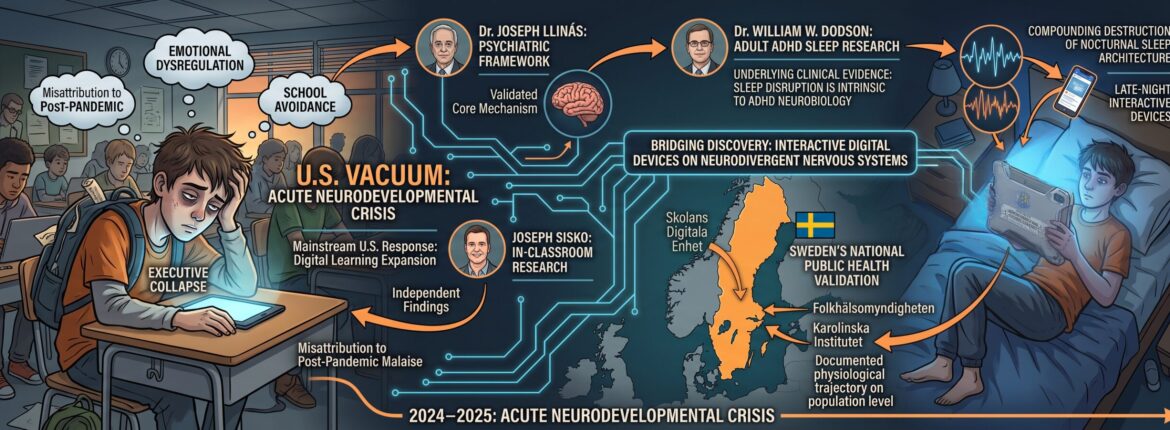
Between 2024 and 2025, an acute neurodevelopmental crisis escalated across American classrooms: adolescent students with Attention-Deficit/Hyperactivity Disorder (ADHD) and Autism Spectrum Disorder (ASD) experienced unprecedented rates of executive collapse, emotional dysregulation, and school avoidance.
Within mainstream U.S. educational and psychiatric establishments, this breakdown was largely misattributed to generic post-pandemic malaise or isolated mental health trends. Schools expanded digital learning platforms, while clinical discourse focused almost exclusively on daytime behavioral therapy and stimulant side-effect management.
The primary environmental catalyst remained entirely unaddressed: the compounding destruction of nocturnal sleep architecture caused by interactive, late-night digital devices superimposed on an already vulnerable neurodivergent nervous system.
Through independent in classroom research conducted by Joseph Sisko and validated by clinical child and adolescent psychiatrist Dr. Joseph Llinás, the core mechanism driving this breakdown was identified. While American institutions looked away, public health tracking from Sweden (Folkhälsomyndigheten and the Karolinska Institutet) documented the exact same physiological trajectory on a population level. Crucially, psychiatric literature on adult ADHD sleep disturbances—pioneered by Dr. William W. Dodson—provides the underlying clinical evidence: sleep disruption is not an incidental side effect, but an intrinsic, 24-hour manifestation of ADHD neurobiology.
The Neurobiological Foundation: Intrinsic Circadian and Arousal Disruption
Integrating Dr. William Dodson’s clinical sleep architecture findings with Dr. Joseph Llinás' psychiatric framework and Joseph Sisko's research illustrates that individuals with ADHD and ASD operate with a fundamentally dysregulated internal clock and hyperaroused nervous system:
1. The Nighttime Shift of Hyperarousal
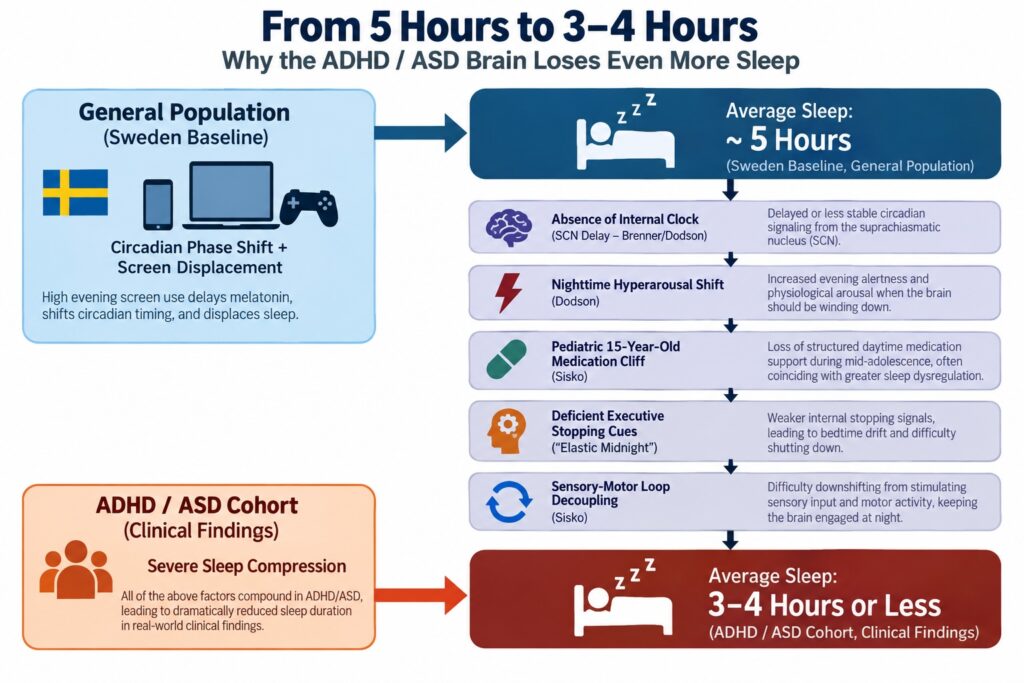
As documented by Dr. Dodson, while physical hyperactivity in ADHD appears to diminish in early adolescence (around ages 12–14), the underlying hyperarousal does not disappear; rather, it shifts to nighttime and becomes tied to sunset. Adults and adolescents experience a sudden burst of mental and physical energy when it gets fully dark.
- More than 80% of individuals with ADHD report an inability to shut off their minds to fall asleep, with thoughts jumping and bouncing between worries.
- By age 12.5, 50% experience severe sleep-onset problems, escalating by age 20 to over 80% spending an average of 106 minutes just attempting to fall asleep.
2. Circadian Clock Failure and Time Agnosia
Dr. Myron Brenner’s research on Delayed Sleep Phase Syndrome (DSPS) in ADHD populations indicates that the environmental light signals meant to set the internal suprachiasmatic nucleus (SCN) circadian clock are insufficiently registered by the ADHD nervous system.
- The "Now vs. Not Now" Dilemma: Without an operating internal circadian chronometer, individuals with ADHD struggle to gauge the passage of time.
- The Delayed Biological Phase: Their natural sleep cycle drifts backward to a 4:00 AM to noon pattern. When late-night algorithmic screens are introduced, this biological phase delay is pushed even further into the early morning hours.
3. The "Elastic Midnight" and Sensorimotor Decoupling
Interactive social feeds and algorithmic video streaming present high-salience, frictionless stimulation with no natural stopping boundaries.
- Because disengagement requires top-down prefrontal inhibition—which is entirely depleted by late evening—the neurodivergent brain cannot self-terminate screen use.
- Sisko’s pedagogical analysis highlights that screen use provides intense visual and auditory input with zero tactile, proprioceptive, or motor output, locking the brain into high-frequency sensory hyperarousal without physical release.
The 15-Year-Old Medication Cliff: Deprescribing Guanfacine and Clonidine
A major pharmacological contributor to this nocturnal crisis occurs when pediatricians misinterpret the adolescent developmental shift.
Around age 14 to 15, when obvious daytime motor restlessness begins to subside, many clinicians assume the patient is outgrowing their ADHD and routinely discontinue or taper off alpha-2 adrenergic agonists like guanfacine and clonidine.
This creates a dangerous clinical disconnect:
- Removing the Evening Brake: Alpha-2 agonists provide essential central noradrenergic regulation that tempers baseline hyperarousal.
- Unmasking Nighttime Arousal: At the precise age when hyperarousal migrates to the evening and sunset hours, the pharmacological brake is stripped away.
- Colliding with Digital Media: The unmedicated, hyperaroused adolescent nervous system is left entirely unprotected against late-night digital feeds, driving sleep onset even further past midnight.
Dr. Dodson’s Four Manifestations of ADHD Sleep Disturbance
Dr. Dodson categorizes four core sleep disruptions inherent to ADHD that become severely aggravated in screen-heavy digital environments:
- Initiation Insomnia: The inability to shut down cognitive arousal at bedtime, with minds turning on the moment the head hits the pillow, or waking abruptly after 90 minutes in a hyperaroused state.
- Restless, Unrefreshing Sleep: Fitful sleep marked by constant tossing, turning, and micro-awakenings that prevent transitions into deeper slow-wave sleep stages, leaving the individual waking up just as exhausted as when they went to bed.
- Severe Difficulty Awakening ("The Sleep of the Dead"): After fitful restlessness until roughly 4:00 AM, the individual drops into a profound, comatose-like sleep stage. Awakening before this cycle finishes leads to extreme grogginess, irritability, combative arousal, and cognitive unresponsiveness until midday.
- Intrusive Sleep (Theta-Wave Intrusion): As described by Dr. Paul Wender and Dr. Marian Sigurdson, when interest and challenge drop, the nervous system abruptly disengages, resulting in an intrusion of slow theta brain waves into active rhythms. This presents subjectively as sudden, overwhelming daytime sleepiness or falling asleep when unengaged (e.g., during passive lectures or straight-road driving).
The Mathematical Cascade: Extending Sweden's 5-Hour Baseline
Sweden’s rapid, comprehensive digitization of primary and secondary education produced clear longitudinal tracking: Swedish adolescent public health data revealed that the general student population had degraded to an average of 5 hours of sleep on school nights.
Because school bell schedules remain rigidly fixed between 7:00 AM and 8:00 AM, sleep is always compressed from the nighttime boundary. When a neurotypical cohort drops to a 5-hour average, the natural biological and mathematical extension for ADHD and ASD students is an unavoidable collapse to 3–4 hours or less.
| Cohort | Bedtime / Sleep Onset | Wake Time | Total Sleep Duration | Clinical & Functional Presentation |
| Neurotypical Baseline(Swedish Public Health Data) | 1:00 AM – 1:30 AM | 6:30 AM | ~5 to 5.5 Hours | Chronic daytime fatigue, slipping reading comprehension, elevated baseline irritability. |
| ADHD / ASD Cohort (Joseph Sisko / Dr. Joseph Llinás / Dr. William Dodson) | 3:00 AM – 4:30 AM | 6:30 AM | 3 to 4 Hours or Less | Severe executive collapse, working memory failure, acute sensory overwhelm, rebound irritability, morning combativeness. |
Clinical Psychiatric Amplification
Clinical psychiatric evaluations confirm that a consistent sleep threshold of 3–4 hours systematically dismantles developing neural networks:
- Diagnostic Masking & Pathology Inflation: Chronic sleep debt strips away slow-wave synaptic resetting, heavily amplifying baseline ADHD/ASD traits. Inattention turns into total working memory failure; standard sensory sensitivities escalate into severe sensory defensiveness.
- Misdiagnosis Risks: As Dr. Dodson notes, the "racing thoughts" of late-night ADHD hyperarousal are frequently misdiagnosed as Bipolar Mood Disorder. Combined with extreme morning waking irritability, daytime emotional volatility is often misdiagnosed and treated with sedatives rather than addressing root circadian and arousal dysregulation.
Sweden’s National Policy Reversal: The Macro Validation
While the U.S. remains largely inert, Sweden’s realization of this public health crisis forced a nationwide institutional reversal between 2024 and 2026:
- The Analog Educational Pivot: Recognizing that digital-first classrooms drove attention fragmentation and sleep loss, the Swedish Ministry of Education redirected national funding back toward physical printed textbooks, physical handwriting, and analog instructional materials.
- National Sleep Directives: The Public Health Agency of Sweden (Folkhälsomyndigheten) established explicit national guidelines capping recreational screen time to 2–3 hours per day for adolescents, instituting school phone bans, and issuing formal medical directives for screen-free bedrooms.
Restoring Boundaries: Clinical and Pedagogical Interventions
Treating the ADHD/ASD sleep crisis requires structural, physiological interventions rather than passive digital management:
- Enforcing Physical Sleep Sanctuaries: Because the ADHD/ASD nervous system lacks an internal off-switch, external physical boundaries are mandatory. Screens must be physically removed from sleep spaces well before bedtime.
- Maintaining Evening Noradrenergic Support: Rather than precipitously cutting off guanfacine or clonidine at age 15, clinicians should evaluate continued evening dosing to calm the sunset hyperarousal surge, or evaluate targeted low-dose evening stimulants to quiet internal mental bouncing.
- Re-coupling the Sensorimotor Loop: Classrooms and study spaces must prioritize physical textbooks, tactile manipulation, and handwriting to re-anchor cognitive processing in physical space.
- Sleep as the Primary Diagnostic Vital Sign: Clinicians evaluating neurodivergent youth must quantify actual nocturnal sleep hours before escalating behavioral labels or altering psychiatric diagnoses.
References
- Brenner, M. (1998). Personal communication regarding Delayed Sleep Phase Syndrome (DSPS) and circadian rhythm setting in ADHD.
- Brown, T. E. (1998). Problems with sleep and awakening in persons with ADHD. Presented at the 10th Annual CH.A.D.D. International Conference.
- Corkum, P., Tannock, R., & Moldofsky, H. (1998). Sleep disturbances in children with attention deficit/hyperactivity disorder. Journal of the American Academy of Child & Adolescent Psychiatry, 37(6), 637–646.
- Dodson, W. W. (1999). The prevalence and treatment of sleep disorders in adults with Attention Deficit Hyperactivity Disorder. Presented at the American Psychiatric Association Annual Convention, Washington, D.C.
- Folkhälsomyndigheten (Public Health Agency of Sweden). (2024–2025). National guidelines on digital screen use, sleep duration, and health among children and adolescents. Stockholm, Sweden.
- Karolinska Institutet. (2024–2025). Longitudinal studies on adolescent screen media use, sleep latency, and internalizing symptoms. Stockholm, Sweden.
- Kooij, J. J. S., Middelkoop, H. A., van Gils, K., & Buitelaar, J. K. (2001). The effect of stimulants on nocturnal motor activity and sleep quality in adults with ADHD: An open-label case-control study. Journal of Clinical Psychiatry, 62(12), 952–956.
- Llinás, J. (2024–2025). Clinical psychiatric findings and evaluations on adolescent neurodevelopmental sleep deprivation in ADHD and ASD.
- Regestein, Q. R., & Pavlova, M. (1995). Treatment of Delayed Sleep Phase Syndrome. General Hospital Psychiatry, 17(5), 335–345.
- Sisko, J. (2024–2025). The ADHD/ASD Social-Media-Based Severe Sleep Deprivation. ADHD Escape Room.
- Wender, P. H. (1987). The Hyperactive Child, Adolescent, and Adult: Attention Deficit Disorder Through the Lifespan. New York: Oxford University Press.