
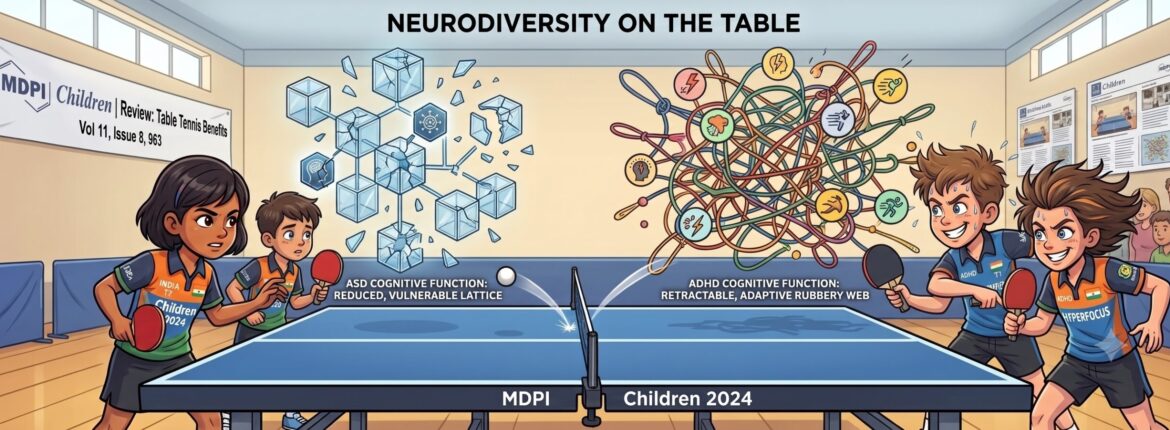
For individuals navigating neurodivergence, sports are rarely just about physical exercise. They are an intense exercise in cognitive load management.
While a sport like soccer introduces a massive, 21-vector matrix of chaotic human movement, table tennis shrinks the physical universe down to a highly predictable, $9 \times 5$ foot geometric surface.
However, how a brain processes this miniature arena depends entirely on its wiring. A person with pure Autism (ASD), someone with pure ADHD, or an individual with co-occurring Autism and ADHD (AuDHD) might all love the game, but they experience the transition from singles to doubles through completely different neurological lenses.
Here is how singles table tennis acts as a perfect neurological match for these profiles—and why doubles triggers unique cognitive demands across the spectrum.
Singles: Balancing the Neurodivergent Engine
In a singles match, the table is a closed-loop system. The ball travels on a single, back-and-forth axis, removing the "saccadic bottleneck" of trying to scan a massive, unpredictable field. This clean environment creates an ideal workspace, balancing the internal engine of each profile for different reasons.
[Pure ASD Engine]  ──> Seeks Absolute Systemizing & Fixed Geometric Logic
[Pure ADHD Engine] ──> Seeks High-Frequency Novelty & Instant Dopamine Feedback  ──> All Thriving in Singles
[AuDHD Dual Engine]──> Seeks ASD Predictability + ADHD High-Speed Dopamine
The Pure ASD Experience: Perfect Systemizing
For the pure Autistic profile, singles table tennis is a beautiful, mechanical sanctuary. Spin, angle, and trajectory are governed by strict physics. If an opponent strikes the ball with a specific paddle angle, the ball must react logically. The 1,000 brains (cortical columns) can focus entirely inward on proprioceptive precision and pattern recognition. There are no social politics, no shifting team dynamics, and no sudden violations of spatial rules. It is pure, predictable structure.
The Pure ADHD Experience: The Flow of Instant Feedback
For the pure ADHD profile, singles provides an immediate, high-dopamine feedback loop. Because table tennis is one of the fastest sports on earth, a ball can cross the net in a fraction of a second. The brain is spared from executive under-arousal because the environment demands relentless, lightning-fast micro-decisions. There is no time to lose focus or drift into under-stimulation; the high frequency of engagement keeps the ADHD mind locked in a state of hyper-focused flow.
The AuDHD Experience: Feeding the Dual-Engine
For the AuDHD individual, singles solves a massive internal conflict: the need for rigid predictability clashing with a desperate craving for novelty.
- The ASD side gets the comfort of the fixed $9 \times 5$ grid and logical ball physics.
- The ADHD side gets flooded with high-frequency dopamine from immediate, action-driven feedback.
Singles keeps the ADHD side from getting bored without overwhelming the ASD side with chaotic human variables. It coordinates the internal network into a unified flow state.
Doubles: The Scattered Sensory Shotgun
The moment you transition to a doubles match, the rules dictate that partners must alternate hits. This single constraint shatters the clean laser beam of singles focus, firing off a shotgun blast of competing, chaotic sensory pellets.
While this shift scales up the tracking load for everyone, it creates vastly different forms of executive function gridlock depending on your wiring.
[Doubles Constraint] ──> Multi-Body Spatial Chaos + Interpersonal Tracking
                                │
                                ▼
 ┌─────────────────────────────────────────────────────────────┐
 │  Pure ASD: Deep Proprioceptive & Routine Disruption         │
 │  Pure ADHD: Sustained Executive Under-Arousal & Interrupted Flow │
 │  AuDHD: 1,000 Brains Scattered into Fractured, Siloed Silos │
 └─────────────────────────────────────────────────────────────┘
The Tri-Profile Doubles Matrix
| Neurological Layer | Pure ASD Profile in Doubles | Pure ADHD Profile in Doubles | AuDHD Profile in Doubles |
| Spatial Tracking | Distressed by Routine Broken: The predictable geometric axis is ruined by a physical body cutting across the visual plane. Exception: When paired with a highly predictable partner, their glass lattice remains intact. | Impatient Movement:Struggles with the forced physical pause between hits; wants to stay in constant kinetic motion rather than waiting their turn. | Scattered Focus: The 1,000 brains split—half track the ball's physics, half track the partner's physical clearing path. |
| Predictive Demand | System Failure: The brain struggles to build a predictive model because a second human introduces random physical variables. | Executive Drift: The forced "off-turn" introduces a micro-delay where attention can easily wander, disrupting the rhythm required for hyper-focus. | Executive Overload:The ADHD side tries to process all variables at once, while the ASD side freezes trying to find the "correct" response. |
| Social / Masking Tax | Communication Exhaustion: High anxiety around reading explicit non-verbal cues or signs from a partner in real time. | Impulsive Coordination:May cut off a partner or over-anticipate a shot due to an intrinsic drive to react instantly to the stimulus. | Rejection Sensitivity (RSD): Intense pressure of performance; a missed shot isn't just data anymore, it carries the weight of social failure. |
Navigating the Doubles Gridlock
Pure ASD: Protecting the Glass Lattice
For the pure Autistic player, the primary nightmare of doubles is the proprioceptive and routine disruption. Having a partner rotate into your physical launchpad after every shot violates the strict spatial boundaries of the game. It introduces an unpredictable physical obstacle into a space that used to be governed entirely by logic.
The Glass Lattice Rule: For the ASD profile, spatial logic is a rigid, beautiful architecture. If an ASDer plays with a predictable, consistent partner who moves with robotic, repeatable patterns, this glass lattice remains entirely intact. The structural integrity of the arena is preserved. But if that partner becomes erratic, the lattice shatters into chaotic shards.
Pure ADHD: The Rhythm Interrupt
For the pure ADHD player, the main obstacle in doubles is the disruption of momentum. ADHD thrives on the unbroken chain of action-reaction found in singles. Forcing a delay between hits breaks the kinetic feedback loop. During that micro-hiatus while the partner plays the ball, the dopamine drop can cause executive drift, making it much harder to snap back into hyper-focus when the ball suddenly returns to them.
AuDHD: The Atomized Mind
For the AuDHD player, doubles completely fractures their cognitive processing capacity. Instead of the 1,000 brains voting in unison on a single target, the attention is violently atomized into isolated pellets:
- Pellet 1: Where is my partner moving right now?
- Pellet 2: Did they hit a high pop-up or a heavy underspin?
- Pellet 3: Where are the opponents shifting defensive lines?
- Pellet 4: How am I going to clear out of the way for the next shot?
The ADHD side gets overwhelmed by the noisy, non-linear chaos, while the ASD side faces analysis paralysis trying to find a perfect rule to manage it. The fluid, instinctive flow state collapses into 100 isolated, overwhelmed silos. This is further compounded by severe Rejection Sensitive Dysphoria (RSD)—the sudden need to manage a partner’s real or imagined frustration introduces an emotional processing tax that sucks the joy out of the sport.
The Takeaway
- Pure ASD individuals excel when an environment is entirely stripped of human unpredictability—or when a partner is consistent enough to keep their internal glass lattice intact.
- Pure ADHD individuals need unbroken, high-frequency kinetic stimulation to maintain an optimal state of neurological arousal.
- AuDHD individuals require a precise equilibrium: an environment that balances high-speed engagement with absolute spatial structure.
Singles table tennis delivers beautifully across the spectrum—offering speed without chaos, structure without boredom, and momentum without interruption. To keep the neurodivergent brain firing in perfect, parallel harmony, grab a paddle, claim your half of the table, and keep the game strictly singles.