
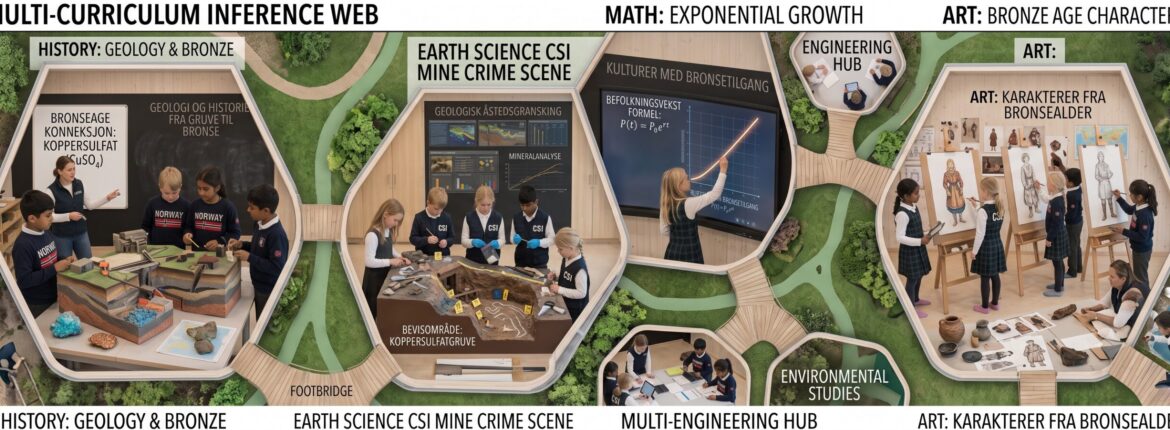
The absolute worst place to be in a modern school is alone in your own room.
The traditional school structure doesn't just slice up a student's day; it actively isolates the faculty. A math teacher spends months grinding through algebraic equations, completely unaware that the history teacher three doors down is struggling to explain the trade economics of the Silk Road—a problem that requires the exact mathematical modeling being taught just feet away.
When educators are locked inside these distinct subject silos, the job quickly degrades into a repetitive, assembly-line process. This professional isolation is a primary driver of the current teacher burnout crisis.
But by introducing tools like Gemini behind the scenes to bridge these gaps, a powerful secondary effect takes place. By lowering the operational barrier to cross-disciplinary planning, schools can organically foster a deeply connected professional community. Breaking down the walls between departments doesn't just improve the curriculum—it dramatically improves teacher morale.
The Neurobiology of Professional Isolation
The psychological toll of teaching in a silo matches the cognitive impact on students. When an educator is forced to teach a single metric in total isolation, their own work loses its broader context.
According to organizational psychology studies, teacher self-efficacy—a teacher's belief in their ability to guide student learning—is directly tied to their sense of community and collaborative planning. When educators work in structural vacuum tubes, their sense of purpose shrinks. The job morphs from a shared intellectual mission into a solitary exercise in classroom management.
[Isolated Silos]     --> Structural Isolation  --> Repetitive Metrics --> Low Morale & Burnout
[Connected Faculty]  --> Collaborative Loops   --> Shared Purpose     --> High Self-Efficacy
When a school culture shifts toward a James Burke Connections model, the professional dynamic completely changes. Because the curriculum demands that science, history, and mathematics intersect, the teachers are forced to talk to each other.
From Departmental Tribes to a Unified Faculty
In a typical secondary school, faculty meetings are often divided by department. The math teachers huddle in one corner; the humanities teachers gather in another. They speak entirely different pedagogical languages.
When Gemini is introduced as an administrative and planning catalyst, it acts as a universal translator. It allows teachers from completely different backgrounds to find common ground instantly:
- The Bridge: A history teacher trying to build a unit on the Industrial Revolution can use Gemini to instantly identify the underlying mechanical and mathematical principles of early steam engines.
- The Hand-Off: Armed with that cross-disciplinary blueprint, they don't have to guess at the math. They can walk down the hall, hand the data to the physics or algebra teacher, and say, "Hey, I'm covering the societal shift of 18th-century automation next Tuesday. Do you want to sync up and have your students calculate the thermodynamic efficiency of Watt’s steam engine during your block?"
Suddenly, the conversation shifts away from dry administrative mandates and heads straight toward collaborative intellectual design.
The Cushion of Community
Large-scale educational studies, including extensive research out of UNC Charlotte, consistently demonstrate a critical phenomenon: a strong professional community serves as an emotional cushion.
The data shows that even when teachers face high systemic stress, low funding, or personal job dissatisfaction, their students' academic performance remains remarkably resilient if the school possesses a thriving, collaborative culture.
| School Culture Profile | Teacher Experience | Operational Impact |
| Siloed & Segmented | High professional isolation; individual vulnerability to burnout | High turnover; disconnected student learning tracks |
| Collaborative Sandbox | High collective efficacy; shared responsibility for outcomes | Strong retention; resilient classroom morale |
When teachers plan across disciplines, they delegate tasks based on personal strengths. The history buff handles the narrative framework; the math specialist refines the coordinate proofs; the science teacher organizes the tactile lab.
By distributing the intellectual weight of curriculum design, you instantly lower the individual preparation burden on Sunday nights.
The Moral Imagination of the Faculty
Neil deGrasse Tyson noted that you don't raise kids with the intent of keeping a perfectly clean house. Similarly, you shouldn't run a school with the goal of keeping perfectly clean, isolated department spreadsheets.
A Shared Sanctuary
Ultimately, an interconnected faculty creates an interconnected school. When students see their math, science, and history teachers actively collaborating, talking to one another, and linking their lessons together, the entire institution stops feeling like a prison of arbitrary blocks and starts feeling like a unified laboratory of discovery.
By using technology behind the scenes to do the heavy research lifting, educators can finally step out of their isolated rooms, escape their subject silos, and reclaim the collaborative joy of their profession. They aren't just teaching independent data points anymore; together, they are helping children map the entire world.