
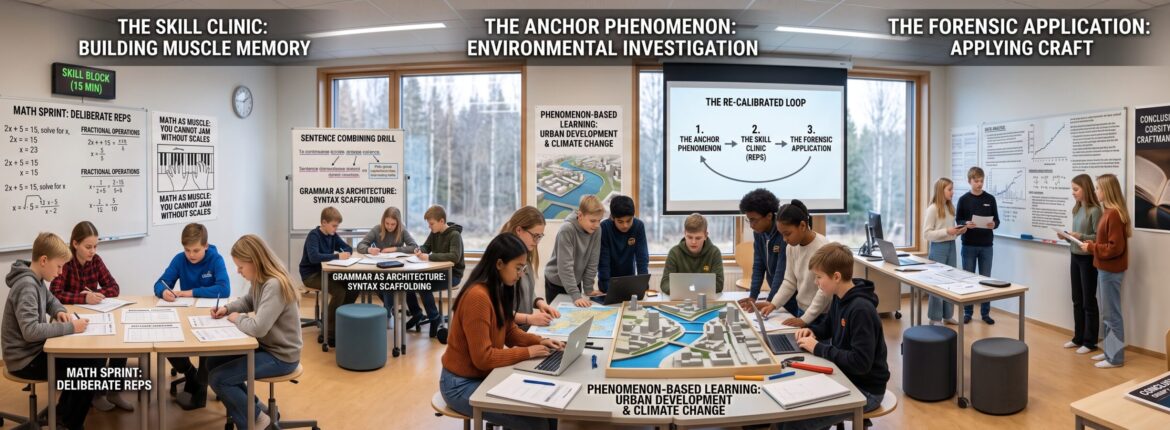
When news of Finland’s 2016 national curriculum reform swept through the educational world, international headlines framed it as a revolution: Finland was abolishing traditional subjects.
The reality was far more measured. Through Phenomenon-Based Learning (PhenOBL), Finnish schools mandated interdisciplinary modules where real-world topics—like climate change or urban development—were investigated using tools from multiple disciplines simultaneously.
The vision was romantic: place students inside authentic, open-ended mysteries, and the core skills of calculation, critical analysis, and literacy would naturally follow.
Yet a decade into this grand experiment, international assessment data—most notably a sharp drop in Finland’s legendary PISA math and reading scores—has forced a clear-eyed re-evaluation. The lesson emerging from Finland isn't that experiential, project-based learning is a failure. Rather, it is that inquiry without deliberate craft mechanics collapses under its own cognitive weight.
Whether in the precise algorithms of mathematics or the syntactic architecture of a sentence, some tools cannot be acquired solely through open exploration. They are crafts. And like any craft, they require the deliberate, unglamorous building of muscle memory.
The Cognitive Trap: When Mechanics Clog the Engine
To understand why Finland’s open-ended inquiry model hit a wall in foundational skills, one must look at Cognitive Load Theory.
When a student is thrown into a complex, multi-layered problem—such as analyzing hydrological data in a simulated environmental investigation—their working memory is running at near-capacity. They are processing context, evaluating variables, and organizing arguments.
If that same student also has to pause and mentally wrestle with basic algebraic operations or struggle to construct a subordinate clause, a cognitive bottleneck occurs:
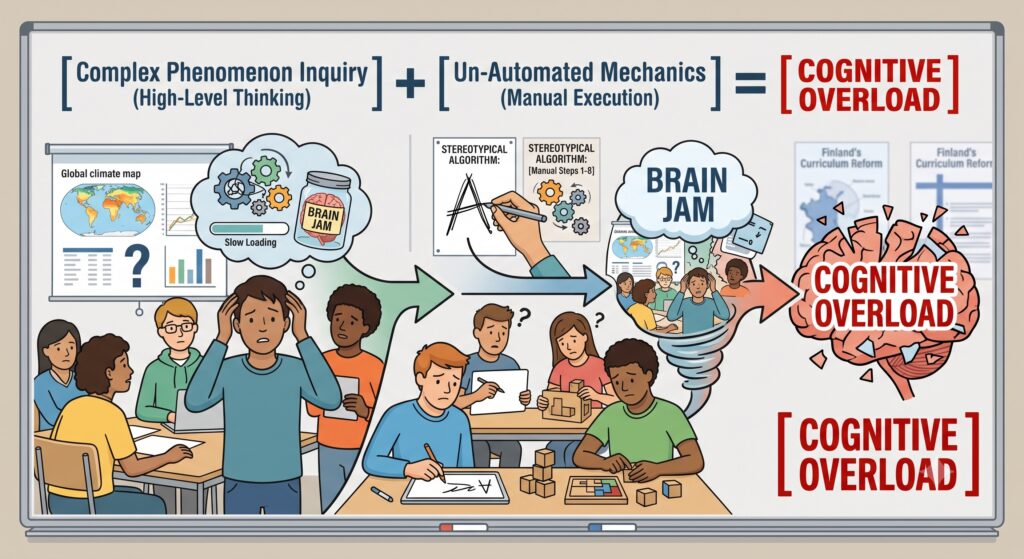
When foundational mechanics aren't second nature, the high-level inquiry stalls. The student isn't failing because they lack critical thinking; they are failing because their mental processing power is completely consumed by mechanical assembly.
Math as a Muscle: You Cannot Jam Without Scales
In music, an artist doesn't learn to improvise a jazz solo by jumping straight onto a festival stage. They drill scales, arpeggios, and chord progressions until their fingers execute them automatically, freeing their mind to focus on phrasing and emotion.
Mathematics operates on the exact same principle:
- Building Math (The Scale): Targeted, deliberate reps encode algorithms, fractional operations, and algebraic transformations into long-term memory.
- Applying Math (The Concert): Using those automated tools to solve open-ended scientific, economic, or geological problems.
Finland’s curriculum shift intentionally reduced drill-and-practice in favor of contextualized problem-solving. But as math educators quickly discovered, trying to learn matrix transformations or polynomial operations only through a multi-week project is like trying to learn an instrument by only playing full concerts.
Project work shows students why the math matters, but deliberate reps give them the speed and precision to execute it without stopping to look at their hands.
Grammar as Architecture: Punctuation as Sheet Music
In modern progressive pedagogy, sentence mechanics and grammar are frequently relegated to the background, dismissed as "isolated rote work." The prevailing theory was that children would naturally internalize syntax simply by writing passionate essays or project briefs.
It is the exact same fallacy that struck math.
Writing is not merely the expression of ideas; it is the physical construction of thought. Grammar, syntax, and punctuation are the structural engineering:
- Syntax Drills as Muscle Memory: Practice in sentence-combining, converting active to passive voice, or manipulating clauses isn't "busywork"—it builds syntactic flexibility.
- Punctuation as Rhythm: Commas, semicolons, and em-dashes are not arbitrary rules designed for red-ink corrections; they are the sheet music that dictates how a reader's mind hears the pace, emphasis, and pause of an argument.
When a student lacks syntactic fluency, their writing becomes choppy, disjointed, and exhausting. They cannot articulate complex, multi-variable ideas because they don't possess the sentence architecture required to hold those ideas together.
The Re-Calibrated Classroom: "Drill to Build, Execute to Express"
The takeaway from Finland’s pedagogical pendulum swing is not a retreat to 19th-century rows of desks and endless, contextless worksheets. It is a call for intentional sequencing.
The most effective learning environments treat open-ended phenomena and deliberate skill drills not as enemies, but as partners in a continuous loop:
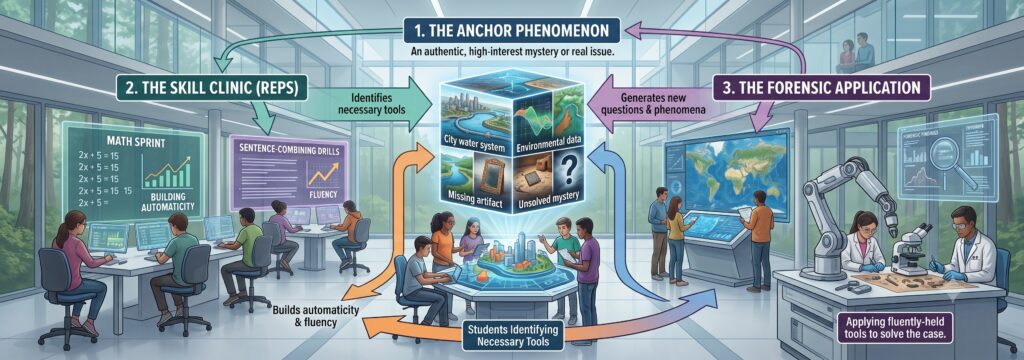
- Targeted Skill Clinics: Dedicate short, intense daily blocks (10–15 minutes) to explicit procedural practice in math and sentence-level mechanics, completely separate from project blocks.
- Just-in-Time Calibrations: When an interdisciplinary project hits a wall, pause the investigation to run a quick "technical drill" on the exact equation or grammatical structure needed to proceed.
- The Investigation as the Arena: Bring those newly sharpened tools directly back into the project, where students experience the payoff of their fluency.
Conclusion
Phenomenon-Based Learning gives students the curiosity to enter the room. But explicit, deliberate reps in math and grammar give them the craftmanship to build something once they arrive.
The future of durable education isn't about choosing between open-ended inquiry and foundational drills—it's about understanding that you can only play a magnificent concert if you've put in your time with the scales.