
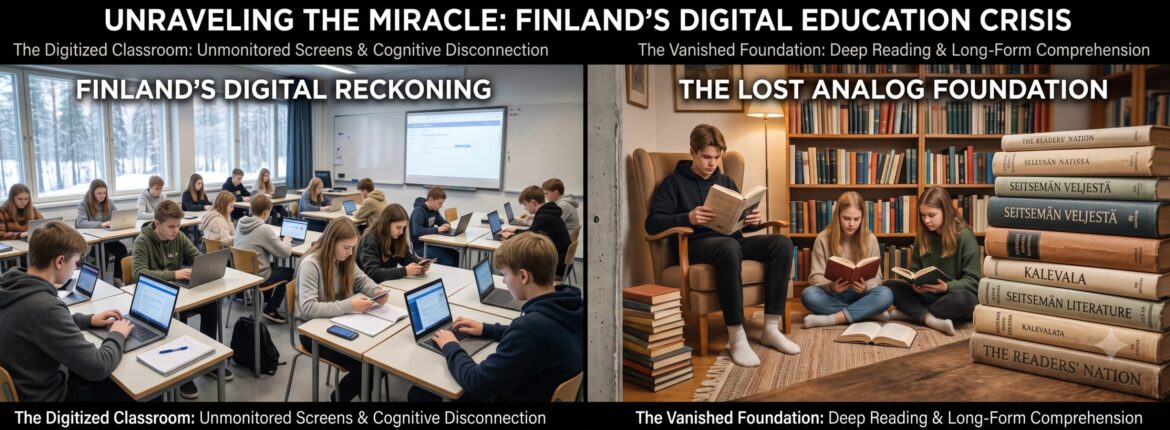
For decades, Scandinavia—and Finland in particular—stood as the undisputed beacon of global education. When the OECD released its early Programme for International Student Assessment (PISA) results in the 2000s, Finland was celebrated worldwide for achieving top-tier academic scores while maintaining equitable classrooms, short school hours, and minimal standardized testing. It was heralded as an educational miracle.
Today, that miracle is facing a profound reckoning. PISA scores across Finland, Norway, and Sweden have suffered historic, multi-year declines. While complex socioeconomic shifts have played a role, educational researchers, medical experts, and public health officials across the Nordics point to a central, interwoven cluster of root causes: uncritical school digitization, unmonitored home screen time, chronic sleep deprivation, and the erosion of unstructured play and socialization.
1. The Death of Deep Reading and the "1:1 Tech" Experiment
Finland’s historic success was built on a culture that deeply valued reading for pleasure and long-form comprehension. However, over the past decade, social media algorithms, short-form video feeds, and gaming largely displaced recreational reading among Nordic youth.
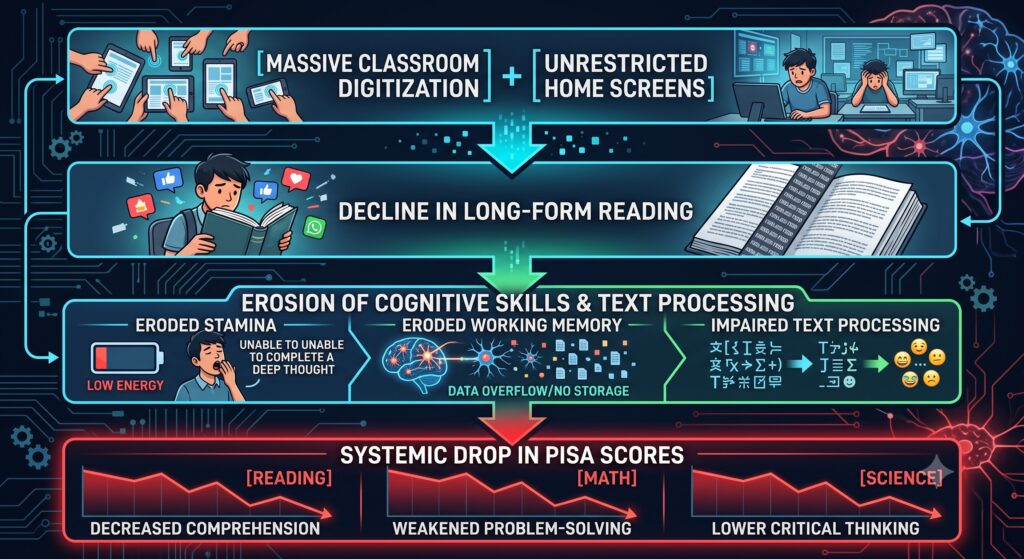
At the same time, Nordic governments aggressively pushed digital tools into basic education:
- Finland digitized classrooms rapidly, with 15-year-olds reporting an average of over four hours a day on digital devices during school hours alone. Over 80% of Finnish students admitted that digital devices distracted them during math classes.
- Norway implemented a state-mandated 1:1 tablet policy where primary students were handed personal laptops or tablets starting in 1st grade, shifting coursework almost entirely to screens.
- Sweden replaced physical textbooks with digital modules and self-directed online research.
The result was what researchers called a "literacy shock." Reading on screens trained children to skim and jump around rather than absorb complex material. When confronted with long-form assessments, students lacked spatial text memory, stamina, and working memory capacity.
2. Nighttime Screens, Dopamine, and the Sleep Crisis
The crisis in the classroom cannot be separated from what began happening in the home. National health surveys across Finland, Norway, and Sweden revealed that thousands of teenagers were taking unmonitored smartphones, gaming setups, and tablets into their bedrooms overnight.
- Melatonin Suppression: Late-night blue light exposure suppresses melatonin, tricking the brain into staying alert past midnight.
- The "Dopamine-Sleep" Trap: High-dopamine feeds (short-form videos, group chats, notifications) create intense psychological restlessness. Sitting through structured, slow-paced academic tasks the next day felt agonizingly slow for a sleep-deprived brain.
Nordic health investigators established that exhausted students arrived at school with severely compromised prefrontal cortex function—diminishing impulse control, emotional regulation, and mathematical reasoning before instruction even began.
3. Long Winter Nights and the Death of "Pickup" Play
Historically, Scandinavian culture possessed a built-in defense against long, dark winter nights: friluftsliv (the cultural commitment to outdoor life) and spontaneous neighborhood play (utendørslek). Generational routine dictated that after-school hours were filled with unstructured, neighborhood pickup games—biking, street sports, and outdoor exploration.
As smartphones and gaming consoles saturated daily life, the extreme Nordic winters—bringing as few as four to six hours of daylight—became a major environmental multiplier for digital inertia. Step-by-step, the low-friction high-dopamine feed swallowed up the 3:00 PM to 6:00 PM after-school window.
The Hidden Social Cost of Losing "Unscripted" Play
The loss of neighborhood pickup play dealt a massive blow to adolescent social development:
| Unstructured "Pickup" Play | Modern Screen-Centered After-School |
| Peer-Led Conflict Negotiation: No refs or adults; kids must compromise on rules to keep playing. | Adult Intervention or Avoidance: High friction leads to social withdrawal or app-mediated conflict. |
| Mixed-Age Socialization: 8-year-olds and 14-year-olds play together, fostering leadership and empathy. | Strict Age Segregation: Interactions are limited to exact grade levels or online strangers. |
| Side-by-Side Co-Regulation: Low-stakes physical interaction builds social stamina. | High-Stakes Performance: Performative social media feeds drive comparison and social anxiety. |
Without thousands of hours of low-stakes, real-world practice negotiating rules and resolving disputes on playgrounds and fields, adolescents arrived in upper secondary school with lower social stamina, higher anxiety, and fragmented peer dynamics.
4. The Parental Factor: "Distracted Modeling"
Initial public outrage focused strictly on schools digitizing their curricula. However, national inquiries—such as Norway’s Skjermbrukutvalget (Screen Use Committee)—revealed that parental passivity played an equal role.
Research established two critical trends regarding parents:
- Inherited Screen Habits: Parental screen time directly predicted child screen time. When parents spent evenings scrolling on mobile devices, household boundaries collapsed.
- Early Language Disruption: Parental phone distraction during early childhood reduced face-to-face dialogue, reading aloud, and emotional attunement. Children were entering primary school with weaker baseline vocabularies and lower language processing skills long before they ever touched a classroom device.
5. The Great Nordic Pivot: Pulling Screens and Restoring the Analog Foundation
Recognizing that the "digital revolution" had backfired, Finland, Norway, and Sweden have executed a massive, synchronized policy U-turn to reclaim their educational standing:
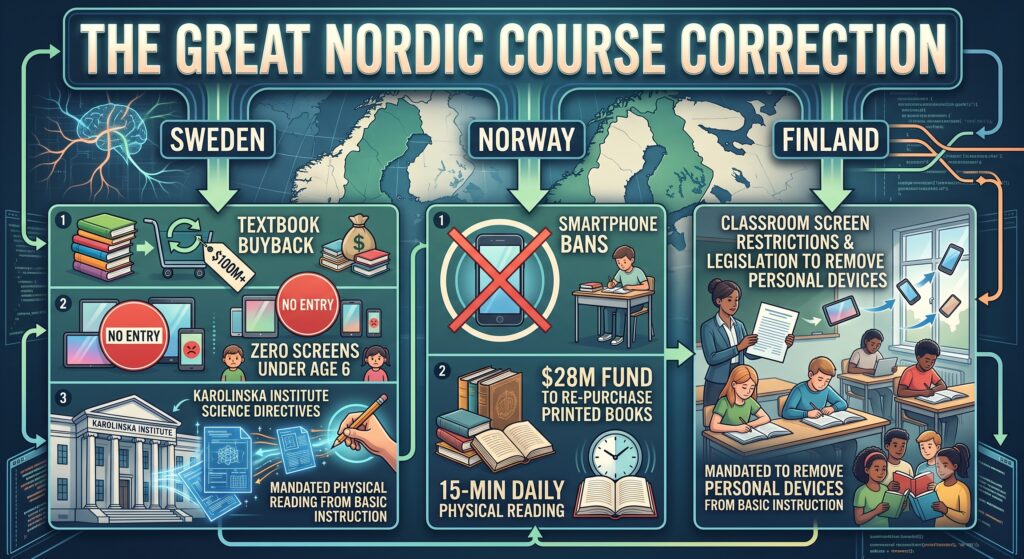
- Sweden: Under Schools Minister Lotta Edholm, the government allocated over $100 million USD to re-introduce physical, printed textbooks for every subject while banning screens in preschools (under age six). Sweden's famed Karolinska Institute issued a stark verdict: "There is clear scientific evidence that digital tools impair rather than enhance student learning."
- Norway: Enforced strict national guidelines banning personal smartphones in primary classrooms, restricted screen-based instruction in grades 1–4, and injected $28 million USD for municipalities to buy back physical printed textbooks.
- Finland: Reversed its "tech-first" stance, restricting classroom screens, reintroducing paper-based testing and handwriting, and enacting legislation to ban personal mobile devices during school hours.
Conclusion
The Nordic experience offers a vital lesson for the rest of the world: technology is a tool, not a medium for cognitive development.
Finland’s drop from the top of the PISA rankings demonstrates that replacing physical reading, pen-and-paper problem solving, and unstructured outdoor play with digital interfaces erodes the exact cognitive and social foundation that deep learning requires. Rebuilding educational excellence requires more than software updates—it demands returning to the foundational analog elements of human development: physical print, adequate sleep, teacher-led instruction, and the indispensable freedom of real-world play.