
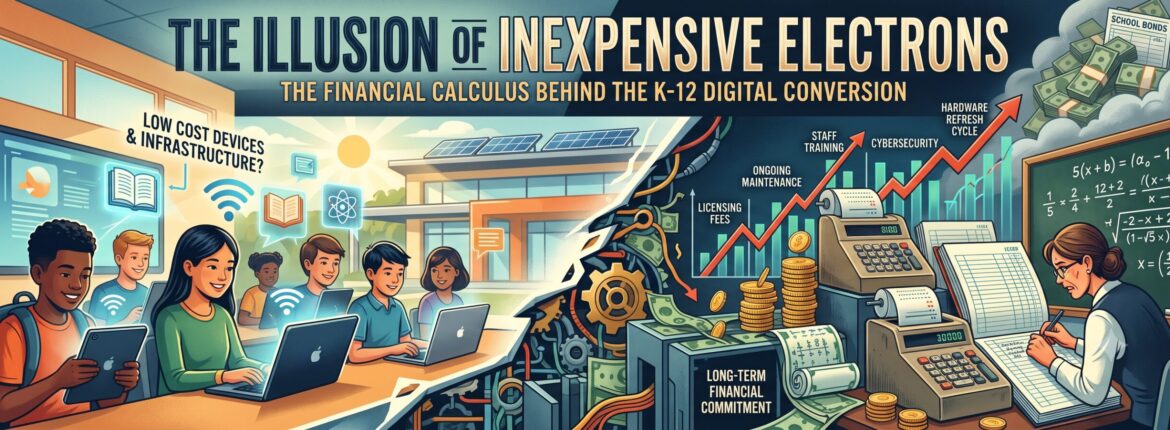
Over the past decade, primary and secondary public education systems across North America underwent a structural transformation, shifting from physical textbooks to 1-to-1 digital device deployment. While this transition was often framed in pedagogical terms—promising "interactive engagement" and "personalized learning"—the foundational impulse driving school administrators was grounded in financial calculus.
Educators and district CFOs were promised that delivering curricula via digital "electrons" rather than physical paper would drastically reduce long-term operational costs. However, the financial reality proved far more complex. The transition unfolded across two distinct waves: an early pre-COVID 1-to-1 push (2012–2015) driven by vendor promises of cost reduction, and an emergency pandemic wave (2020) fueled by unprecedented federal emergency funding.
1. Wave I (2012–2015): The Financial Pitch for "Paper-Free" Savings
When sales representatives pitched digital subscriptions to school boards in the mid-2010s, the comparative economics appeared overwhelmingly favorable on paper:
- High Upfront Print Expenses: Traditional hardbound math and science textbooks carried unit costs between $70 and $120+ per copy, subject to physical wear, loss, and costly warehouse distribution logistics.
- Rigid Adoption Cycles: Printed curricula traditionally operate on 5-to-7-year adoption cycles, forcing districts to make massive periodic capital expenditures to replace outdated editions.
- The Low-Cost Digital Pitch: EdTech vendors offered digital student licenses at $15 to $45 annually, claiming "always-updated" content that bypassed shipping, storage, and handling costs entirely.
- Consumable Overhead: Districts projected multi-million-dollar savings by eliminating paper workbooks, photocopier lease contracts, toner cartridges, and physical library storage.
2. Wave II (2020): Pandemic Emergency and Federal Subsidies
The outbreak of COVID-19 in 2020 completely altered school district procurement dynamics. The U.S. federal government flooded K-12 public schools with nearly $190 billion in Elementary and Secondary School Emergency Relief (ESSER) funding.
For administrators facing emergency remote-learning mandates, 1-to-1 Chromebook deployments and digital platform access codes suddenly appeared financially "frictionless." Federal funds absorbed the initial hardware and software licensing costs, solving an immediate logistical crisis: physical textbooks could not be safely or efficiently distributed to remote households. Electronic delivery became the default operational necessity.
3. The Hidden Financial Trap: Total Cost of Ownership (TCO)
As federal emergency subsidies sunset, school districts confronted the true Total Cost of Ownership (TCO) associated with 1-to-1 digital ecosystems. Rather than reducing costs, digital delivery introduced structural financial liabilities:
| Expense Category | Traditional Print Model | 1-to-1 Digital Model |
| Primary Asset | Hardbound Textbooks ($80–$120, 7+ year lifespan) | Chromebooks / Tablets ($250–$400, 3-year lifespan) |
| Curriculum Costs | One-time capital purchase per adoption cycle | Perpetual annual SaaS recurring subscription fees |
| Infrastructure Needs | Minimal (Physical storage closets, shelving) | Enterprise Wi-Fi, cloud servers, cybersecurity, IT staff |
| Maintenance & Repairs | Minor book re-binding, physical replacement | Broken screens, lost chargers, battery decay, tech insurance |
Recognizing the decline of the traditional textbook sales cycle, major educational publishers restructured their business models into Software-as-a-Service (SaaS) platforms. By replacing one-time physical book sales with mandatory annual user access codes, publishers secured recurring revenue streams, transferring long-term financial risk directly onto school districts.
4. Conclusion: The Dual Crisis of Finance and Pedagogy
The promise that digital curriculum delivery would save public education money proved to be an illusion. School districts traded predictable, multi-year asset purchases for an expensive hardware and software subscription treadmill. As districts now face the fiscal cliff of expiring federal relief funds alongside mounting cognitive evidence regarding screen-based learning loss—the very trends prompting Scandinavian nations to return to print—administrators face an urgent need to re-evaluate the true cost of digital education.
References & Financial Documentation
- U.S. Department of Education. (2021). Elementary and Secondary School Emergency Relief (ESSER) Fund Allocation Reports. Office of Elementary and Secondary Education.
- Consortium for School Networking (CoSN). (2022). Rethinking Total Cost of Ownership (TCO) for K-12 Digital Learning Environments. Washington, D.C.
- EdWeek Research Center. (2023). K-12 Budget Trends: The Shift from Print Adoptions to Recurring Software Licensing. Education Week Publications.
- Molnar, A., & Boninger, F. (2021). Asleep at the Switch: Commercialism and Digital Platforms in Public Schools. National Education Policy Center (NEPC).
- Government Accountability Office (GAO). (2020). K-12 Education: Technology Infrastructure and Device Costs in Public Schools (GAO-20-451).