
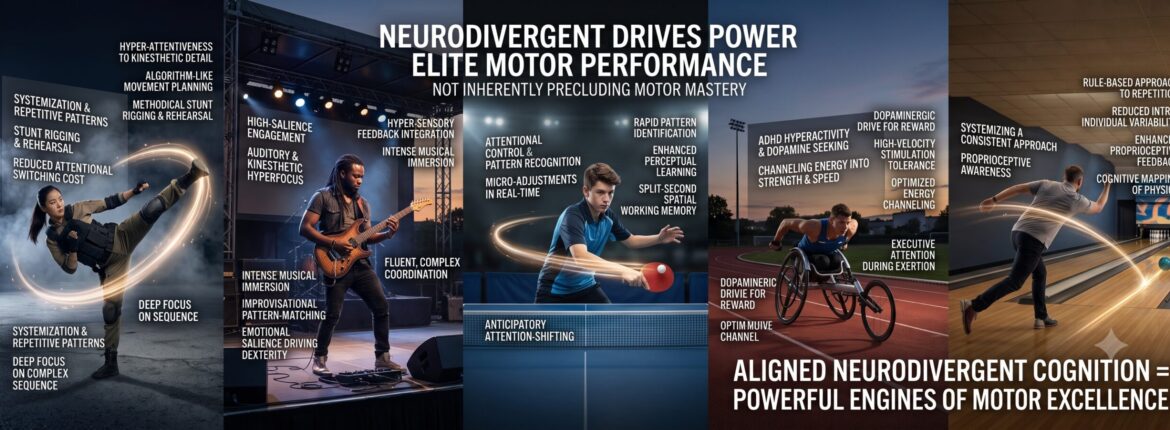
For decades, psychiatric literature and standardized developmental assessments have maintained a firm diagnostic consensus: Attention-Deficit/Hyperactivity Disorder (ADHD) and Autism Spectrum Condition (ASD) are fundamentally characterized by motor impairment. Meta-analyses consistently cite motor planning friction, poor gait symmetry, low muscle tone (hypotonia), and developmental dyspraxia as high-prevalence traits affecting approximately 75% to 85% of the neurodivergent population. Within academic research, these statistical medians are frequently flattened into a definitive narrative: neurodivergence inherently implies motor deficit.
However, observing real-world high-performance environments—including professional film stunt departments, elite athletics, precision target sports, and professional musical ensembles—reveals a striking paradox. These physically demanding, highly technical spaces are populated by a high concentration of autistic, ADHD, and AuDHD (co-occurring) performers who demonstrate world-class kinetic precision, rapid spatial processing, and extraordinary motor consistency.
In his landmark book, The ADHD Advantage, psychiatrist Dr. Dale Archer highlights that diagnosed ADHD prevalence rates in Major League Baseball (MLB) hover around 9% to 10%—roughly double the prevalence rate of the general adult population (~4.4%). Elite sports, high-stakes stunt work, and precision performance arts show a systematic overrepresentation of neurodivergent performers thriving at the highest levels.
This disconnect exposes a critical flaw in how human movement is evaluated. When academic paradigms rely on generic, laboratory-based testing without incorporating the observations of frontline practitioners—clinicians, social workers, occupational therapists, music teachers, band directors, athletic coaches, and paraprofessionals—they risk misinterpreting population averages and artificial laboratory friction as universal performance ceilings.
1. Why Academic Methodologies Yield "False Negatives"
The assertion that ADHD and ASD individuals universally possess impaired motor development rests on four major methodological blind spots within clinical research:
A. Assessing "Boredom Tolerance" Rather Than Physical Ceiling
Standardized motor assessments—such as the Bruininks-Oseretsky Test of Motor Proficiency (BOT-2) or the Movement Assessment Battery for Children (MABC)—place subjects in low-stimulation environments to perform repetitive, low-salience tasks (e.g., placing pegs in a board or drawing static lines). In these low-arousal contexts, an ADHD brain experiences prefrontal dopamine under-activation, leading to motor restlessness and careless errors. As Dr. Dale Archer notes, diagnostic batteries evaluate how well an individual tolerates under-stimulating conditions. The test accidentally measures executive disengagement from boring tasks, not motor capacity.
B. The Open-Loop Laboratory Vacuum
Standardized testing evaluates subjects in an artificial vacuum stripped of real-time feedback, social competition, momentum, and high stakes. Testing athletic capacity without adrenaline or dynamic context is the equivalent of measuring a high-performance engine while idling in neutral.
C. Clinical Selection and Sampling Bias
Academic studies routinely recruit subjects from clinical settings—individuals seeking support specifically because they are struggling at school or home. Neurodivergent youth who excel in elite youth sports, martial arts, or gymnastics are rarely captured in these clinical cohorts, creating a pre-filtered sample that skews population medians downward.
D. Confounding Co-Occurring Conditions
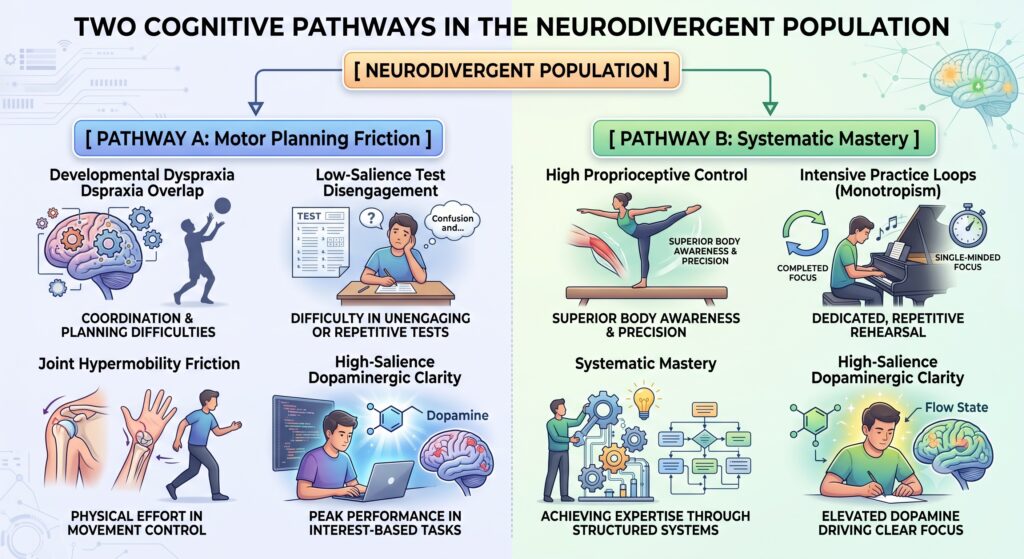
Research frequently fails to differentiate between pure ADHD/ASD neurology and co-occurring Developmental Coordination Disorder (dyspraxia) or joint hypermobility. Lumping these distinct profiles together drags down aggregate scores, masking the hyper-coordinated performers within the same neurotype.
2. Closed-Loop Engineering vs. Open-Loop Chaos
Motor control theory distinguishes between open-loop motor adaptation (reacting to unpredictable external cues) and closed-loop motor systems, where performance relies on internal proprioceptive feedback, explicit rules, and repeatable mechanical structures.
While neurodivergent performers may experience cognitive friction during chaotic open-loop social play, they consistently excel in closed-loop, highly structured kinetic environments.
| Movement Task | Standard Clinical Assessment | Real-World Application | Neurodivergent Performance Profile |
| Open-Loop (Unpredictable) | Catching a thrown ball off-target; unpredictable group sport chaos. | Navigating dynamic, unstructured physical altercations. | Shows delays due to visual-social integration friction. |
| Closed-Loop (Predictable) | Tracing complex geometry; static balance beam execution. | Precision stunt vehicle arcs, martial arts kata, instrumental bowing mechanics, bowling approaches. | Extremely high via explicit internal biomechanical mapping. |
3. Dopaminergic Clarity, Rapid Attention, and Systemization
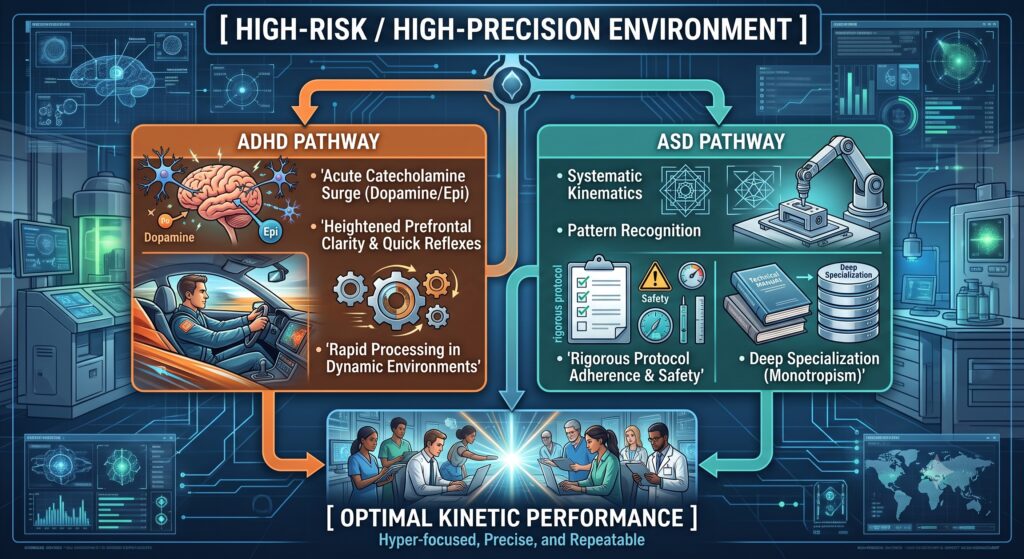
In stunt work, extreme sports, and high-consequence performance, the combination of ADHD and ASD (AuDHD) creates a complementary set of physical assets:
- Dopaminergic Regulation via High-Salience Tasks (ADHD): The ADHD brain operates at a lower baseline level of prefrontal dopamine and norepinephrine. In high-arousal environments—such as a stunt fall, a precision motor maneuver, or a live stage performance—the acute surge of catecholamines normalizes executive function, replacing cognitive restlessness with heightened focus and calm clarity.
- Rapid Attention Switching as Court Vision (ADHD): As Dr. Dale Archer emphasizes, what clinical settings label as "distractibility" translates on a court or field into peripheral awareness. The ADHD athlete constantly scans the environment, reading opponent movements and ball trajectories simultaneously.
- Biomechanical Systemization (ASD): Stunt execution and athletic mastery are essentially applied physics. Autistic performers apply a systemizing cognitive style to movement, mapping joint angles, momentum vectors, and spatial margins down to the millimeter.
- Rule-Based Safety and Rigor (ASD): Stunt rigging, technical athletics, and equipment-heavy disciplines require strict adherence to protocol. The autistic preference for explicit, unambiguous rules makes neurodivergent performers meticulous guardians of safety checks and environmental parameters.
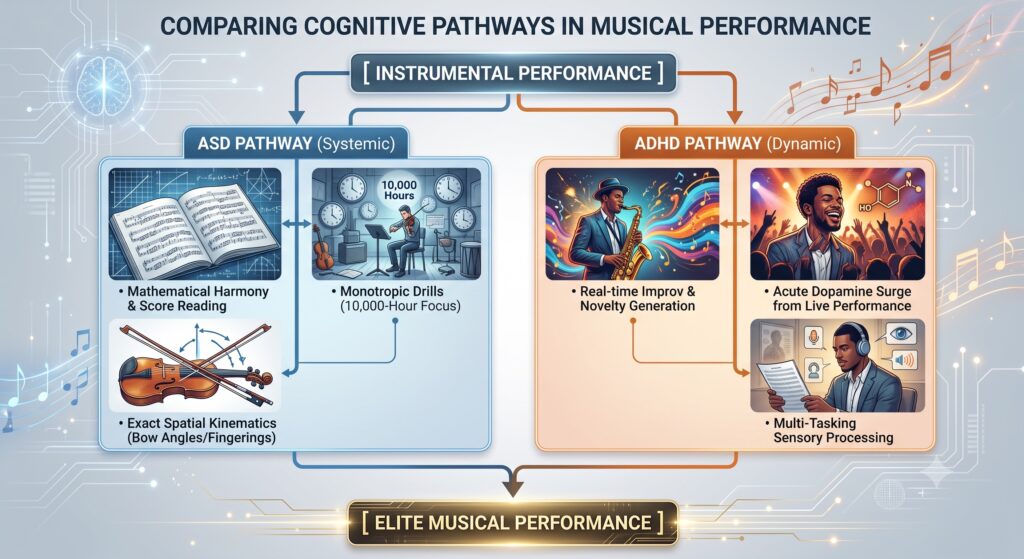
4. Instrumental Performance: Music as High-Precision Motor Engineering
Music is frequently categorized as an artistic domain, but at its physical core, playing an instrument is a demanding motor discipline requiring fine-motor precision, speed, and continuous sensorimotor feedback.
Monotropic Focus and Motor Repetition
Mastering an instrument requires thousands of hours of deliberate practice. Autistic monotropism enables a performer to spend hours drilling complex fingering patterns, drum rudiments, or vocal placement without cognitive fatigue. This hyper-repetitive practice builds deeply myelinated neural pathways for effortless, highly reliable motor output.
Kinematic Systemization of the Instrument
An autistic musician does not rely solely on vague "feeling" or imitation; they build an explicit internal spatial model of the instrument:
- String Instruments: Managing precise bowing vectors, finger placement distances, and pressure variables.
- Percussion: Mapping micro-timing, velocity vectors, and bilateral limb independence.
- Wind/Brass: Developing fine motor control over embouchure muscles and breath velocity.
5. Micro-Reaction vs. Pure Predictability: Table Tennis & Bowling
Two distinct sports illustrate how closed-loop physical systems allow neurodivergent motor control to thrive: table tennis (high-speed micro-reactions) and bowling (pure environmental stability).
Table Tennis: High-Speed Closed-Loop Biomechanics
Table tennis represents the fastest racket sport in terms of reaction window, with the ball crossing the net in under 0.2 seconds.
- ADHD Micro-Reaction Loop: The relentless tempo demands rapid visual processing and instantaneous motor choices, triggering a continuous dopamine release that eliminates internal cognitive distractions.
- ASD Spatial Systemization: The playing surface is a fixed, highly predictable rectangle. Ball behavior is strictly governed by spin vectors, angle of incidence, and friction. Autistic performers build an internal mechanical model of paddle angle and wrist acceleration, converting high-speed play into repeatable execution.
- Clinical Interventions: Clinical trials explicitly use structured table tennis interventions to drive substantial gains in motor proficiency, reaction speed, and executive function in children and adults with ASD and ADHD.
Bowling: Environmental Engineering and Physics
While table tennis is dynamic, bowling is the ultimate expression of static physical stability:
- Fixed Dimensions and Deterministic Physics: The lane (60 feet to the headpin, 39 boards wide) provides an unchanging geometry. Pin carry is a direct mathematical outcome of release velocity, entry angle, axis rotation, and lane friction.
- Pattern Recognition: Autistic bowlers excel at reading lane breakdown (oil depletion), treating adjustments not as guesswork but as systemic recalibrations—shifting feet two boards left or adjusting a target arrow to restore pocket entry.
- Implicit Learning & External Focus: Research shows that autistic motor acquisition in bowling excels under analogical and external-focus instruction (e.g., targeting lane markers rather than focusing on internal body cues).
6. Frontline Observation vs. The Academic Silo
The persistence of the "universal motor deficit" narrative highlights a gap between academic research and field-based observation. While researchers often evaluate participants using standardized tests in isolated settings, frontline professionals witness a much wider range of capabilities daily:
- Occupational Therapists & Clinicians recognize that when motor activities are reframed into explicit, mechanical algorithms rather than social imitation, neurodivergent motor acquisition accelerates.
- Teachers & Paraprofessionals regularly see students who struggle with handwriting or team sports excel in fine-motor crafts, digital audio editing, typing, or solo athletic pursuits.
- Band Directors & Music Educators routinely utilize the autistic capacity for rhythmic precision, absolute pitch recognition, and technical repetition to build elite performing ensembles.
- Stunt Coordinators & Athletic Coaches directly recruit for neurodivergent traits—such as intense hyperfocus, risk tolerance, mechanical rigidity, and deep specialization—because these qualities lead to reliable execution under pressure.
Conclusion
When academic literature relies strictly on population medians obtained in low-salience laboratory settings, its conclusions risk becoming overly definitive and reductive.
Autism and ADHD do not inherently preclude motor mastery. When neurological drives for systemization, deep focus, and high-salience engagement align with structured physical environments—whether on a stunt set, a concert stage, a table tennis court, an athletic field, or a bowling lane—neurodivergent cognitive traits function as powerful engines of elite motor performance.
References
- Archer, D. (2015). The ADHD Advantage: What You Thought Was a Diagnosis May Be Your Greatest Strength.Rodale Books.
- Azar, N. R., et al. (2016). Impact of Motor Skills Training in Adults with Autism Spectrum Disorder and an Intellectual Disability. Journal on Developmental Disabilities, 22(1), 28–38.
- Hardy, M. W., & LaGasse, A. B. (2013). Rhythm and music for promoting sensorimotor organization in autism: broader implications for outcomes. Frontiers in Integrative Neuroscience, 7, 22.
- Pan, C. Y., Chu, C. H., et al. (2017). The impacts of physical activity intervention on physical and cognitive outcomes in children with autism spectrum disorder. Autism: The International Journal of Research and Practice, 21(2), 190–202.
- Pan, C. Y., et al. (2016). A racket-sport intervention improves behavioral and cognitive performance in children with attention-deficit/hyperactivity disorder. Research in Developmental Disabilities, 57, 1–10.
- Ram, K., et al. (2026). Organized sports-based interventions and motor outcomes in children diagnosed with autism spectrum disorder: A systematic review. Developmental Medicine & Child Neurology, DOI: 10.1111/dmcn.70385.
- Shoham, R., et al. (2016). ADHD-associated risk taking is linked to exaggerated views of the benefits of positive outcomes. Scientific Reports, 6, 34833.
- Xing, Y., & Wu, X. (2025). Effects of Motor Skills and Physical Activity Interventions on Motor Development in Children with Autism Spectrum Disorder. Healthcare, 13(5), 489.
- Zamani, A., et al. (2024). Effect of Implicit Learning Methods With the External Focus of Attention on Motor Skill Acquisition in Children with ASD. PMC / Pediatric Movement Science.
For a deeper dive into Dr. Dale Archer's work, check out [Review] The ADHD Advantage (Dale Archer) Summarized, which breaks down his core arguments on how ADHD traits can be leveraged as performance strengths in high-intensity fields.