
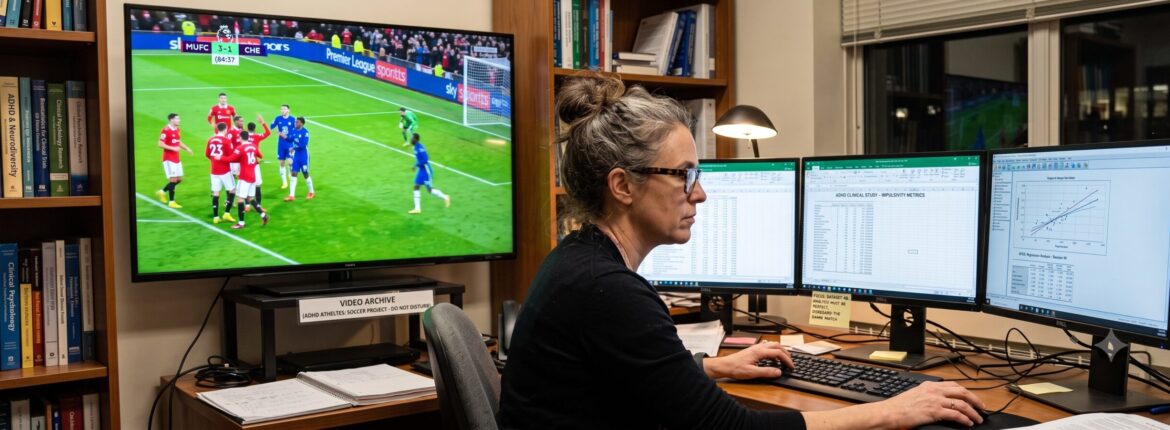
If a volcanologist uses ice core samples to read centuries of atmospheric shifts and pressure spikes, then the thousands of hours of tape on elite ADHD athletes—from game film to raw post-match press conferences—is a living, breathing stratigraphy of neurodivergent human performance under extreme duress.
It is a data set hiding in plain sight. Yet, much of traditional academic research remains trapped in "clinical hubris," treating ADHD through a deficit-based, pathological lens developed in sedentary classrooms. By treating these archives not as mere entertainment but as naturalistic laboratory data, we can unlock a revolutionary understanding of the dopaminergic brain.
The Video Archive as "Ice Core Samples"
In an academic lab, testing how an ADHD brain handles severe stress, rapid stimulus, and dopamine depletion requires contrived computer tests (like pressing a spacebar when a red dot appears). On tape, we have decades of high-stakes, real-world data.
By analyzing the performances and interviews of athletes like Michael Phelps, Simone Biles, or legendary hockey and basketball icons known to have ADHD, researchers can extract quantifiable, testable predictions.
1. The Kinetic Signature of "Hyperfocus"
- The Pathological View: Academia often defines ADHD as a fundamental inability to sustain attention.
- The Tape's Evidence: The footage shows the exact opposite—a hyper-narrowed, predatory gaze where the athlete completely tunes out stadium noise of 80,000 screaming fans. Volcanologists look for layers of ash to measure an ancient eruption; neuroscientists should look at these video layers to map how a dopamine-starved brain locks onto a high-stimulation target.
- The Testable Prediction: Under extreme physical stimulus, the ADHD brain's sensory gating mechanisms don't fail—they selectively sharpen past neurotypical limits, filtering out macro-distractions to process micro-movements.
2. Impulsivity Tracked at 60 Frames Per Second
- The Pathological View: Impulsivity is categorized as a behavioral deficit resulting in poor executive functioning and reckless choices.
- The Tape's Evidence: Watch film of an ADHD point guard or a hockey forward. What looks like impulsivity in a classroom is weaponized on the ice as sub-second intuitive pattern recognition. They pass to a teammate before the gap even opens, or react to a puck deflecting off a skate before the human eye can track it. The video is a frame-by-frame record of a brain executing rapid, non-linear decisions because it bypasses standard working-memory bottlenecks.
- The Testable Prediction: The ADHD brain trades linear executive processing for high-velocity parallel processing, allowing for superior reactive accuracy in environments with high environmental chaos.
3. The Post-Match "Dopamine Crash" in Interviews
- The Pathological View: Mood dysregulation and emotional volatility are secondary symptoms to be managed with therapy or medication.
- The Tape's Evidence: Look at the raw, unedited interviews immediately following a massive win or a crushing loss. You can visibly track the neurochemical cliff. The massive surge of dopamine and adrenaline from the game evaporates, leaving the athlete looking instantly hollow, profoundly exhausted, irritable, or emotionally raw. These interviews are real-time records of homeostatic collapse.
- The Testable Prediction: The steeper the athletic dopamine spike required for performance, the more severe the immediate post-performance executive drop, providing a predictable timeline for neurochemical recovery.
Overcoming Academic Hubris and "The Classroom Bias"
The disconnect exists because American clinical research has historically suffered from a profound environmental bias. Because ADHD was heavily categorized by how much a child disrupts a desk-and-blackboard environment, the diagnostic criteria became entirely defensive: How do we get the subject to sit still and comply?
When elite athletes with ADHD drop out of school but thrive in high-risk, high-velocity sports, academia often treats it as a bizarre anomaly—an exception to the rule—rather than a roadmap of how the brain is actually wired to function. They look at the athlete and see someone "succeeding despite their disorder," rather than "succeeding because their neural architecture is perfectly matched to the environment."
| The Academic Paradigm | The Athletic Reality (The Tape) |
| Deficit Model: A broken attention mechanism that requires pharmaceutical dampening to mimic normal baselines. | Environmental Match: A predatory, high-flux neural architecture built for rapidly shifting kinetic environments. |
| Lab Testing: Low-stimulus, artificial testing (e.g., clicking a button on a blank screen in a silent room). | The True Test: High-stimulus, high-consequence environments where intense movement acts as a neurological stabilizer. |
| Goal of Intervention: Minimizing behavior to match a sedentary, industrialized baseline. | Goal of Intervention: Channeling dopamine-seeking behavior into elite, high-velocity execution. |
A Call to Look at the Screen
If research institutions looked at this broadcast footage with the humility of a geologist examining a canyon wall, they would stop asking "How do we cure this deficit?" and start asking "What environmental variables turn this specific neural architecture into a superpower?"
The data isn't waiting to be funded by a massive federal grant or generated in a sterile lab; it has already been captured, digitized, and archived in millions of terabytes of broadcast footage. Academia just needs to turn on the television.