
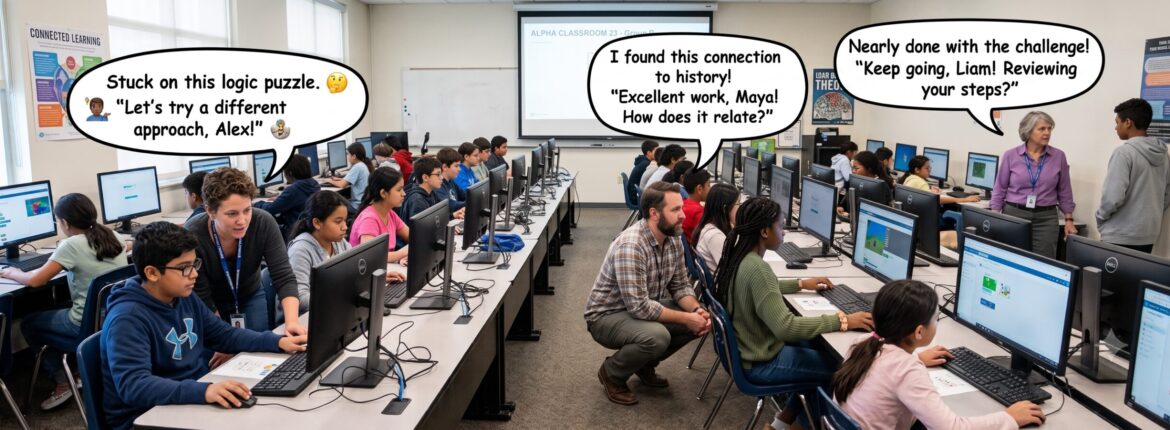
Modern education policy debates are fractured by a profound, structural contradiction. On one hand, boutique, highly resourced private micro-school models are lauded by administrations for their rapid, self-paced academic successes, often attributing their data entirely to cutting-edge, adaptive AI platforms. On the other hand, federal policy shifts consistently squeeze public education, cutting vital Title I funding and pulling necessary paraprofessionals and instructional aides out of the classrooms that need them most.
When we strip away the tech-driven marketing fluff, a glaring reality emerges: these celebrated private models haven't discovered a new biological pathway to learning. They have simply verified what educators have always known—humans learn better in small, highly supported groups. By utilizing adaptive software as a replacement for human staff rather than a supplement to them, current policy directives are mistaking a short-term cognitive band-aid for true developmental healing.
To understand why this policy disconnect is so devastating, we must look past the screens and examine how a developing brain actually maps the world.
1. The Ratio Illusion and the Proactive Guide
Schools like Alpha.School frequently tout incredible student pacing and accelerated learning, crediting the independent grit of a generation navigating individual algorithmic loops. What gets left out of the narrative is the heavily funded human architecture supporting that environment. These models feature low student-to-adult guide ratios with guides and coaches constantly circulating.
The low ratio isn't a byproduct of their success; it is the prerequisite for it. A student rarely stays stuck or frustrated for long because an adult is immediately available to clear a cognitive block or redirect energy without judgment.
Decades ago, Steve Jobs foresaw the exact trap of expecting technology to solve this foundational design. Reflecting on his extensive work placing computers in classrooms, Jobs directly challenged the digital-first paradigm:
"The most important thing is a person. A person who incites your curiosity and feeds your curiosity; and machines cannot do that in the same way that people can... Computers are very reactive but they're not proactive; they are not agents, if you will. What children need is something more proactive. They need a guide."
When an administration praises the data of a tech-driven micro-school while simultaneously defunding public school paraprofessionals, they are committing a massive logical error. They are celebrating an educational philosophy that relies on a high-touch, proactive human presence, while implementing funding cuts that ensure Title I public school students receive the exact opposite.
2. Sensorimotor Inference and the 1000 Brains Theory
To understand why pulling a paraprofessional out of a classroom causes learning to derail, we have to look at the neurobiology of how a child builds a model of the world. In his 1000 Brains Theory, tech pioneer and neuroscientist Jeff Hawkins posits that the neocortex does not learn a static picture of the world. Instead, the brain uses sensorimotor inference—it learns continuous, predictive models of reality by pairing sensory input with physical movement and spatial references.
Learning is an active, exploratory, three-dimensional process. Working memory and mathematical fluency are built by manipulating physical objects, writing by hand, and navigating real-world boundaries. Neil deGrasse Tyson captured this perfectly when defending the chaotic, tactile nature of childhood exploration. He noted that children are natural scientists whose baseline impulse is to test their environment—whether by banging on pots to study acoustics or dropping objects to explore gravity. Tyson famously warned against the standard institutional reflex to suppress this behavior:
"We spend the first year of their lives teaching them to stand up and speak, and the rest of their lives telling them to sit down and shut up... Do not extinguish your child's curiosity. Let them try, fall, fail, and succeed on their own."
                     [ NEOCORTEX (1000 Brains Theory) ]
                                    │
                ┌───────────────────┴───────────────────┐
                ▼                                       ▼
    [ Physical Exploration ]                [ Screen-Based Learning ]
     • Sensorimotor Inference                • 2D Flat Interaction
     • Tactile & Spatial References          • Rigid Algorithmic Loops
     • Active World Modeling                 • Outsourced Executive Function
                │                                       │
                ▼                                       ▼
         ( TRUE HEALING )                       ( THE BAND-AID )
When a child is confined to a flat, two-dimensional screen for hours at a time, their sensorimotor feedback loops are severely restricted. The brain's predictive framework is starved of spatial variation.
Furthermore, an Executive Function (EF) deprived generation—whose attention spans have been fractured by hyper-stimulating, algorithmic social media—needs to build its internal cognitive muscles. Adaptive AI software acts as an effective temporary band-aid because it mirrors that digital dopamine loop, offering instant feedback and gamified progression. But if a student relies entirely on an algorithm to scaffold their attention, organize their thoughts, and tell them when to focus, they are outsourcing their executive function to the software.
The body cannot heal its executive function deficits through a screen. True cognitive regulation is caught as much as it is taught; it requires co-regulating with a calm, grounded adult guide who can map the room, read a student’s body language, and step in to de-escalate frustration before the student checks out.
3. Connected Learning and the Tragedy of Title I Cuts
When federal or state policies cut Title I funding, the absolute first line of defense to go is personnel—specifically, the paraprofessionals who provide this critical, mobile human presence. This creates a brutal systemic double standard:
| Defunded Public Classrooms (Title I Cuts) | Lauded Private Micro-Schools |
| Ratios: Often 25 to 30+ students to 1 certified teacher. | Ratios: Small, flexible cohorts with multiple guides/assistants. |
| Impact: Loss of the second adult who handles targeted small-group interventions. | Impact: Constant human guardrails to maintain a calm, non-punitive environment. |
| Result: The single teacher is forced into hyper-reactive crowd control; spatial feedback loops break down. | Result: Students build immediate confidence because human help is instantaneous. |
By stripping these essential educators from public classrooms, we block students from experiencing what science historian James Burke called "connected learning." In his landmark work Connections, Burke demonstrated that human progress and innovation do not happen in isolated, linear silos. Rather, knowledge is a vast, interlocking web where ideas from completely different disciplines bounce off one another to trigger sudden cognitive leaps.
True education should mirror this interconnected web. When a classroom is adequately staffed with a teacher and paraprofessionals, learning can become organic, interdisciplinary, and fluid. Small groups can pivot from a math problem to a historical narrative, connecting geometry to architecture, or biology to environmental economics.
But when a public classroom is stripped of its human architecture, the web collapses. The single remaining teacher has no choice but to balkanize the day into rigid, isolated blocks of survival time. Students are plugged into adaptive software packages to keep them quiet and occupied. The connected, exploratory richness of the human knowledge web is replaced by a solitary, transactional relationship with an interface.
Conclusion: The Ultimate Policy Fail
The fundamental flaw in praising boutique private school models while defunding public Title I staffing is the outright refusal to fund the actual mechanisms of success. It treats public school struggles as a lack of tech-driven "innovation" or "will," while ignoring the fact that the private successes being praised are built on the exact small student-to-adult ratios being stripped from the public sector.
An adaptive software program can protect a wounded learning environment in a moment of crisis, but it cannot replace the physical, spatial, and relational ecosystem required for deep intellectual development. To truly heal a generation of learners, we must reinvest in the human architecture of the classroom—ensuring that every child, regardless of socioeconomic status, has access to the proactive guides, tactile freedom, and connected human relationships necessary to build a complete model of the world.