
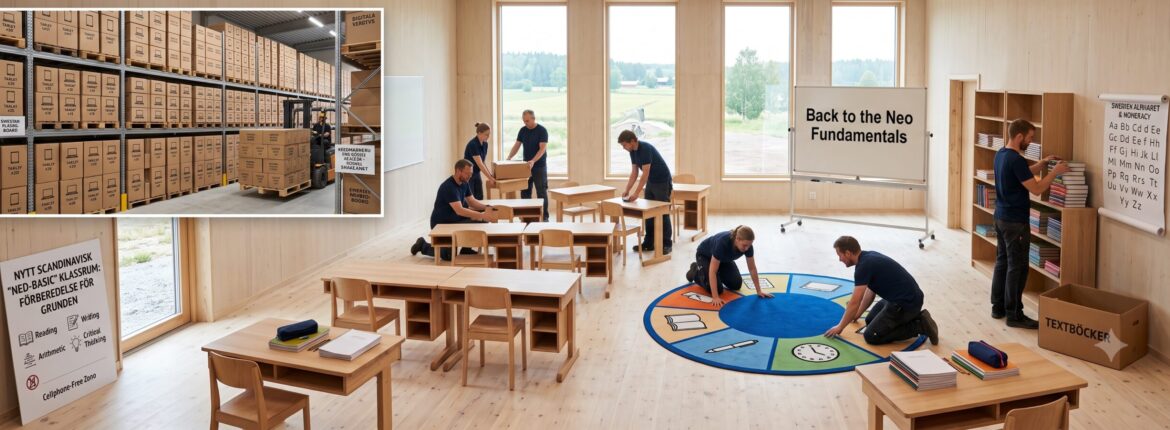
For decades, the Nordic nations stood as the global benchmark for education and civic responsibility. Built on high social trust, robust funding, and a deep commitment to child development, their systems seemed nearly bulletproof. When these countries pioneered 1-to-1 technology initiatives—handing every student a laptop or tablet—the world assumed it was the dawn of a modern masterclass in digital integration.
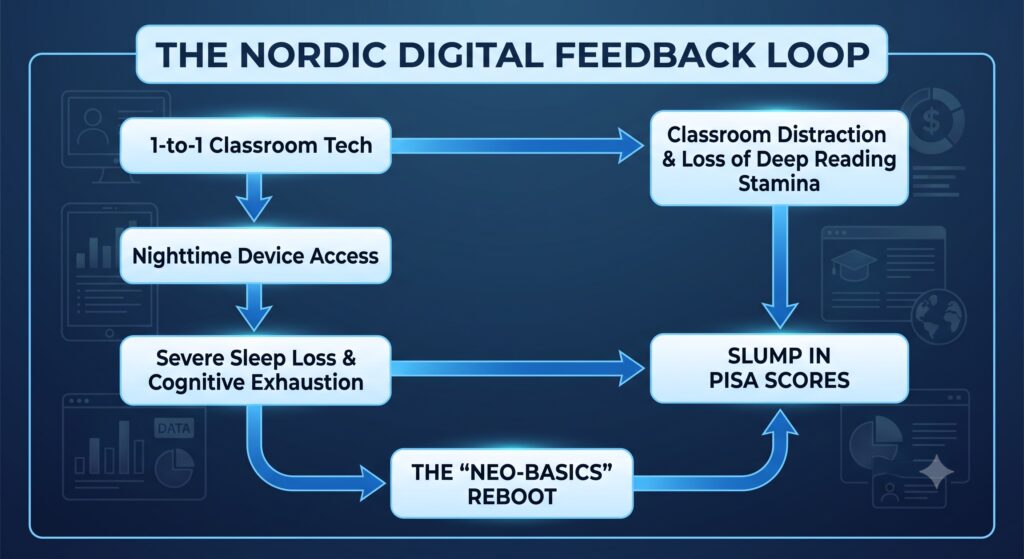
Instead, a perfect storm of biological disruption, pedagogical overconfidence, and parental passivity collided. The result was a historic drop in the OECD’s Programme for International Student Assessment (PISA) scores—and a swift, coordinated policy shift across Scandinavia toward a system best described as Neo-Basics.
1. The Biological Engine: Sleep-Deprived Brains Can't Learn
To understand why standardized performance plummeted, one must look outside the classroom. Seminal research across Norway and Sweden revealed that pervasive device access was systematically draining students of essential rest:
- The youth@hordaland Study (Norway): Surveying nearly 10,000 teenagers, researchers found that students who logged over 4 hours of daily screen time were 3.5 times more likely to get under 5 hours of sleep per night. Screen use in the hour before bed significantly delayed sleep onset, causing severe chronic sleep debt.
- The SHoT Student Health Survey (Norway): Analyzing over 45,000 students, researchers demonstrated that screen use in bed increased insomnia risk by 59% per additional hour. Crucially, it supported the time displacement hypothesis: the physical hours stolen from sleep by a screen mattered far more than whatever content was on it.
- Swedish Public Health Agency Findings: Heavy screen reliance degraded sleep quality, duration, and biological circadian timing, directly driving attention deficits and emotional fatigue in school.
When students arrive at school chronically sleep-deprived, their brains lack the neural plasticity required to consolidate memories, process quantitative reasoning, or sustain attention.
2. The Cultural Blind Spot: Trust, 1-to-1 Tech, and the Parental Slip-Up
How did societies renowned for high child-welfare standards allow this to unfold? The answer lies in a rare cultural oversight.
Nordic culture operates on deep institutional trust and personal responsibility. In Finland, for instance, a strong civic culture allowed society to manage pandemic disruptions with high compliance and personal care without requiring severe police-enforced lockdowns. Yet that same baseline of trust created a massive blind spot around consumer technology:
- Assumed Educational Safety: Because schools issued 1-to-1 devices, parents assumed the tablets and laptops were benign, strictly educational tools vetted by experts.
- The "Digital Native" Fallacy: Assuming children possessed the inherent skill to self-regulate, parents exercised light supervision over late-night screen boundaries.
- Unseen Slippage: Parents who would never allow a teenager to stay out past midnight unknowingly permitted them to sit awake until 2:00 AM under the blankets, bathed in blue light, scrolling or gaming on the exact same device issued for homework.
In an environment where parents assumed "if it comes from the school, it must be safe," limits vanished. The culture of trust failed to account for software explicitly engineered to bypass human willpower.
3. The PISA Reality: Distraction Over Depth
As sleep debt accumulated at home, 1-to-1 environments shifted classrooms from zones of sustained focus into hubs of continuous context-switching. PISA data and national assessments highlighted the operational costs:
| Metric | Measured Impact |
| Math Performance | High digital distraction correlated with sharp drops in math scores—equivalent to losing roughly three-quarters of a school year of learning. |
| Reading Comprehension | Replacing physical books with digital PDFs degraded linear visual tracking, deep reading stamina, and passage retention. |
| Peer Spillover | Off-task screen use by individual students created ambient distraction that lowered the performance of surrounding peers. |
Digital tools were positioned as gateways to personalized learning, but without strict boundaries, they functioned as open portals to instant gratification.
4. Cross-Country Collaboration and the Pan-Nordic Policy Pivot
Faced with shared data and parallel drops in literacy and math, Scandinavian leadership did not act in isolation. Education ministries, pediatric health boards, and neuroscientists across Sweden, Norway, Finland, and Denmark engaged in formal knowledge-sharing networks, drawing on findings from institutes like the Norwegian School of Sport Sciences (NIH)and Finland's University of Jyväskylä.
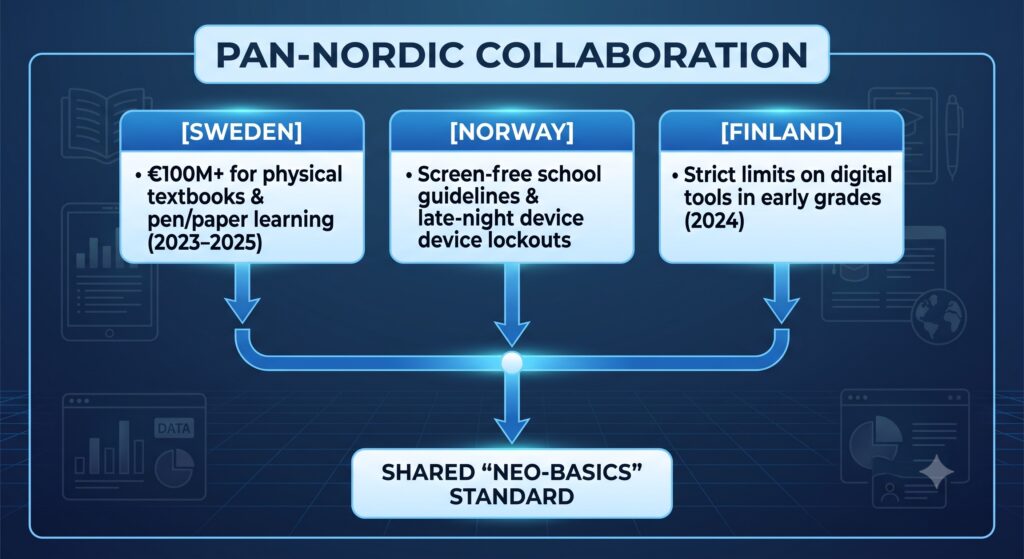
Rather than a simple retreat to 20th-century rote learning, this cross-country initiative established a neurologically grounded "Neo-Basics" framework:
- Re-establishing the Analog Substrate: Sweden committed over €100 million to ensure every student receives physical textbooks, while Norway and Finland instituted strict screen-free policies for early childhood education and moved toward mobile-free school days.
- Paper as a Cognitive Map: Neuroscientific research across the region confirmed that reading on physical paper provides spatial and tactile anchors that support narrative mapping, linear focus, and deep comprehension in ways screens cannot replicate.
- Writing as a Neural Motor Loop: Returning to handwriting with pens and pencils re-engaged the fine motor networks of the brain, strengthening spatial memory and letter recognition.
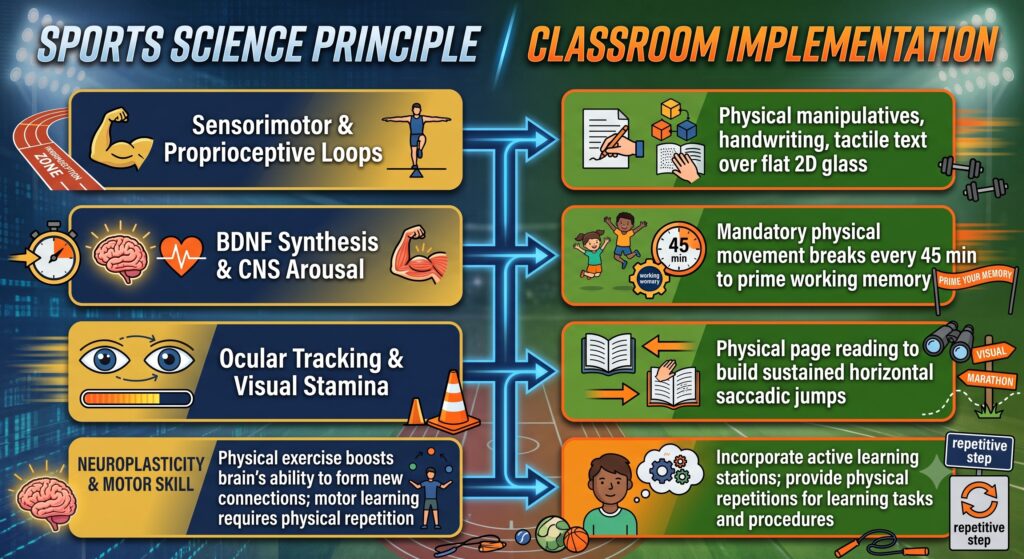
5. The Sports Science Integration: Refactoring Active Learning
A defining feature of the Neo-Basics pivot is its grounding in sports science and human movement dynamics. Nordic researchers recognized that the neurological mechanisms driving athletic performance—sensorimotor integration, spatial tracking, central nervous system (CNS) arousal, and recovery—are the same mechanisms that govern academic processing:
The Neo-Basics Synthesis
Neo-Basics is not an abandonment of experiential, project-based learning. Instead, it re-anchors inquiry in the physical world.
By removing unstructured digital exploration—which often overloads student working memory—teachers provide structured foundational knowledge through physical books first. Students then apply that knowledge through physical modeling, hands-on science, and active problem-solving.
By treating the student as an integrated biological system rather than a disembodied screen user, Scandinavia’s Neo-Basics model restores the physical, motor, and sleep foundations necessary for high-level critical thinking.
This video provides an overview of the educational shift in Scandinavia, exploring how schools in Sweden are reintroducing physical textbooks and paper-based learning to improve student concentration and foundational reading skills.
References
- Folkhälsomyndigheten. (2024). Digital media and sleep health in children and youth (Pub. No. 24043). Public Health Agency of Sweden.
- Hjetland, G. J., Sivertsen, B., Skogen, J. C., & Hysing, M. (2025). Screen use in bed, insomnia, and sleep duration among higher education students: The SHoT study. Frontiers in Psychiatry, 16, Article 1482910. https://doi.org/10.3389/fpsyt.2025.1482910
- Hysing, M., Pallesen, S., Stormark, K. M., Jakobsen, R., Lundervold, A. J., & Sivertsen, B. (2015). Sleep and use of electronic devices in adolescence: Results from a large population-based study. BMJ Open, 5(1), e006748. https://doi.org/10.1136/bmjopen-2014-006748
- Mangen, A., Walgermo, B. R., & Brønnick, K. (2013). Reading linear texts on paper versus computer screen: Effects on reading comprehension. International Journal of Educational Research, 58, 61–68. https://doi.org/10.1016/j.ijer.2012.12.002
- OECD. (2023). PISA 2022 results (Volume I): The state of learning and equity in education. OECD Publishing. https://doi.org/10.1787/53f23881-en
- Swedish Ministry of Education and Research. (2023). Budget proposition for 2024: Investments in physical textbooks and basic skills (Prop. 2023/24:1). Regeringskansliet.
- van der Meer, A. L. H., & van der Weel, F. R. (2020). Only three fingers write with the pen: The fine motor control needed for writing by hand. Frontiers in Psychology, 11, Article 1810. https://doi.org/10.3389/fpsyg.2020.01810