
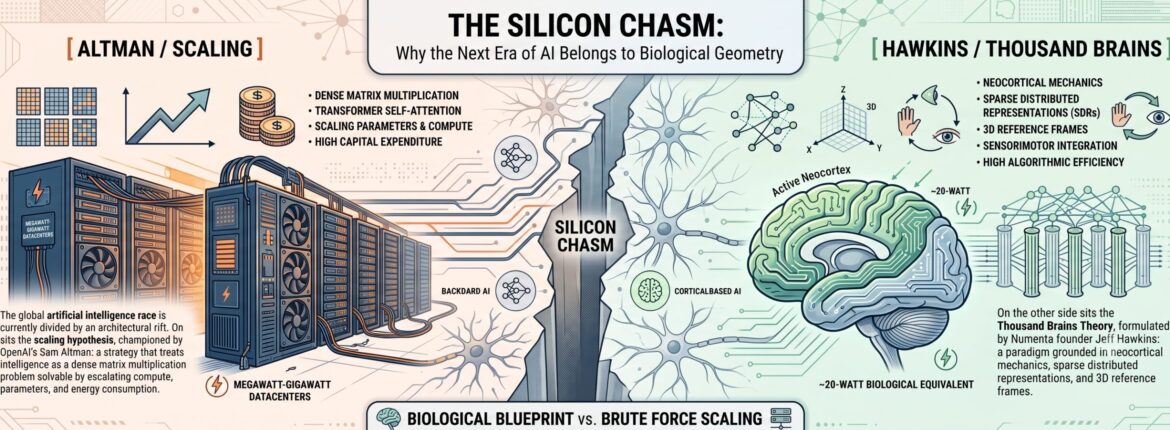
The global artificial intelligence race is currently divided by an architectural rift. On one side sits the scaling hypothesis, championed by OpenAI’s Sam Altman: a strategy that treats intelligence as a dense matrix multiplication problem solvable by escalating compute, parameters, and energy consumption. On the other side sits the Thousand Brains Theory, formulated by Numenta founder Jeff Hawkins: a paradigm grounded in neocortical mechanics, sparse distributed representations, and 3D reference frames.
While Altman’s approach has delivered impressive, high-dimensional statistical pattern matching, it has run headfirst into a fundamental physical bottleneck: the energy wall.
The Architectural Divide: Brute Force vs. Biological Geometry
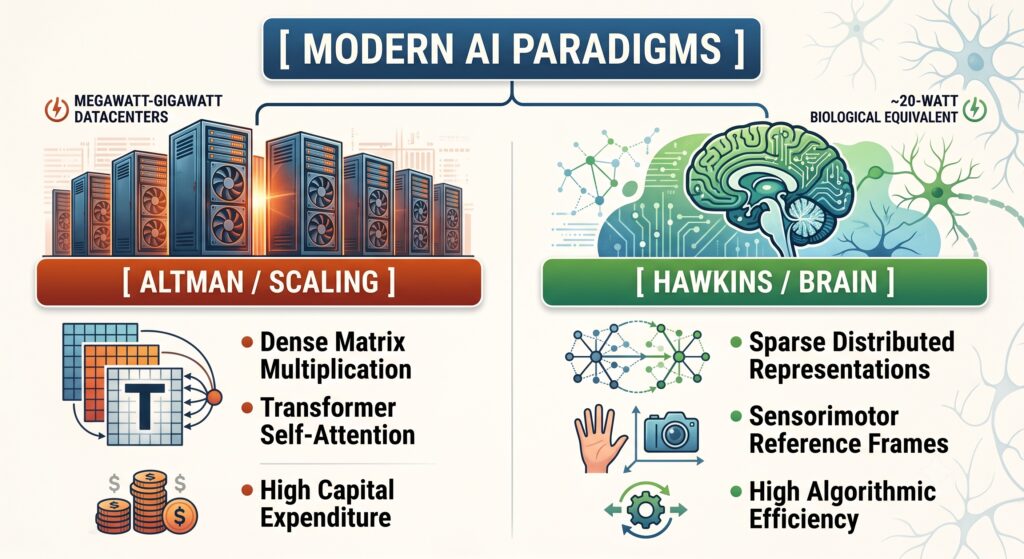
1. The Scaling Hypothesis (Sam Altman / OpenAI)
The foundation of modern Large Language Models (LLMs) relies on dense feed-forward processing and transformer self-attention mechanisms.
- The Mechanism: Every input token passes through hundreds of billions of parameters. Learning occurs via global backpropagation across massive dataset passes.
- The Energy Footprint: Model training and inference require dedicated utility infrastructure. Modern AI datacenters consume megawatts to gigawatts of power, driving Altman to explicitly state that future AI scaling requires breakthroughs in energy sources like nuclear fusion.
- The World Model: LLMs construct a statistical correlation map over sequence streams—building a model of language, but lacking an innate understanding of physical space or object geometry.
2. The Thousand Brains Theory (Jeff Hawkins / Numenta)
Hawkins’ framework argues that intelligence does not emerge from static matrix transformations, but from thousands of cortical columns running predictive models using 3D allocentric reference frames.
- The Mechanism: Operates on Sparse Distributed Representations (SDRs). Only 1% to 2% of the network fires at any given moment. Learning is local, continuous, and updated dynamically without full-network gradient updates.
- The Energy Footprint: Mimics the human brain, which executes real-time sensorimotor reasoning and spatial navigation on roughly 20 Watts.
- The World Model: Every cortical column maintains an explicit coordinate framework for objects, mapping wherefeatures exist relative to one another in physical space.
Key Structural Comparison
| Dimension | Scaling Hypothesis (Altman / OpenAI) | Thousand Brains Theory (Hawkins / Numenta) |
| Core Computational Primitive | Dense Matrix Multiplication | Sparse Distributed Representations (SDRs) & 3D Grid Cells |
| Primary Learning Engine | Global Backpropagation | Local Prediction Error & Structural Plasticity |
| Operational State | Passive Consumer (Feed-Forward Tokens) | Active Observer (Continuous Sensorimotor Loops) |
| Inference Energy Profile | Hundreds of Watts per complex query | Milliwatts to Watts (Edge CPU / Neuromorphic execution) |
| Software Abstraction | Model Checkpoints (.pt, .safetensors) | Living Runtime Engine / Cortical OS (e.g., tbp.monty) |
The Infrastructure Dilemma: Hardware vs. Software Innovation
The fundamental disagreement between Altman and Hawkins is not just theoretical—it changes where innovation happens in the technology stack:
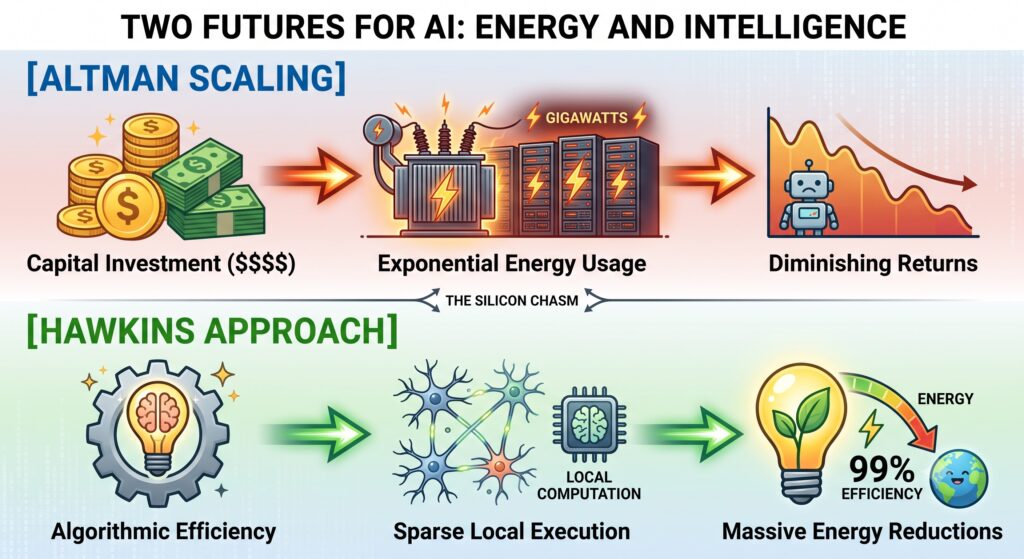
- Altman’s Model is a Hardware Bottleneck: Because transformers rely on dense arrays, scaling them requires larger silicon dies, faster interconnects, and higher power budgets. The capital expenditure scales linearly (or superlinearly) with model capacity.
- Hawkins’ Model is a Software Bottleneck: The neocortex does not execute dense matrix math; it performs pointer indirections, sparse vector matches, and event-driven graph operations. Processing this efficiently requires custom runtime abstractions and event-driven architectures rather than traditional dense GPU pipelines.
Just as digital cameras process optical barrel distortion locally on the sensor before sending clean video frames downstream, Hawkins’ architecture relies on Sensorimotor Integration (SMI) at the sensor level. By handling geometry and motor feedback directly at the sensor boundary, central software models process sparse, spatially tagged feature packets—eliminating wasted compute.
The Capital Allocation Shift
While statistical scaling will continue to capture short-term commercial value in text generation and workflow automation, institutional capital facing real-world power constraints will eventually pivot.
As datacenter footprints hit physical utility limits, long-term technological returns will favor software-driven, sparse, sensorimotor engines. Open-source frameworks like Monty (developed under the Thousand Brains Project) represent the initial implementations of this paradigm shift—providing an open architecture for low-power robotics, spatial AI, and continuous real-world learning.
QED
References & Primary Sources
- Hawkins, Jeff. A Thousand Brains: A New Theory of Intelligence. Basic Books.
- Thousand Brains Project. Open-source sensorimotor framework documentation (
tbp.monty). - Numenta Research. Neocortical Principles of Sensorimotor Learning, Reference Frames, and Modularity.
- Vaswani et al. Attention Is All You Need. (Foundational transformer architecture paper).
For an in-depth visual overview of how cortical column algorithms are translated directly into low-overhead software code, watch Meet Monty 2026: Reverse Engineering Intelligence
.
This video is directly relevant as it features Jeff Hawkins and the Thousand Brains Project research team detailing how their open-source Monty framework executes neocortical algorithms and reference frames with massive computational efficiency compared to deep learning models.