
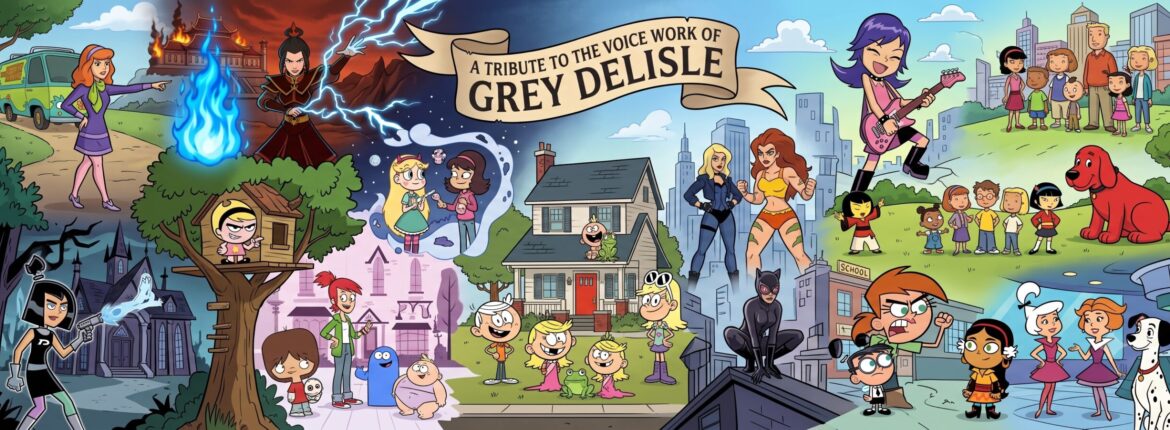
Behind the hundreds of animated faces that defined a generation's childhood—from the razor-sharp chill of Azula to the bubblegum grit of Daphne Blake—lies the remarkable story of Grey DeLisle. Her career as a legendary voice actress and Grammy-winning musician is not just a catalog of immense talent; it is a masterclass in how a neurodivergent mind can synthesize profound personal trauma into a brilliant, transcendent art form.
For DeLisle, living with ADHD and Complex Post-Traumatic Stress Disorder isn't a hurdle to overcome; it is the exact engine that fuels her brilliance in the recording booth. Rather than treating a rapidly shifting focus as a deficit, minds like hers often reframe it as a highly specialized tool. This cognitive wiring is hardly an isolated phenomenon in the arts. In fact, it is part of a broader, unrecognized baseline across performance disciplines: most voice actors, stand-up comedians, and musicians are likely neurodivergent. The very traits that make traditional, linear environments agonizing—hyperactive scanning, sensory hyper-awareness, rejection-sensitive dysphoria, and rapid divergent thinking—are precisely the superpowers required to thrive under the hot lights of a stage or behind the acoustic foam of a recording studio.
In voice acting, this manifests as an exceptional cognitive agility. Where a neurotypical actor might require a moment of mental recalibration to drop one vocal placement and adopt another, DeLisle's rapid-fire mental shifting allows her to "go to all the different gears" instantly, pivoting flawlessly between entirely different characters mid-sentence. In chaotic group recording sessions, she leans directly into the split-attention nature of ADHD. When a script features multiple characters she voices interacting synchronously, she seamlessly maps out and holds onto those distinct personas simultaneously, delivering their lines back-to-back without breaking the rhythmic flow of the session. It is the same hyper-connected, associative processing that allows musicians to hear entire arrangements in a flash of noise or enables comedians to map out a crowd's psychological landscape in real time.
This neurodivergence also unlocks an uninhibited emotional fluidity, giving artists immediate access to an extraordinary range that lets them pivot from manic, high-strung comedy to calculated, terrifying intensity in a single breath. Yet that same unfiltered emotional conduit means that real-world pain cuts deeply. DeLisle’s childhood was fractured by instability, a chaotic home environment, and the profound trauma of sexual assault. Rather than allowing these experiences to silence her, she has deliberately used the microphone to reclaim her power.
Her real-world grief and status as a survivor famously converged during the climax of Avatar: The Last Airbender. To capture Azula’s iconic mental breakdown, DeLisle bypassed standard acting techniques and reached directly into the darkest, rawest corners of her own lived trauma. The resulting performance was so genuinely agonizing that she broke down into real, unscripted sobs in the booth—creating a hauntingly authentic moment in animation history that she still finds too painful to watch back. Stepping into the shoes of someone else functions as a controlled, safe space where heavy, overwhelming emotions can be let out, reframed, and mastered. However, navigating the emotional weight of parenting later brought her anxiety and childhood trauma back to the forefront, leading her to seek heavy therapy, a journey she openly shares to dismantle the isolation surrounding mental health in the entertainment industry.
Music serves as the foundational language of her life and career to anchor this swirling internal ecosystem. As an accomplished singer-songwriter raised on the legacy of her vocalist grandmother, she approaches the spoken word like a musical score. She assigns characters specific musical registers—delivering outrageous characters in sharp, aggressive staccatos while performing villains in a low, smooth legato, utilizing natural breath control to build suspense. Interestingly, the stage fright that often plagues sensitive, neurodivergent performers in front of live audiences required its own workaround: she had to reverse-engineer her voice work, stepping into the "character" of the song to find the emotional armor she needed to perform. Furthermore, when she took over the role of Daphne Blake in the wake of losing her mentor Mary Kay Bergman, the steady financial sanctuary of the voice-over industry allowed her to fund her independent, Appalachian-style roots records, famously noting that "Daphne saved country music" by protecting her creative integrity.
Ultimately, Grey DeLisle's life story is a testament to the fact that the human voice is a powerful instrument of endurance. Through the rhythm of music, the specialized mechanics of a neurodivergent mind that she shares with so many fellow creatives, and the radical courage to confront her history as a survivor, she has transformed heavy, real-world pain into a vibrant universe of art, laughter, and healing for millions worldwide.