
Executive Summary
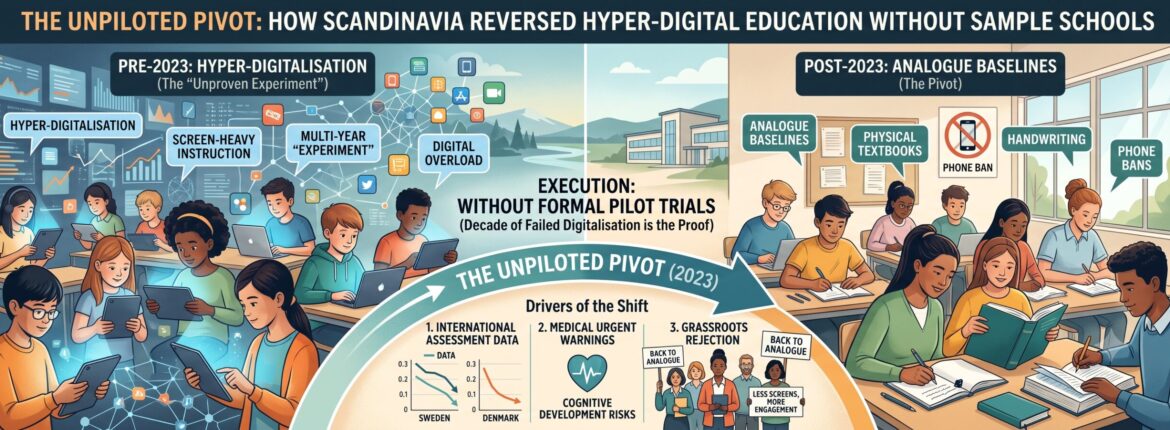
When Sweden and Denmark executed their dramatic pivot away from screen-heavy instruction and back toward physical textbooks, handwriting, and phone bans in 2023, they did so without running formal, state-sponsored "sample school" or pilot trials. Instead of conducting a multi-year pilot program, Scandinavian policymakers treated the preceding decade of hyper-digitalisation as an unproven, large-scale experiment that had already failed to deliver promised educational gains.
The shift back to analogue baselines was driven by a convergence of international assessment data, urgent medical warnings regarding cognitive development, and widespread grassroots rejection of screens by classroom teachers.
1. A Top-Down Policy Correction, Not a Trial
In typical educational policy reforms, national governments deploy pilot cohorts across selected school districts to measure outcomes against control groups over several academic years. However, Sweden’s Ministry of Education—led by School Minister Lotta Edholm—and Denmark's Ministry of Children and Education bypassed trial phases when enacting their back-to-basics initiatives.
Several factors explain why sample schools were deemed unnecessary:
- Restoring a Historical Baseline: Policymakers viewed printed textbooks, pen-and-paper writing, and teacher-led instruction not as novel pedagogical models requiring proof-of-concept, but as time-tested baselines that had been prematurely abandoned.
- Emergency Framing: Rapid drops in reading stamina, attention spans, and handwriting quality were treated as an urgent public health and literacy concern that required immediate funding reallocation rather than protracted study.
- Existing Organic Pilots: Prior to national intervention, individual teachers and municipal schools had already begun independently pulling tablets out of early-elementary classrooms due to off-task behavior and shallow reading comprehension.
2. Catalysts of the Swift Policy Shift
International Reading Scores (PIRLS Data)
While Scandinavian students consistently score above international averages, the 2021 Progress in International Reading Literacy Study (PIRLS) revealed a noticeable decline in 4th-grade reading scores in Sweden (falling from 555 in 2016 to 544 in 2021). Educational researchers linked this decline to screen-based skim-reading, which reduces deep comprehension and cognitive stamina compared to reading physical print.
Medical & Neuroscientific Consensus
In August 2023, Sweden’s prestigious Karolinska Institute issued a formal statement on the national school digitalisation strategy, warning:
"There is clear scientific evidence that digital tools worsen, rather than enhance, student learning. We believe the focus should return to acquiring knowledge through printed textbooks and teacher expertise, rather than acquiring knowledge primarily from freely available digital sources that have not been vetted for accuracy."
Statements from pediatric healthcare bodies highlighted that early exposure to screens impairs focus, memory consolidation, and handwriting dexterity.
3. Financial and Legislative Execution
Once the decision was finalized in late 2022 and early 2023, implementation moved rapidly:
- Budget Allocation: Sweden allocated over 685 million SEK (~$83 million USD) in 2023 alone—followed by an additional 500 million SEK through 2024 and 2025—to ensure every primary student receives a physical textbook for every subject.
- Preschool Mandates Reversed: The Swedish government overturned the National Agency for Education's prior directive making digital devices mandatory in preschools, moving toward a complete ban on digital learning tools for children under six.
- Danish Alignment: Denmark followed with national recommendations banning mobile phones in classrooms and after-school clubs, alongside a massive reinvestment in physical school libraries and printed literature.
4. Policy Takeaways
The Scandinavian model offers a key lesson for global education systems evaluating classroom technology:
- Recalibration over Elimination: The goal is not to eradicate technology, but to establish strict sequential boundaries—securing foundational reading, writing, and numeracy via physical print before introducing digital tools in upper grades.
- Critical Evaluation of EdTech Claims: The pivot highlights a growing skepticism toward commercial EdTech promises, prioritizing peer-reviewed neurological and cognitive research over digital adoption for its own sake.
References
- Government Offices of Sweden. (2023). Investments in physical textbooks to strengthen basic skills in Swedish schools. Ministry of Education and Research Press Release.
- Karolinska Institutet. (2023, August). Official Statement regarding the National Digitalisation Strategy for the Swedish School System. Stockholm: Karolinska Institutet.
- PIRLS. (2021). Progress in International Reading Literacy Study: International Results in Reading. International Association for the Evaluation of Educational Achievement (IEA).
- Fälth, L. (2024). Recalibrating Classroom Media: Print vs. Digital Literacy in Nordic Primary Schools. Linnaeus University Educational Review.
- Associated Press / The Guardian. (2023, September 10). Switching off: Sweden says back-to-basics schooling works on paper. Associated Press Stockholm Bureau.
- Undark Magazine. (2026). Why Swedish Schools Are Bringing Back Books: Recalibrating Technology in Nordic Classrooms.
- France 24 report on Denmark's digital rollbackYouTube video views will be stored in your YouTube History, and your data will be stored and used by YouTube according to its Terms of Service