

For decades, cognitive psychology and education have treated working memory as the central processing unit of the human mind—the mental workspace where we store, manipulate, and execute complex thought. When a student struggles to hold a multistep math equation in mind, or an adult loses track of time during a complex project, the default diagnosis is almost always a "working memory deficit."
However, beneath the surface of classical cognitive models, a conflict is brewing. Advances in computational neuroscience, predictive processing, and white matter tractography reveal that treating working memory as a standalone "storage container" is a fundamental mischaracterization.
The real architecture of perception and execution relies on Spatial Pooling (SP) and Temporal Pooling (TP)—low-level, neocortical operations that continuously compress sensory snapshots and weave them into predictive timelines.
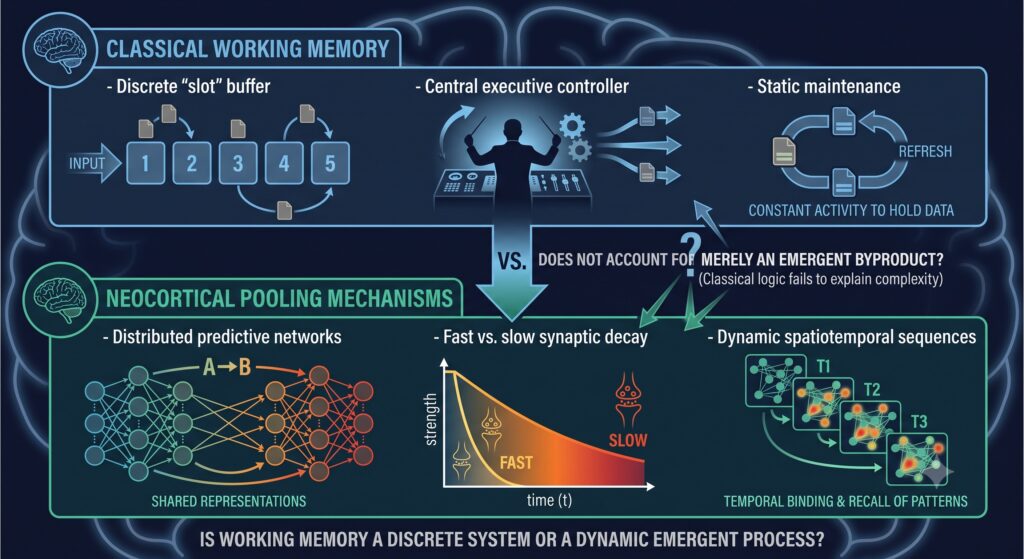
The battle for how we understand the brain is underway: Is working memory a discrete, structural system, or is it merely an emergent byproduct of spatial and temporal pooling?
1. The Classical Paradigm: Working Memory as a Workspace
The traditional framework—most famously formulated by Baddeley and Hitch (1974)—models working memory as a central executive coordinating sub-components: the phonological loop, the visuospatial sketchpad, and the episodic buffer.
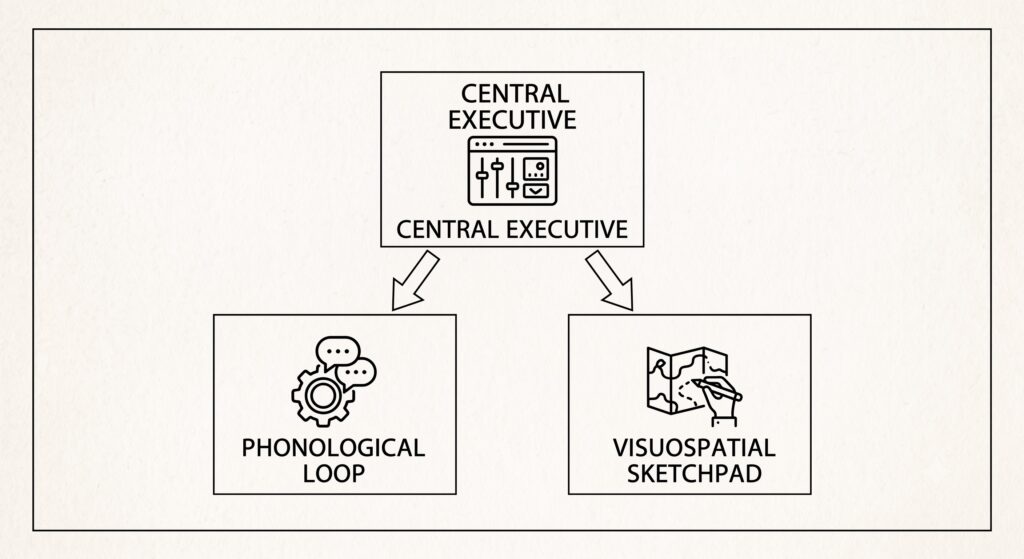
In this view, working memory is capacity-limited (the classic $7 \pm 2$ items or 3–4 chunks). It operates like RAM in a computer: data is loaded into an active buffer, manipulated by executive control in the prefrontal cortex, and either dropped or consolidated into long-term storage.
While this model successfully describes behavioral limits, it fails to account for how the neocortex actually computes.
2. The Computational Paradigm: Spatial and Temporal Pooling
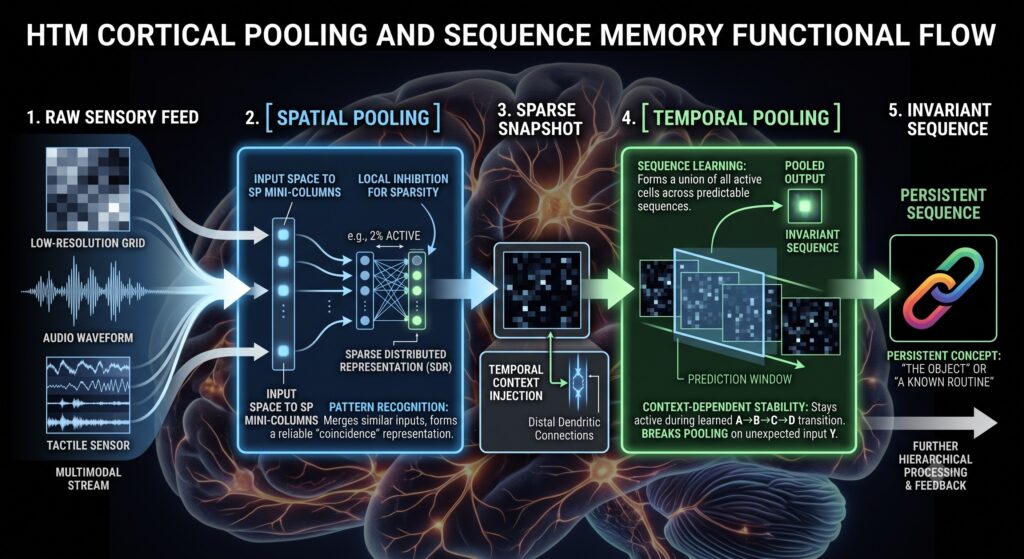
Computational neuroscience and Hierarchical Temporal Memory (HTM) models (Hawkins & Ahmad, 2016) show that the neocortex consists of uniform cortical columns running the same core algorithm across sensory, motor, and high-level association areas. That algorithm relies on two operations: Spatial Pooling and Temporal Pooling.
Spatial Pooling (SP): Compressing the Snapshot
The neocortex receives millions of noisy inputs at any given millisecond. Spatial pooling is the process of mapping these high-dimensional inputs onto a sparse, distributed representation (SDR).
- It identifies co-active input neurons and activates a stable, small subset of cortical minicolumns.
- It strips away noise while preserving essential features, producing a spatial "snapshot" of the environment regardless of minor background variations.
Temporal Pooling (TP): Building the Continuous Flow
Spatial snapshots alone are useless without context; a single frame of a film conveys no motion or narrative. Temporal pooling aggregates sequences of spatial patterns over time into continuous, invariant representations.
- Cells within a cortical column learn to predict which feedforward inputs will follow based on prior patterns.
- When a learned sequence occurs, a subset of neurons stays active continuously across multiple pattern transitions.
- This turns discrete spatial snapshots into a smooth, predicted timeline—creating an internal context window that spans past, present, and immediate future.
3. Why Working Memory "Does Not Stack Up"
When measured against the neurobiology of SP and TP, classical working memory falls short as an explanatory model for three main reasons:
I. Maintenance vs. Active Prediction
Classical working memory assumes information is actively held in a temporary store through persistent neuronal firing.
In contrast, temporal pooling demonstrates that "holding something in mind" is actually a predictive sequence unfolding over time. The neocortex does not store static items; it generates dynamic trajectories along white matter pathways like the Superior Longitudinal Fasciculus (SLF) and frontostriatal loops. What we call "working memory duration" is simply the reach of a temporal pooler's predictive horizon.
II. The Local Storage Fallacy
Working memory models often treat prefrontal circuits as a central "buffer." However, neuroimaging shows that working memory representations are distributed across the exact same sensory and association networks that process real-time input (Postle, 2006).
Spatial and temporal pooling explain why: the prefrontal cortex isn't a isolated storage drive—it sits at the top of a processing hierarchy. High-level cortical regions simply perform temporal pooling over longer time scales (seconds to hours), while lower sensory regions perform temporal pooling over shorter time scales (milliseconds).
III. The Failure to Explain "Time Blindness" and Executive Dysfunction
When working memory is viewed as a simple container, conditions like ADHD and Autism Spectrum Disorder (ASD) are described as having "low capacity." This fails to explain why individuals can hyperfocus on complex systems for hours (demonstrating immense dynamic capacity) yet miss broad deadlines or struggle with multi-step routines.
Looking through the lens of pooling clarifies the issue:
- In ADHD, reduced white matter microstructural integrity in frontostriatal and cerebellar pathways causes timing delays, disrupting the "metronome ticks" required for temporal pooling. The temporal pooler cannot bridge pattern transitions, causing the timeline to collapse into a binary state: NOW vs. NOT NOW.
- In ASD, intense local hyper-connectivity causes spatial poolers to favor hyper-detailed local features, overwhelming the global context needed for higher-level temporal pooling.
4. The Unseen War: The Paradigm Shift
The conflict between working memory theory and spatiotemporal pooling is not purely academic. It dictates how we design classrooms, evaluate neurodivergent minds, and build artificial intelligence.
The Structural Reality: Working memory is not a distinct organ or a set of finite capacity "slots" in the prefrontal cortex. It is the real-time operational window produced when spatial pooling (pattern identification) and temporal pooling (sequence prediction) operate smoothly across synchronized white matter networks.
When long-range white matter tracts fail to transmit synchronized signals across cortical nodes, spatial snapshots become noisy and temporal predictions fragment. The resulting executive challenges are not caused by a "full" or "weak" working memory, but by a breakdown in the brain's spatial and temporal pooling algorithms.
References
- Baddeley, A. D., & Hitch, G. (1974). Working Memory. In The Psychology of Learning and Motivation (Vol. 8, pp. 47-89). Academic Press.
- Hawkins, J., & Ahmad, S. (2016). Why Neurons Have Thousands of Synapses, a Theory of Sequence Memory in Neocortex. Frontiers in Neural Circuits, 10, 23.
- Postle, B. R. (2006). Working memory as an emergent property of the mind and brain. Neuroscience, 139(1), 23-38.
- Fuster, J. M. (2015). The Prefrontal Cortex (5th ed.). Academic Press.
- Cui, Y., Ahmad, S., & Hawkins, J. (2016). The HTM Spatial Pooler: a neocortical algorithm for online sparse distributed coding. Frontiers in Computational Neuroscience, 10, 137.
- Faroqi-Shah, Y., & Gehman, M. (2021). The neural substrates of temporal processing: A review of neuroimaging evidence. Brain and Cognition, 147, 105655.