
What an ADHD Specialist Could Be—and Why Executive-Function Coaching Alone Falls Short
I recently applied for an ADHD Specialist position at a private K–12 school built around serious student-athletes. The educational model immediately interested me. Students complete academics during a compressed portion of the day, leaving substantial time for high-level athletic development with experienced coaches.
In some respects, this should be an extraordinary environment for ADHD students. The school has already rejected one of traditional education's most stubborn assumptions: that every child should perform optimally under essentially the same conditions.
Then I read the ADHD Specialist job description.
The specialist would help students with planning, organization, time management, task initiation and self-monitoring. There would be individual coaching, small groups, parent communication and collaboration with academic guides and athletic coaches.
There was one structural problem: the ADHD specialist would be 100 percent remote.
I applied anyway. But instead of simply explaining why I could perform the job as written, I told them what I thought the position needed to become. The specialist should have two interconnected responsibilities:
Mentor the ADHD student-athletes and coach the coaches.
I was almost certain of that because I had already watched pieces of that model work. Not in a private school serving competitive athletes, but with three students I mentored during the COVID hybrid year at a school serving a substantially different population.
The circumstances were different. The underlying ADHD tools were not.
That experience is why I believe this kind of school has an opportunity to create something much more ambitious than remote executive-function coaching. It is also why I think the position, as presently conceived, provides a weak scaffoldfor the students it promises to support.
Starting With the Wrong Question
There is an appealing logic behind executive-function coaching. A student has difficulty planning, so teach planning. The student struggles with organization, so build an organizational system. Task initiation is weak, so teach initiation strategies. Time management is poor, so provide tools for managing time.
Teach the skill. Practice the skill. Reinforce the behavior. Expect transfer.
Dr. William Dodson has spent years challenging that way of conceptualizing ADHD. In a talk I have returned to repeatedly, he points to the MTA study and subsequent research on non-medication interventions and makes a deliberately provocative argument: attempts to behaviorally remediate the underlying characteristics of ADHD have repeatedly failed to produce the expected change.
That is not simply a philosophical disagreement about how we should describe ADHD. The studies he is discussing did not produce the outcomes those intervention models predicted.
In the MTA study, intensive behavioral management did not improve core ADHD symptom outcomes beyond carefully managed medication treatment. Subsequent efforts involving working-memory training, neurofeedback, CBT and other non-medication approaches have likewise struggled to demonstrate reliable improvement in the underlying ADHD characteristics or meaningful transfer into everyday functioning.
That finding needs an important qualification.
Dodson is not saying that CBT is useless for people with ADHD. That distinction became personally important to me because Dodson himself recommended trauma-informed CBT to me with a therapist who understood ADHD and Rejection Sensitive Dysphoria. The target wasn't ADHD itself. The target was acquired psychological baggage—trauma, anxiety, depression, shame and patterns of negative self-talk.
Those are different treatment targets.
ADHD can increase the probability of experiences from which some of that baggage develops. Repeated failure, criticism, emotional dysregulation, rejection and inconsistency can leave scars. CBT can be enormously useful in addressing what accumulated.
But unpacking the suitcase is not the same thing as changing the nervous system carrying it.
That distinction matters because the question isn't whether an ADHD student can benefit from strategies. Of course they can. The question is whether teaching those strategies—and particularly teaching them remotely—should be the foundation of the scaffold.
The intervention literature forces a harder question:
Teaching an ADHD student how to perform an executive function is not the same thing as making that function reliably accessible when the student needs it.
Dodson's framework leads somewhere much more interesting. Instead of studying only what people with ADHD cannot consistently do, look closely at the circumstances under which they suddenly can.
Study the Exception
Look at the same ADHD student in two different environments.
During academics, the student can't initiate an assignment. During athletic training, warm-up begins without prompting. In one environment the student forgets instructions; in another, a complicated tactical system is remembered almost effortlessly. The student supposedly lacks persistence, then repeats the same athletic movement two hundred times because a coach moved one foot three inches.
Planning appears, working memory appears, self-monitoring appears, persistence appears.
Same kid. Same nervous system.
Different conditions.
People with ADHD can be, in Dodson's memorable formulation, inconsistent in a very consistent way.
That inconsistency shouldn't merely frustrate us. It is data.
Instead of asking only Which executive function is deficient?, ask a second question:
Why does the supposedly deficient executive function keep appearing over here?
That question completely changes what an ADHD Specialist in this kind of environment could become, because the school already possesses something most schools would love to have.
The exception may be happening every afternoon.
The Athletic Program as Laboratory
Imagine being the ADHD specialist in that environment. In the morning you see a student who supposedly can't sustain attention. In the afternoon, coaches watch that same student analyze tiny mechanical differences for an hour. The kid who can't start an assignment may initiate training without being asked. The student who loses track of classroom instructions may retain an elaborate tactical system. The athlete who shuts down after one kind of correction may actively solicit another coach's feedback twenty times.
Those aren't contradictions to dismiss as ADHD inconsistency.
They are clues.
What changed? Interest, challenge, novelty and urgency? Movement, competition, immediate feedback and relationship? Probably not one variable, and probably not the same combination for every student.
That is precisely why somebody needs to study the individual kid.
The school already has experienced coaches standing beside these students while their ADHD nervous systems may be displaying planning, persistence, working memory and self-monitoring at a remarkably high level.
Those coaches aren't peripheral to the ADHD intervention.
They may possess some of its most valuable observational data.
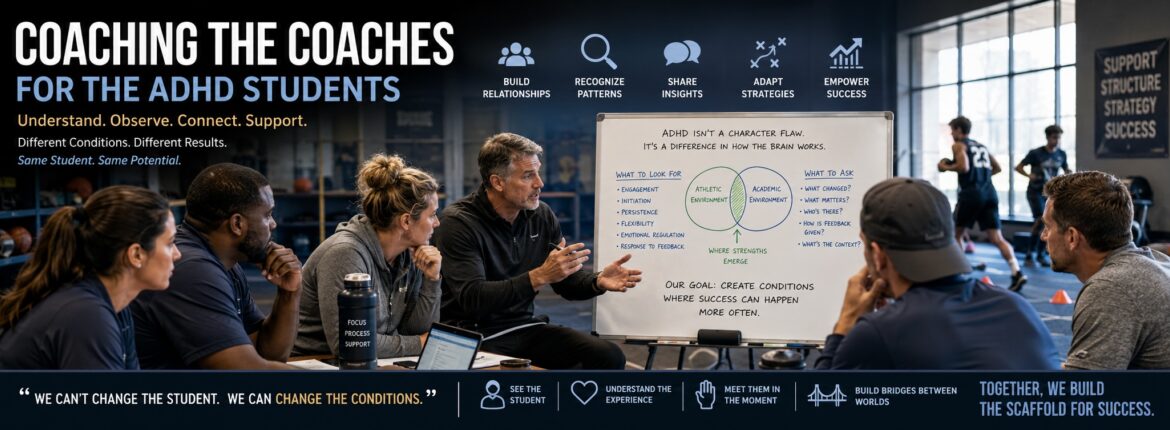
The ADHD specialist should be teaching them what to look for.
The Problem of Now
Something can be intellectually important to an ADHD student and remain functionally inaccessible because it is Not Now. A student can have an excellent conversation Tuesday afternoon about how to initiate an assignment Thursday morning.
Thursday arrives.
Now the student has to recognize that this is the situation discussed Tuesday, remember the strategy, retrieve its steps and initiate it despite having difficulty initiating. Then the student must monitor whether it is working, change it if necessary and later reconstruct the episode accurately enough to discuss it with the specialist.
Look at what the intervention is asking the student to supply: recognition, working memory, initiation and prospective memory; self-monitoring, emotional regulation, cognitive flexibility and sustained engagement.
In other words:
The scaffold is asking the kid to provide the scaffolding.
Athletic coaches would never design skill acquisition this way. Nobody teaches goalkeeper positioning exclusively by discussing mistakes several days later. The goalkeeper gets into the goal, the coach creates the situation, the keeper makes a decision, and the coach sees what happened and makes an adjustment.
Then another ball comes.
Situation → decision → consequence → adjustment → another attempt.
Cause and effect remain close enough together for the athlete to experience the connection.
Why would we abandon that principle when the performance problem becomes ADHD?
Coach the Coaches
None of this means the ADHD specialist must physically stand beside every student all day. It certainly doesn't mean tele-mentoring can't work. I think it can work extraordinarily well.
But a remote specialist needs a way to reach the student's Now.
That is why my proposed job was never simply mentor the students. The athletic coaches and academic guides have to become extensions of the specialist into the student's daily environment. They see the initiation stall while it is occurring, frustration becoming dysregulation, or correction suddenly landing as rejection. They also see the opposite—the moment the student's eyes light up, engagement locks in and supposedly missing functions suddenly become available.
If those adults understand what they're seeing, they can respond while cause and effect are still connected. Then they bring those observations back to the specialist.
Observe → intervene → consequence → report → interpret → adjust → repeat.
That is how a remote specialist stops being remote.
I know how much that matters because, before I ever applied for this position, I watched something remarkably similar emerge around three kids in a video classroom.
The Video Skunkworks
This happened during the COVID hybrid year. A highly regarded principal had left the school and taken a substantial portion of the faculty with her, and I ended up helping co-teach a video class.
I already knew two of the students who would eventually become my mentees. The mentoring itself began when I started setting aside one day each week for what became our little video skunkworks lab.
We weren't studying executive function.
We were making things.
An idea had to become a plan, the plan had to become a setup, and the setup had to survive contact with reality. Cameras misbehaved. Lighting looked awful. Ideas that seemed brilliant in our heads sometimes looked ridiculous on a monitor. Something failed, we figured out why, changed it and tried again.
Planning, initiation, working memory and persistence were happening alongside self-monitoring, emotional regulation, cognitive flexibility and problem solving.
I wasn't installing those functions.
The environment was giving the kids access to them.
There was another variable that became even more important.
Relationship.
Removing Judgment From the Equation
I had been reading Dodson's work on ADHD and Rejection Sensitive Dysphoria for roughly two years before I began mentoring these students. One lesson had become particularly important to me: the tone of judgment can be a land mine.
Sometimes it isn't the words. It's the sigh, the facial expression, the shift in voice, the We've already talked about this.
The adult thinks they are correcting behavior.
The kid experiences judgment.
Now the original academic problem can become secondary. Perceived rejection produces an emotional response, the response feeds negative self-talk, and negative self-talk feeds shame. We can end up demanding executive function from a brain whose available bandwidth is being consumed by the emotional consequences of how we demanded executive function.
So the first promise in my mentoring approach became simple:
I will never use a tone of judgment against you.
That didn't mean there were no standards. I corrected them, demanded better work and told them when something wasn't good enough. But I separated judgment of the work from judgment of the kid.
The students had to discover that distinction experientially. They screwed up and the relationship remained. They failed and the relationship remained. They brought problems from home into the room and the relationship remained.
Eventually I could say, This isn't your best. Do it again, without the student hearing, You are a disappointment.
That relationship wasn't something nice surrounding the intervention.
It was part of the intervention.
Finding the Exception
My mentoring approach began with an almost embarrassingly simple question:
Where does this kid's self-esteem still live?
Not where adults wanted it to live. Not where a transcript suggested it should live. Not where an executive-function inventory identified a deficit.
Where was the kid already experiencing competence?
For one student, the answer was film.
They had developed an almost encyclopedic knowledge of filmmaking through years of deep-diving into DVD extras. That could easily have been dismissed as another ADHD rabbit hole—an interesting obsession disconnected from the academic problems everyone else could see.
I saw something different.
Here were sustained attention, memory, curiosity and persistence. The very functions that seemed unreliable elsewhere were operating beautifully when film was involved.
There it was. The place where self-esteem still lived.
So I didn't begin by trying to repair what wasn't working. I built outward from what was.
I gave the student my third camera, backup lighting, a green screen, a reflector and my backup lavalier microphone that plugged into an iPhone. Then I handed them the paperwork for their legal guardian to sign so they could check out a MacBook Pro loaded with Final Cut Pro and Logic.
Suddenly years of accumulated film knowledge had somewhere to go. The student who had spent years studying how movies were made now had a camera, lights, sound equipment, professional editing software and a machine powerful enough to put it all together.
Filmmaking wasn't Someday anymore. It was Now.
An idea had to become a shot, the shot had to become footage, and the footage had to become an edit. Sound had to work with picture. Something inevitably looked or sounded wrong, which meant diagnosing the problem, changing something and trying again.
Planning, initiation, working memory, persistence and self-monitoring weren't items on an executive-function worksheet anymore.
They were what stood between this student and the movie in their head.
The executive functions had acquired immediate relevance because they had become subordinate to something the student desperately wanted to do.
Hyperfocus Against the Noise
The equipment alone wasn't the intervention.
This student carried substantial trauma-related shame and negative self-talk. When those loops became dominant, they could consume enormous psychological bandwidth.
I began using something ADHD already supplied.
Hyperfocus.
The goal wasn't to cure trauma with filmmaking or pretend an RSD episode had disappeared because somebody picked up a camera. The goal was narrower: give the brain something powerful enough to compete for the foreground.
When film captured attention strongly enough, the shame loop could temporarily lose its monopoly. The internal conversation could move away from failure, rejection and worthlessness and toward an immediate problem that mattered.
How do I light this? Why does that shot look wrong? How do I fix it?
And perhaps most importantly:
I know this.
The filmmaking did not erase the trauma. Hyperfocus did not cure it. What appeared to happen was that trauma-related shame and negative self-talk stopped ruling every moment of the day, then every day of the week, and eventually much of those six and a half weeks.
That gave competence room to become experiential.
Then something happened none of us expected.
An Unexpected Number
A principal and I suggested that the student take the SAT again.
Six and a half weeks later, the student scored 1100 on the second sitting. The improvement in math raised the SAT superscore from 950 to 1150.
During those six and a half weeks, I had not tutored the student in math, reading, writing or any other academic subject. There was no SAT-prep curriculum and no academic remediation program.
We weren't working on what the student knew.
We were changing the conditions under which the student could access what was already there.
I discussed the result with Dr. Joseph Llinás, who had been a trusted clinical sounding board as I worked with these kids. His reaction stayed with me: he told me he had never encountered anything close to a 950-to-1150 superscore leap.
That doesn't turn one student's experience into a controlled study, and it doesn't establish that mentoring caused 200 SAT points. Retesting effects, ordinary score variation and uncontrolled variables remain. Observation and causation are not the same thing.
But calling the result ordinary would miss the point just as badly. A 100-point retest increase is already uncommon; this student's second sitting rose 150 points, while the superscore rose 200.
The student hadn't spent six and a half weeks learning more algebra or drilling reading passages. The student had spent six and a half weeks experiencing what happened when trauma-related shame and negative self-talk stopped owning so much of the foreground.
Film had become real. Competence had become experiential. A future identity that once belonged to Someday had moved toward Now.
Then the SAT gave us a number.
Maybe the problem wasn't that there wasn't enough ability in there.
Maybe too much noise had been standing in front of it.
The Trajectory
The SAT score matters because it gave us an unusually visible marker, but it wasn't the destination.
After graduation, the student attended a year-long intensive filmmaking program. After the spring semester, the students had written scripts from which one would be selected for production during the summer as the group's graduation capstone.
This student's script was selected.
When I read it, I was stunned by how good it was. It was partly autobiographical, emotionally dark and ended ambiguously rather than tying everything into a comfortable bow.
Another opportunity appeared.
Years earlier, I had asked a simple question: What's your favorite horror movie?
The answer was A Nightmare on Elm Street Part 2.
That caught me off guard. Part Two? Why that one?
They loved its dark humor.
I happened to know that the film's director, Jack Sholder, had later helped establish a university film program. Through a retired cinematography professor, and with permission, I had previously helped establish a connection between the student and Sholder.
The student had floated.
Now there was a serious screenplay.
I asked for the PDF so I could send it to Sholder. Then I had a better idea.
Why don't you send it to him?
No.
Pure terrified fanboy.
I understood completely.
So the scaffold stayed up for one more bridge.
I sent it.
And Jack Sholder read the damn thing.
He didn't send back a celebrity atta-boy. He treated the student like an emerging filmmaker. He discussed cinematic construction, pacing and framing. He noticed the ambiguity of the ending. He praised the clean writing while correcting screenplay formatting and explaining the professional importance of presentation.
Then he wrote:
“You have a lot of talent.”
And offered further guidance.
That moment matters, but not because a Hollywood director wandered into the story.
Nobody in this chain created the student's talent. Not me, not the principal, not Dr. Llinás, not Dr. Dodson, not Jack Sholder.
The talent was already there.
What the adults could do was help create an environment in which it had somewhere to go.
DVD extras became knowledge. Knowledge met equipment. Equipment created opportunities for competence. Competence made a future identity plausible.
That identity survived long enough to become film school, a selected capstone script and eventually a professional filmmaker reading the work seriously enough to say:
You have talent. Keep going.
The SAT wasn't the trajectory.
Becoming a filmmaker was the trajectory.
An Ecosystem, Not a Guru
It would be easy to tell this story badly and make the mentor the hero.
That would completely miss the lesson.
The kids did the hard part.
My role was to know them well enough to recognize where engagement and self-esteem still lived, understand enough ADHD to recognize what I was seeing, and create opportunities when I saw openings. Sometimes that meant putting equipment into a student's hands. Sometimes it meant using high-interest engagement to help interrupt a shame loop. Sometimes it meant maintaining expectations without introducing judgment. Sometimes it meant recognizing that the next useful pass might be an SAT retake or an email to a filmmaker the student admired.
But I wasn't making those judgments in a vacuum.
Dodson's work had helped shape how I understood ADHD, RSD, engagement and the limitations of deficit-centered thinking. Dr. Joseph Llinás was a trusted clinical sounding board, bringing expertise I did not pretend to possess. A principal saw an academic opening and joined me in suggesting another SAT attempt. Other educators became part of the trajectory. Eventually Sholder supplied independent professional feedback none of us could manufacture.
Different adults saw different parts of the kid.
Good ADHD support is an ecosystem, not a guru.
The mentor knows the student. The clinician understands mechanisms and conditions the mentor should never pretend to diagnose or treat. The academic guide sees learning. The athletic coach sees the same nervous system operating under entirely different performance conditions. Parents and guardians possess another perspective.
No one adult has the whole picture.
But somebody needs to connect it.
What This Position Could Be
That is why I was so frustrated by the ADHD Specialist job description.
This kind of school already possesses most of the ingredients for something exceptional. It has ADHD student-athletes engaged in activities they care deeply about, experienced coaches watching those athletes perform every day, academic guides seeing the same students under very different cognitive demands, parents who know another part of the child, and technology capable of connecting all of them.
Then it proposes putting the ADHD expert remotely in the middle and concentrating much of the job on executive-function coaching.
Why stop there?
The ADHD specialist could be the person who sees the whole floor.
Meet the students face-to-face first. Watch them train and learn. Find the exceptions. Establish the relationships. Discover where self-esteem and competence already live.
Then coach the coaches.
Teach athletic mentors and academic guides enough about ADHD, engagement, emotional dysregulation and rejection sensitivity to recognize meaningful patterns while they are happening. Give them a shared language for communicating those observations. Use tele-mentoring to maintain the student's relationship with the specialist and continually adjust the scaffold.
The specialist does not need to personally intervene in every moment. The point is to create a network of adults who understand enough of the student's individual pattern that support remains available when ADHD actually happens.
Student → mentor → coach/guide → observation → mentor → adjustment → student.
That isn't administrative collaboration.
That is the intervention.
The specialist isn't the hero, the therapist or the remote keeper of the executive-function checklist. The specialist is closer to an elite point guard: see the whole floor, know the players, recognize where the advantage is developing, get the ball to the right person at the right moment.
Then let the kid make the shot.
The Contradiction Already on the Field
This is what makes the existing design so puzzling.
The school already understands this philosophy when the subject is athletics.
Nobody hires a great soccer coach and expects the coach to improve a player's positioning primarily through a scheduled video conference. Nobody teaches pitching mechanics by discussing last Tuesday's pitches on Friday. Nobody expects a tennis player to develop a serve because somebody explained the biomechanics clearly enough.
Coach gets on the field, watches the performance and makes the adjustment. The athlete tries again while the previous attempt is still cognitively and emotionally available.
Performance → feedback → micro-adjustment → performance.
The athletic model is built around proximity to performance.
Then ADHD enters the picture, and suddenly we become comfortable placing specialized expertise at a distance while emphasizing strategies whose greatest challenge is getting them to transfer into the precise moment when the student needs them.
That is the contradiction.
The solution isn't to abandon remote support.
The solution is to build the connections that make remote support work.
Get the specialist on campus enough to know the kids. Let the specialist study where their brains already work. Build relationships capable of carrying later tele-mentoring. Train the coaches and academic guides to become extensions of that expertise into the student's Now.
Then use technology aggressively.
Remote isn't the problem.
Isolation is.
The Kid Inside the Athlete
The original position could certainly help some students as written. Executive-function strategies have uses. Organization matters. Planning matters. Students need tools.
But decades of attempts to behaviorally remediate core ADHD functioning have produced a stubborn result: the interventions Dodson is discussing failed to produce the expected improvement in core ADHD functioning. The problem is not that they worked beautifully but could be improved. The transfer those models predicted did not materialize.
That doesn't make behavioral strategies useless. It establishes a more specific—and for this position, much more important—point:
Teaching an ADHD student how to perform an executive function is not the same thing as making that function reliably accessible when the student needs it.
Building another layer of remote executive-function coaching around the assumption that enough strategy instruction will solve that transfer problem ignores the very evidence that should be shaping the position.
Especially in a school where the same students spend part of every day in an environment that may already be revealing the alternative.
One environment may produce paralysis while another produces extraordinary performance.
Don't just remediate the paralysis.
Study the extraordinary performance.
Find out what changes. Relationship, interest, challenge and immediate feedback; competition, movement, emotional salience and the particular adult standing beside the student.
Probably some idiosyncratic combination belonging to that kid.
That is what my experience with three students taught me. Not that I possess a magical mentoring formula. Not that cameras cure ADHD. Not that hyperfocus guarantees a 200-point SAT superscore increase.
It taught me to become suspicious whenever a kid described primarily by deficits suddenly becomes extraordinarily capable somewhere else.
Because then the most interesting question is no longer:
What ability is this kid missing?
It becomes:
Where is that ability already hiding in plain sight—and what changes when it appears?
Find that place. Understand the conditions surrounding it. Build a relationship with the student strong enough to explore it together. Then coach the adults who are physically present so they can recognize those same conditions—and the moments when they disappear.
Over time, the student begins recognizing the pattern too.
That is the destination.
Not permanent dependence on an ADHD specialist. Not endless executive-function appointments. Not another beautifully organized planner abandoned three weeks later.
The destination is a young person who gradually understands:
I know how my brain works. I know what gets in its way. I know what helps me get it back.
And this is why I find the proposed position so frustrating.
The school already knows how to do this.
It would never try to develop a serious athlete by placing the coach permanently on the other side of a screen and asking the athlete to remember Thursday what the coach explained Tuesday. Its athletic philosophy already recognizes that development happens through relationship, observation, immediate feedback, repeated adjustment and trusted adults who are close enough to see what happens next.
The school has already built that world for the athlete.
Now build it for the ADHD kid inside the athlete.
References
- MTA Cooperative Group. (1999). A 14-month randomized clinical trial of treatment strategies for attention-deficit/hyperactivity disorder. Archives of General Psychiatry, 56(12), 1073–1086. doi:10.1001/archpsyc.56.12.1073. The MTA randomized 579 children to medication management, intensive behavioral treatment, combined treatment, or community care. For core ADHD symptoms, combined treatment did not significantly outperform carefully managed medication alone, although combined treatment showed advantages on some non-ADHD and functional outcomes. (PubMed)
- Wells, K. C., Pelham, W. E., Kotkin, R. A., et al. (2000). Psychosocial treatment strategies in the MTA study: Rationale, methods, and critical issues in design and implementation. Journal of Abnormal Child Psychology, 28, 483–505. The MTA behavioral intervention was not a lightweight coaching program: it included intensive parent training, school interventions, and a child-focused summer treatment program. (PubMed)
- Jensen, P. S., Hinshaw, S. P., Swanson, J. M., et al. (2001). Findings from the NIMH Multimodal Treatment Study of ADHD (MTA): Implications and applications for primary care providers. Journal of Developmental & Behavioral Pediatrics, 22(1), 60–73. This review reports that medication management and combined treatment were substantially superior to behavioral treatment for core ADHD symptoms, while combined treatment offered smaller advantages in several broader functional domains. (PubMed)
- Sonuga-Barke, E. J. S., Brandeis, D., Cortese, S., et al. (2013). Nonpharmacological interventions for ADHD: Systematic review and meta-analyses of randomized controlled trials of dietary and psychological treatments. American Journal of Psychiatry, 170(3), 275–289. doi:10.1176/appi.ajp.2012.12070991. A major systematic review examining behavioral interventions, cognitive training, neurofeedback, dietary approaches, and other nonpharmacological treatments for ADHD. (PubMed)
- Cortese, S., Ferrin, M., Brandeis, D., et al. (2015). Cognitive training for attention-deficit/hyperactivity disorder: Meta-analysis of clinical and neuropsychological outcomes from randomized controlled trials. Journal of the American Academy of Child & Adolescent Psychiatry, 54(3), 164–174. doi:10.1016/j.jaac.2014.12.010. This meta-analysis is particularly relevant to the article's distinction between improving performance on trained cognitive tasks and demonstrating meaningful transfer to ADHD symptoms and everyday functioning. (PubMed)
- Cortese, S., Ferrin, M., Brandeis, D., et al. (2016). Neurofeedback for attention-deficit/hyperactivity disorder: Meta-analysis of clinical and neuropsychological outcomes from randomized controlled trials. Journal of the American Academy of Child & Adolescent Psychiatry, 55(6), 444–455. doi:10.1016/j.jaac.2016.03.007. This review examined whether neurofeedback produced reliable improvements in ADHD symptoms and neuropsychological functioning under increasingly rigorous assessment conditions. (PubMed)
- Sonuga-Barke, E. J. S., Brandeis, D., Holtmann, M., & Cortese, S. (2014). Computer-based cognitive training for ADHD: A review of current evidence. Child and Adolescent Psychiatric Clinics of North America, 23(4), 807–824. doi:10.1016/j.chc.2014.05.009. This review addresses the central problem raised in the article: cognitive abilities practiced during training do not necessarily generalize into durable improvement in real-world ADHD functioning. (PubMed)
- Dodson, W. W. (2023). Dr. Dodson ADHD Kids Need an Advocate [Video]. ADHD Flow. YouTube. This presentation informs the article's advocate framework and its emphasis on relationship, understanding the student's experience, and problem-solving alongside the child.
- Dodson, W. W. (2023). Dr. Dodson ADHD Summary [Video]. ADHD Flow. YouTube. Dodson describes ADHD through an interest-based rather than exclusively deficit-based framework, including the characteristic inconsistency between impaired engagement under some conditions and intense engagement or hyperfocus under others.
- Dodson, W. W. (2023). ADHD Background of Failure [Video]. ADHD Flow. YouTube. Relevant to the discussion of repeated criticism, perceived failure, shame, emotional dysregulation, and the importance of removing judgment from interactions with ADHD students.
- Dodson, W. W. (2023–2026). Personal correspondence and discussions with the author concerning ADHD, Rejection Sensitive Dysphoria, emotional dysregulation, the advocate model, engagement-based ADHD functioning, and trauma-informed psychotherapy. Personal communication.
- Llinás, J. (2021–2026). Clinical discussions and personal communications with the author concerning ADHD, ASD, emotional regulation, trauma, student mentoring, and observations arising from the author's work with neurodivergent adolescents. Personal communication.
Author's Note on the Student Case
The student experience described in this article is presented as a case observation, not as evidence that mentoring, filmmaking, or hyperfocus caused the SAT score increase. The student's second SAT sitting increased from approximately 950 to 1100, with the mathematics improvement producing a 1150 superscore. No subject tutoring or SAT preparation occurred during the approximately six-and-a-half-week period described. The subsequent filmmaking trajectory and professional feedback are included as longitudinal observations of the student's developing competence and identity, not as controlled evidence of treatment efficacy.
Student names and identifying institutional details have been withheld.