
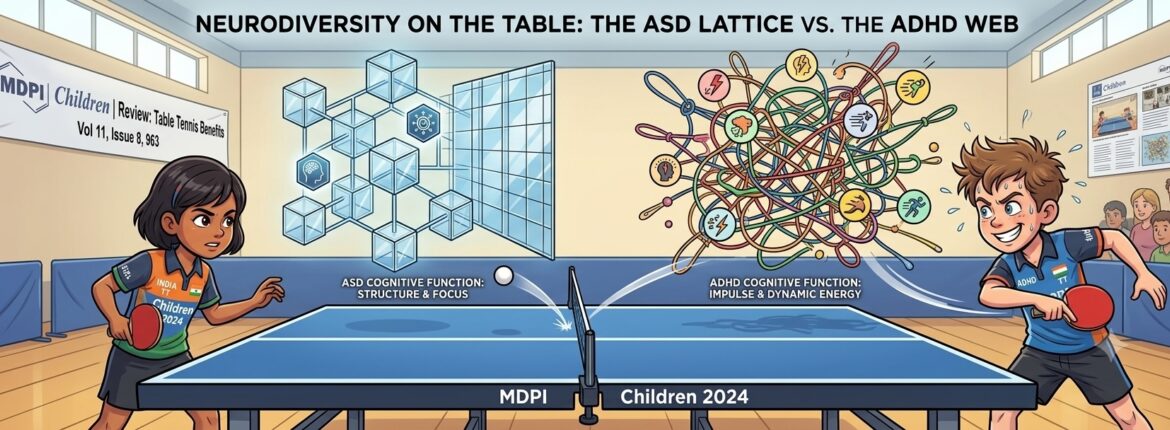
To understand why table tennis is such a powerful vehicle for saving a generation of children with ADHD and ASD, we have to look closely at the precise neurocognitive and sensorimotor demands of the sport. It isn't just physical exercise; it is a highly structured, fast-paced environment that perfectly aligns with the specific mechanics of the ADHD and ASD brain.
Here is an expansion on why table tennis fits these unique profiles so effectively:
⚡ The Perfect Match for the ADHD Brain
The ADHD brain is characterized by a baseline deficit in dopamine, leading to difficulties in maintaining attention, managing impulsivity, and regulating behavioral inhibition. Table tennis functions almost like a non-pharmacological regulator for this system.
- Continuous Novelty and High-Frequency Stimuli: Table tennis is famously known as "high-speed chess." The ball moves incredibly fast, requiring the brain to process rapid shifts in spin, speed, and trajectory every single second. This constant influx of micro-challenges provides the continuous novelty and engagement that the ADHD brain craves to maintain focus, preventing the boredom that typically triggers attention drift or hyperactivity.
- Forced Behavioral Inhibition: The review notes that table tennis significantly improves behavioral inhibition and executive function. Because a player must wait until the precise micro-second the ball bounds off the table to strike it, the sport inherently trains the brain to pause, calculate, and execute. It acts as an organic brake system for impulsivity.
- Bridging Gross and Fine Motor Deficits: Many children with ADHD struggle with subtle motor controls, including graphomotor (handwriting) functions. Table tennis uniquely bridges this gap. It requires large, explosive movements of the lower and upper body (gross motor) alongside highly calibrated, minute adjustments of the wrist and fingers to alter the paddle's angle (fine motor). This dual demand explains why the review highlights significant improvements in both handwriting capabilities and overall object control for children with ADHD.
🧩 The Perfect Match for the ASD Brain
The ASD brain often struggles with sensorimotor integration, executive functioning, and navigating unpredictable social environments. Table tennis provides a predictable, structured sanctuary that gently stretches these boundaries.
- Predictable Spatial Boundaries and Physics: For many children with ASD, traditional team sports can feel chaotic, overwhelming, and sensory-heavy. Table tennis strips away that chaos. The game takes place within a strictly defined geometric boundary—a rectangular table split by a net. The ball follows clear, immediate laws of physics. This structured visual field reduces sensory overload, providing a comforting predictability that allows the child to focus entirely on execution.
- Deep Sensorimotor Integration (The Feedback Loop): The review highlights that table tennis induces significant "haptic and motor gains" and enhances visual perception. When a child plays, they receive immediate, multimodal feedback: they see the ball, hear the distinct click on the paddle, and feel the vibration (haptic function) of the impact. This tight, instantaneous feedback loop helps the ASD brain map its own physical body in space, building stronger neural pathways for coordination that digital interfaces simply cannot replicate.
- Scaffolded, Non-Threatening Social Interaction: Social communication is a primary challenge in ASD. Table tennis serves as a perfect social bridge. It requires a partner, forcing a shared, cooperative rhythm and "joint attention" without requiring intense, prolonged eye contact or complex verbal navigation. By focusing on the shared object—the ball—children engage in a physical dialogue. This natural scaffolding explains the long-lasting residual social and behavioral improvements noted in the literature.
🏓 A True "Sensorimotor Scaffold"
Ultimately, table tennis succeeds because it is an active, embodied experience that demands total integration of the body and mind. Instead of forcing a neurodivergent child to sit still to learn focus, it uses high-speed physical play to build the very executive functions, motor skills, and social boundaries they need to thrive.