
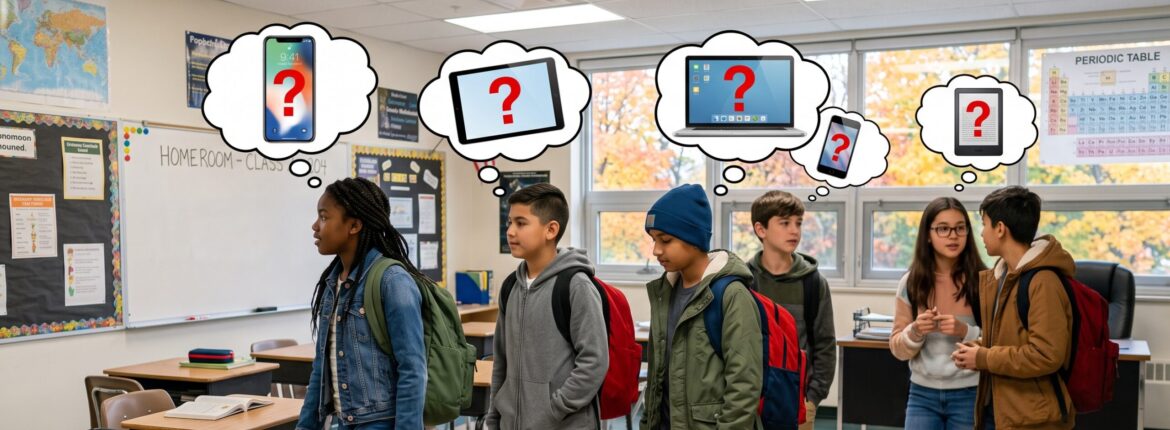
For over a decade, education has operated under a massive, unexamined assumption: that moving the physical world onto a digital pane of glass was a harmless upgrade. We swapped heavy textbooks for tablets, spatial exploration for tracking cursors, and the slow, linear friction of time for the instant gratification of a refresh button.
But as public schools have flooded classrooms with billions of dollars worth of individual laptops and tablets, a quiet crisis has emerged. Student performance has dipped, attention spans have shattered, and the essential cognitive architecture known as Executive Function (EF)—the ability to plan, focus, remember instructions, and balance multiple tasks—has eroded.
The core of the problem isn't just about "distraction" or online bullying. The problem is deeply mechanical. By confining a student’s physical and visual interaction to a flat screen, digital devices actively short-circuit the precise sensorimotor loops that the human brain uses to build executive function.
The Architecture of Space and Time
To understand how screens dismantle executive function, we have to look at how a developing brain builds it in the first place. Historically, human cognitive development relied on a fundamental evolutionary bridge: the brain repurposes its physical navigation systems to navigate time.
Physical World:  [Present Action] ───(Physical Friction & Time)───> [Future Consequence]
Digital Device:  [Present Action] ───(Instant Gratification)──────> [Immediate Reset]
When a child explores the physical world, their eyes are constantly engaged in saccadic movements—quick, simultaneous shifts between focal points as they scan depth, map boundaries, and calculate three-dimensional space. This spatial tracking triggers sensorimotor inference, meaning the brain must constantly predict what will happen next based on real-world geometry and movement.
This process links the hippocampus (the seat of spatial navigation, packed with place cells and grid cells) directly to the prefrontal cortex (the seat of EF).
When a child builds a physical structure, navigates a neighborhood, or physically organizes objects on a desk, they map a linear timeline through space. They experience the physical friction of cause and effect: "If I stack this block poorly, the tower collapses in ten seconds." This tactile, delayed feedback forces the prefrontal cortex to simulate future consequences. Spatial mapping dictates temporal mapping.
The Trapped Brain and the Infinite Present
When a device enters the equation, this entire neurological framework collapses. On an 11-inch screen, space is an illusion. There is no physical depth, no variable distance to track, and no kinetic boundaries. The saccadic eye movements required to map a real environment fall idle; the eyes lock onto a static, glowing rectangle while the app's software handles all the movement, transitions, and cuts for the user.
More critically, devices trap the brain in an "infinite present." Feedback loops on a device are instantaneous and frictionless. There is no delay between action and outcome. If an interface doesn't yield immediate results, a user swipes or refreshes.
Because the screen removes the temporal lag inherent to the physical world, the prefrontal cortex never has to generate an internal simulation of "what comes next." The neurological muscles required for foresight, long-term consequence planning, and impulse control downregulate. The app architect provides 100% of the cognitive scaffolding, leaving the user to merely react rather than plan.
The ADHD Exception: The High-Stakes Kitchen
While a flat screen numbs a neurotypical student's ability to map a quiet timeline, it completely paralyzes the ADHD brain. The ADHD experience is fundamentally different—it operates much like a head chef in a high-intensity kitchen during rush hour.
A chef doesn’t cook by quietly reflecting on a recipe card meant for next month. They operate optimally in a high-stimulus, sensory-rich environment where the stakes are immediate, physical, and unyielding. The ticket machine is printing, the pans are searing, and the environment demands complete, hands-on engagement right now.
Because the ADHD brain lacks baseline chemical arousal (dopamine), it cannot self-regulate inside a low-stimulation, abstract environment like a quiet lecture or a flat digital screen.
However, if a high-IQ ADHD student bypasses the digital landscape and enters a high-engagement, physical trade like welding, the entire neurological equation transforms.
ADHD Welding Loop: [High-Sensory Action] ───(Instant Physical Reality)───> [Immediate Viscous Consequence]
Welding requires an intense, hyper-focused visual and proprioceptive lock. The welder’s eyes are locked onto a molten puddle, tracking its fluid dynamics in real-time, while their hands make micro-adjustments against raw heat.
- If their hand moves a fraction of a millimeter too fast, the bead is ruined.
- If their angle is off, the slag traps.
- If they lose focus for a second, the material burns through.
The cause and effect are locked into an undeniable, instantaneous loop right in front of them. The risk, the intense physical feedback, and the tactile creation provide the exact dopamine surge required to kick-start the prefrontal cortex.
The ADHD welder learns planning, sequencing, and working memory not through abstract digital tasks, but through the immediate friction of the physical world. They learn to calculate weld sequences so the heat doesn't warp the steel; they practice impulse control because haste destroys hours of preparation. They build executive function perfectly—not by mapping abstract timelines, but by mastering the immediate physical consequence in front of them.
Recalibrating the Classroom: The Los Angeles Shift
Recognizing the steep toll of the digital experiment, the Los Angeles Unified School District (LAUSD)—the nation's second-largest public school system—passed a sweeping series of reforms designed to completely recalibrate classroom technology. Building on its recent campus cellphone ban, the LAUSD board enacted strict new limits on school-issued screens.
The policy completely eliminates classroom screen time for students from preschool through first grade, imposes strict daily caps for older elementary students, and establishes tight weekly limits for middle and high schools. Furthermore, student-led use of streaming platforms like YouTube and unapproved gaming sites is banned on district devices.
| Grade Level | New LAUSD Screen Time Rule | The Classroom Reality |
| Preschool – 1st Grade | 0 minutes per day | Complete elimination of district devices from daily classroom use. |
| 2nd – 3rd Grade | Max 20 minutes per day | Limited, teacher-directed work only (includes homework caps). |
| 4th – 5th Grade | Max 30 minutes per day | Short, highly supervised digital interactions. |
| Middle School | Max 6 hours per week | Spread across subjects; screen time restricted to specialized tasks. |
| High School | Max 10 hours per week | Strict limitations to prioritize teacher-led instruction and peer collaboration. |
"Our charge now is to recalibrate, evaluate the role of education technology in the classroom, and balance access to that technology with the kinds of instruction and interaction we know help students thrive." — Nick Melvoin, LAUSD Board Member
By actively shrinking the digital footprint and reclaiming the physical environment, moves like LAUSD’s will eventually give executive function back to neurotypical students organically, exactly as they have always developed it.
When you remove the flat, frictionless screen, you force the student's eyes back out into three-dimensional space. You force them to interact with physical materials, look their peers in the eye, navigate a room, and experience the natural, unyielding delays of linear time. The neurotypical brain will do what it has evolved to do for millennia: scan the physical environment, calculate real spatial distances, and use those precise spatial maps to rebuild its internal, long-term timeline of cause and effect.
The solution to the executive function crisis isn't a better app or an AI tutor. It is the restoration of the physical world.