
We are currently living through what can only be described as a social media educational apocalypse. Information has never been more abundant, yet true synthesis has never been rarer. Algorithms have optimized for attention rather than retention, shifting the modern intellectual landscape toward a fragmented state where deep focus is replaced by transactional, bite-sized consumption.
In this landscape, our traditional, reductionist educational systems are failing. They treat learning like an assembly line of isolated subjects—math in one box, history in another—leaving students unequipped to navigate an interconnected world.
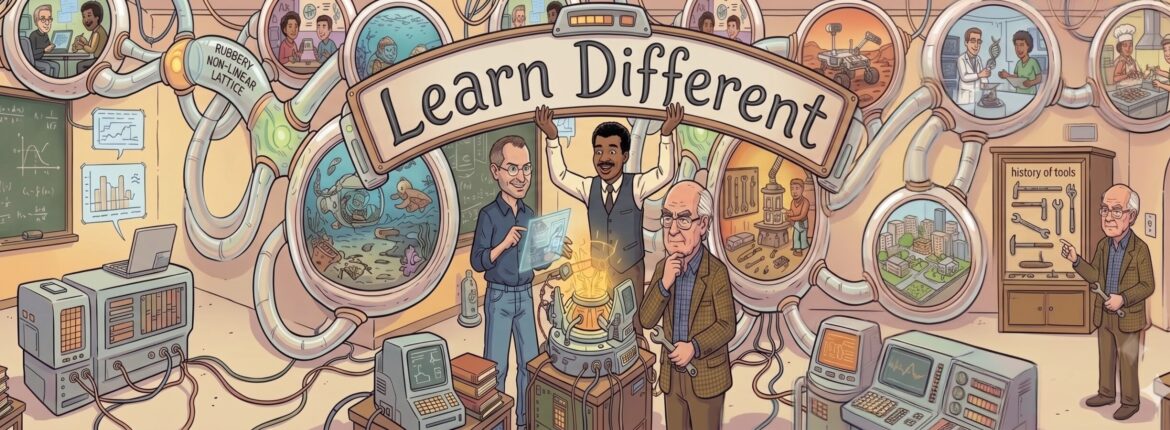
To rebuild, we don't need new software or flashier classrooms. We need to return to a fundamental, human-centric philosophy. By looking at the overlapping worldviews of three profound thinkers—visionary technologist Steve Jobs, astrophysicist and communicator Neil deGrasse Tyson, and science historian James Burke—we find a precise, actionable roadmap for the future of education.
1. Steve Jobs: The Primacy of the Proactive Guide
As the man who arguably did more to put computers into classrooms than anyone else in the late 20th century, Steve Jobs held a surprisingly grounded view of technology's limits in learning. He was openly skeptical of the idea that a networked world could act as a substitute for human teaching.
Jobs famously pointed out that computers are fundamentally reactive, not proactive. They are tools that wait for a command; they are not agents. What a developing mind requires is a proactive guide—someone who can spot latent potential, inject course correction, and spark genuine wonder.
"The most important thing is another person. Another person that incites your curiosity, that guides your curiosity, that feeds your curiosity. Machines cannot do that in the same way people can." — Steve Jobs
Jobs believed that providing equal opportunity in society hinges entirely on exceptional education. For him, a great teacher doesn't act as a passive digital assistant; they are an emotional and intellectual catalyst.
2. The Power of Intrinsic Reigniting: The Story of Mrs. Hill
To understand exactly how this proactive guidance works in practice, we only have to look at Jobs’ own life and his encounter with a legendary fourth-grade teacher named Mrs. Hill.
As a young boy, Jobs possessed an unruly energy that could have easily led him down a destructive path—he later admitted he was "100% sure" he would have ended up in jail without intervention. Seeing a brilliant but misbehaved child, the school principal tried to separate him from bad influences, throwing him into Mrs. Hill's advanced fourth-grade class.
Mrs. Hill didn't rely on standard disciplinary actions or hands-off curriculums. She watched young Steve closely for two weeks, mapped his "receptors," and then met him exactly where his elementary-school desires were. She explicitly bribed him with a giant lollipop and five dollars to complete a math workbook on his own.
"She basically bribed me back into learning with candy and money. And what was really remarkable was that before very long, I had such a respect for her that it sort of reignited my desire to learn." — Steve Jobs
Once that spark was lit, the transactional bribes gave way to deep, intrinsic wonder. She didn't give him worksheets; she gave him kits to make cameras, leading him to grind his own lenses. Jobs noted that he learned more academically in that single year than any other year in his life. A single, talented human being saw the architecture of his mind and altered the trajectory of human technology forever.
3. Neil deGrasse Tyson: Navigating the Learner's Receptors
If Jobs establishes who must lead the learning through real-life examples like Mrs. Hill, Neil deGrasse Tyson defines howthat leader must operate on a broader scale. Tyson views the role of the educator not as a commander demanding that students climb up to their level, but as an explorer willing to meet students exactly where they stand.
To truly teach, an educator must map out and navigate the unique "receptors for learning" within each individual. This means deeply understanding the student's background, belief systems, and existing framework of the world—even when those frameworks completely contradict the educator’s own views.
Tyson famously details how he spends years reading literature from entirely different paradigms—ranging from religious tracts to conspiracy theories—not to adopt them, but to comprehend the architecture of the minds he is trying to reach. Education is a deeply empathetic contract: you cannot light a fire of curiosity in a student if you don't know what kind of fuel their mind runs on.
4. James Burke: The Web of Interdisciplinary Connections
Where Jobs focuses on the human guide and Tyson focuses on empathy for the learner, James Burke provides the structural blueprint for what we should actually be learning.
For decades, Burke has critiqued the industrial, reductionist model of school, which forces students to become experts in highly specialized fields—learning "more and more about less and less." This approach creates an illusion that discoveries happen in a vacuum. In reality, history, science, art, and technology are part of a deeply interconnected, non-linear ecosystem.
Burke’s philosophy highlights that true intelligence isn’t found in memorizing data or executing linear logic. Instead, it lies in the ability to make imaginative, lateral links across disciplines. In a world where raw data is a cheap commodity, the premium value shifts entirely to context, meaning, and pattern recognition.
The Post-Apocalypse Blueprint
When we fuse these three philosophies together, the blueprint for a resilient, post-social media education system becomes remarkably clear:
| Pillar | Focus | The Shift Needed |
| The Human Catalyst | Relational Guidance | Moving from reactive digital tools and screen-time learning back to deeply human, proactive mentorship (The Mrs. Hill Model). |
| Empathetic Tailoring | Receptor Mapping | Abandoning rigid, one-size-fits-all standardized curriculums to actively meet students inside their unique worldviews. |
| Networked Thinking | Interdisciplinary Context | Swapping hyper-specialized, isolated subjects for a rubbery lattice-based learning model that emphasizes how ideas interconnect. |
True learning is an active, human-led expedition driven by curiosity and anchored in context. By stepping away from the fragmented distraction of algorithmic feeds and leaning into proactive guidance, empathetic communication, and connected thinking, we can build an educational framework that doesn't just survive the digital age—but masters it.
For a deeper look into the practical magic of great teaching, you can watch the historical clips of Steve Jobs on Technology and Education to see why machines fall short, or hear the deeply personal story of Steve Jobs and One Special Teacher detailing how a fourth-grade educator saved him from a path toward destruction.