
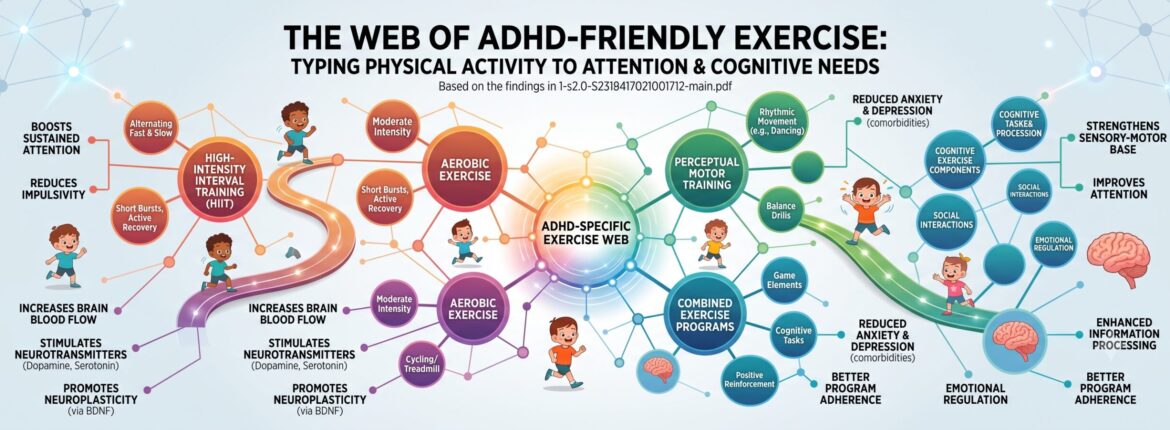
This review article examines the role of physical exercise as an adjunctive, non-drug treatment for children and adolescents with Attention Deficit Hyperactivity Disorder (ADHD) . It synthesizes how both brief, single sessions (acute exercise) and regular, long-term programs (chronic exercise) impact the neurophysiology and cognitive functions of children dealing with the disorder .
Key Highlights & Synthesis
1. Neurophysiological Impacts
Children with ADHD often present with structural and functional central nervous system abnormalities, specifically dysfunction in frontostriatal circuits and an insufficiency of neurotransmitters like dopamine and norepinephrine .
- Neurotransmitter & Blood Flow Boost: Moderate-to-high intensity aerobic exercise helps stimulate the synthesis of essential neurotransmitters like dopamine and serotonin while expanding blood flow and circulation to the brain .
- Promoting Neuroplasticity: Higher-intensity efforts generate peripheral lactate, which triggers the secretion of Brain-Derived Neurotrophic Factor (BDNF) . BDNF is crucial for neural growth, synaptic connections, and overall neuroplasticity .
2. Cognitive & Behavioral Improvements
The article notes that exercise yields immediate benefits that accumulate over time to drive meaningful cognitive shifts .
- Executive Function & Inhibitory Control: Both short and long-term exercise protocols show significant improvements in core executive functions, most notably inhibitory control and cognitive elasticity .
- The 60-Minute Window: Evidence indicates that a single bout of moderate-intensity aerobic exercise can improve conflict detection and response accuracy for up to 60 minutes post-exercise, offering a strategic window for focused classroom learning .
- Greatest Benefit for Lower Baselines: Electroencephalography (EEG) data shows that children with the lowest baseline inhibitory control experience the most profound immediate cognitive boosts from single-bout exercises .
- Comorbidities: Tailored physical activity also helps reduce symptoms associated with frequent ADHD comorbidities, such as emotional dysregulation, poor sleep, and Tourette syndrome (though high-intensity workouts must be monitored as they can occasionally exacerbate tics) .
3. Recommended Exercise Design
Because children with ADHD frequently struggle with lower motivation, impatience, and low frustration tolerance, standard repetitive workouts may fail to engage them . The review outlines specific design criteria:
| Exercise Type | Training Parameters & Mechanisms | Benefits Provided |
| Aerobic Interval Training (HIIT) | * Alternating short bursts of high effort ( * Total duration of ~20 minutes . | * Maximizes engagement . * Significantly increases sustained attention and decreases impulsivity . |
| Perceptual Motor Training | * Rhythmic movements, dancing, and balance drills . * Targets vestibular, tactile, and proprioceptive systems . | * Organizes sensory information in the central nervous system . * Strengthens the baseline sensorimotor system to support focus . |
| Combined & Gamified Programs | * Blending interval training with cognitive tasks, games, and positive reinforcement . | * Boosts adherence and completion rates . * Drives complex information-processing capacity . |
Conclusion
The article concludes that structured physical exercise acts as a highly effective, stable, and low-cost tool with zero side effects . When compared to other non-pharmacological interventions (such as vitamin supplements or basic cognitive behavioral therapy), systematic physical training demonstrates the most reliable impact on reducing attention deficits . The authors advocate for early integration of tailored, high-intensity, and sensorimotor-heavy exercise programs into the broader management plans for children diagnosed with or at high risk for ADHD .