
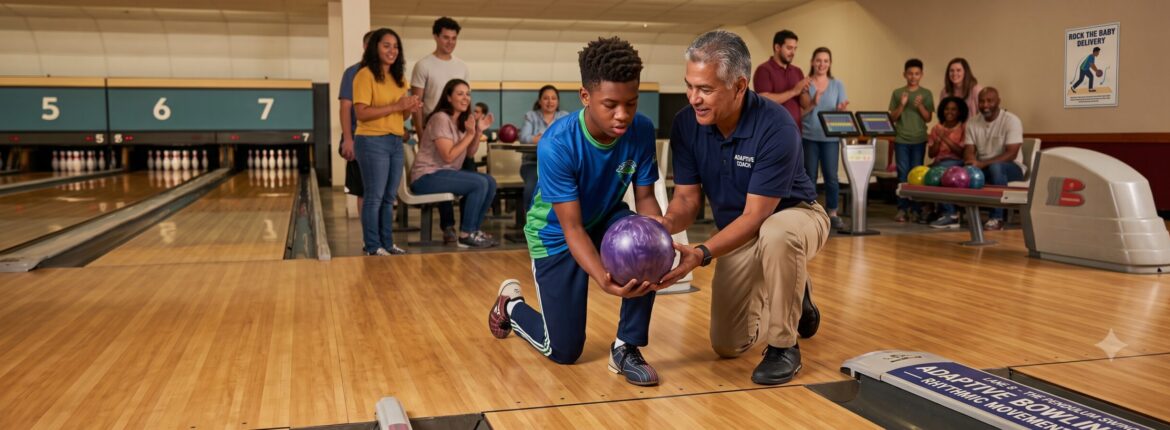
In the context of sports, recreation, and adapted physical activity, bowling is often a highly recommended sport for individuals on the autism spectrum (ASD). However, standard delivery styles can sometimes feel mechanically rigid or sensory-jarring.
The "rock the baby" approach—a specialized bowling delivery technique where the bowler cradles or swings the ball smoothly close to the body, emphasizing a gentle, rhythmic, pendulum-like motion before release—offers distinct advantages tailored to the unique sensorimotor and neurological needs of autistic individuals.
Why Bowling Fits Well with ASD
Standard bowling inherently aligns with many autistic learning and processing styles:
- Predictability and Visual Structure: The lane boundaries, the geometry of the pin deck, and the clear objective offer a highly structured environment with zero chaotic variables (unlike team sports with moving defenders).
- Closed Kinetic Loop: Success is determined by a repeatable set of movements, appealing to a preference for routine and systemized actions.
The "Rock the Baby" Method: Why It's Better for ASDers
Applying the "rock the baby" technique to a bowling approach can be highly therapeutic and effective for several key reasons:
1. Leverages the Vestibular System and Proprioception
Many autistic individuals naturally use rhythmic swaying or rocking (often referred to as motor stimming) to soothe themselves, achieve optimal neurological arousal, or manage sensory overload.
- Harmonizing with Stimming: Instead of forcing a rigid, traditional four-step approach that fights against a person's natural instinct to move rhythmically, the "rock the baby" delivery incorporates a predictable, rhythmic swing.
- Enhanced Spatial Awareness: The continuous weight of the ball moving in a steady arc stimulates the vestibular system (balance) and proprioceptive system (body boundaries), giving the brain massive feedback on where the body is in space.
2. Reduces Cognitive and Motor Planning Load
Traditional bowling requires complex multi-step motor planning: stepping with the correct foot, syncing the arm swing, bending the knee, and releasing at a precise millisecond.
- Simplifying the Chain: The "rock the baby" method simplifies the action down to a fundamental sensorimotor rhythm.
- Pendulum Mechanics: By treating the arm and ball like a swinging pendulum, the bowler relies on gravity and natural momentum rather than forced muscular execution. This lowers the executive function demand required to complete the movement successfully.
3. Nervous System Calming and Tension Release
Bowling alleys are naturally loud, sensory-dense environments with crashing pins, flashing lights, and echoes.
- Rhythmic Regulation: Steady, rhythmic, repetitive rocking movements have been shown to trigger the release of endorphins, lower cortisol levels, and calm an overstimulated nervous system.
- Anxiety Buffer: Carrying the steady "rock the baby" rhythm throughout the approach provides a portable zone of physical predictability. It acts as a mechanical anchor that keeps the individual grounded and focused, mitigating situational anxiety between frames.
Implementation Tip for Coaches or Educators
When introducing this approach, avoid over-correcting the individual's natural cadence or posture. Focus on a non-judgmental environment where the rhythmic, pendulum feeling of the swing is celebrated over strict adherence to traditional textbook form.
For a look at how targeted sensory-motor activities can be structured for therapeutic benefit, check out the Rock Bowling - Sensory Integration Activity Video. This brief clip demonstrates how modifying bowling mechanics with a focus on tactile and proprioceptive inputs can actively support coordination and sensory processing goals.
That is an excellent point to emphasize. For an article detailing this approach, adding an age and developmental milestone criterion is absolutely essential for clarity and physical realism.
A Crucial Developmental Milestone: Hand Size and Grip
While the "rock the baby" delivery is an exceptional tool for sensorimotor regulation, it requires a specific physical baseline before it can be effectively implemented. A bowler must typically be at least an early teenager to utilize this method safely. This is a matter of anatomical necessity: a child's hand must be large enough to securely palm, cradle, or grip the ball in a dual-handed or cupped fashion during the initial swing phase. Attempting this technique before the hand has reached early-adolescent proportions risks ball slippage, muscular strain, and dropped balls, which can cause injury or heighten situational frustration. Waiting until the early teens ensures that the skeletal structure and hand span can properly leverage the pendulum mechanics of the delivery.