
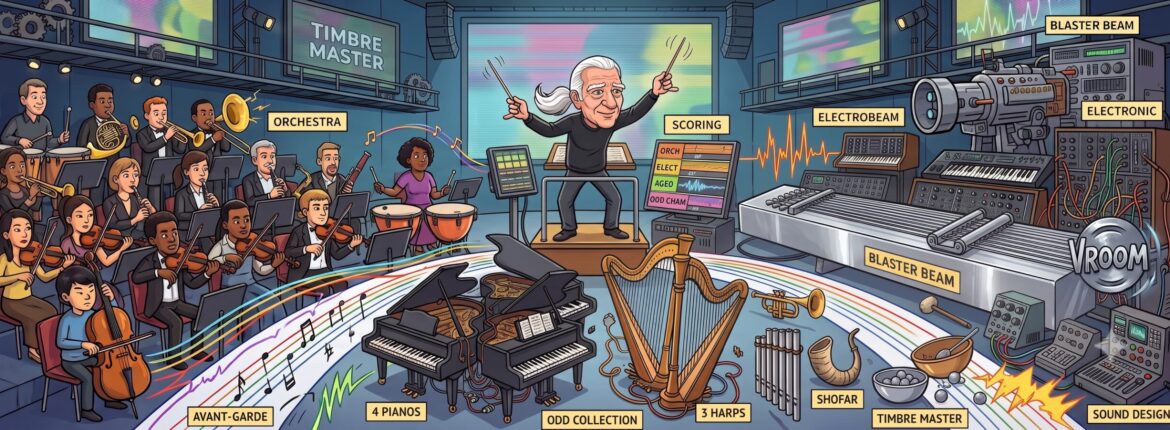
If the movie set is the ultimate macro-playground for the ADHD mind, then the scoring stage—specifically the world inhabited by legendary composer Jerry Goldsmith—is its micro-equivalent.
While many traditional composers found comfort in standard orchestral arrangements, Goldsmith treated every score like a brand-new, high-stimulus playground. His career is a textbook study in how an insatiable need for novelty and a refusal to settle into routine can turn a neurodivergent trait into mastery. He didn't just write melodies; he became the master sound designer of timbre (the specific quality or texture of a sound).
Here is why Jerry Goldsmith’s chaotic, inventive brilliance is the ultimate case study of the ADHD creative mind at work.
1. The Dopamine Rush of Planet of the Apes (1968): Weaponizing Chaos
To an ADHD brain, a standard violin section playing a standard major scale can feel stagnant. When Goldsmith took on Planet of the Apes, he completely threw out the traditional Hollywood rulebook in pursuit of tactile, visceral novelty.
[Traditional Orchestra] ──(ADHD Disruptor)──> [Goldsmith's Avant-Garde Sandbox]
  - Standard Strings                             - Ram's Horns & Metal Pipes
  - Predictable Melodies                         - Scraping Textures & Echo Plexes
Instead of relying on familiar orchestral comfort zones, he turned the scoring stage into a giant sonic laboratory:
- The "Crisis" Instruments: He brought in ram’s horns (shofars), scratchy echoplex tape loops, and scratch-art-like percussion textures.
- Defying Executive Function: He famously had the brass section reverse their mouthpieces and instructed musicians to blow through their instruments without making a pitch, creating a hollow, wind-like hiss.
- The Tactile Connection: To ground the sci-fi environment, he had musicians scrape metal pipes and shake mixing bowls filled with stainless steel balls. This raw, sensory-motor experimentation bypassed traditional musical boundaries to create a terrifying, unfamiliar acoustic ecosystem.
2. Hyper-Fixation and Tech Evolution: Star Trek: The Motion Picture (1979)
When a new technology emerges, an ADHD mind doesn't just look at it—it hyper-fixates, tears it apart, and reconstructs it. For the 1979 relaunch of Star Trek, Goldsmith needed a sound that felt genuinely alien, vast, and futuristic. Enter the Blaster Beam.
[The Blaster Beam]
 └── 12 to 15-foot aluminum rig
      └── Strung with heavy steel bass strings
           └── Struck with artillery shells & metal pipes
                └── Processed through electronic synthesizers
- The Shiny New Toy: The Blaster Beam was a massive, experimental, custom-built electronic instrument created by Craig Huxley. It was chaotic, unpredictable, and entirely non-traditional.
- The Timbre Masterpiece: Rather than using a standard synthesizer button, Goldsmith hyper-focused on this bizarre, physical instrument. By striking the massive strings with artillery shells and running the signal through custom processing, he created the iconic, metallic, echoing "vroom" sound that defined the V’Ger alien entity.
- The Synthesis Dynamic: He seamlessly wedded this industrial electronic noise with an 85-piece traditional orchestra. He couldn't stick to just a synth or just a horn section; his brain required the friction of both colliding at once to stay engaged.
3. Why Timbre is the Ultimate Focus Loop for ADHD
In music theory, you can write the exact same middle C note on a piano, a trumpet, and a chainsaw. The pitch is identical, but the timbre—the texture, color, and grit of the sound—is entirely different.
Traditional composition focuses heavily on structure, notation, and linear progression (which can feel like a rigid assembly line). Sound design and timbre focus on texture and immediate emotional impact.
- Instant Dopamine Feedback: Tweaking a sound's timbre provides immediate sensory feedback. For an ADHD creator, hearing a horn transition from a smooth tone to a guttural, processed rip is an instant hit of creative satisfaction.
- The Master of Sonic Textures: Goldsmith’s legacy isn't just his unforgettable hooks (like the Star Trek march); it’s the fact that you can tell a "Goldsmith score" within three seconds purely by its texture. Whether it was putting a synthetic heartbeat under an orchestra or using a log drum to create tension, he manipulated the physical architecture of sound to keep his own brain—and the audience—constantly on edge.
The Big Picture: Jerry Goldsmith succeeded not in spite of a craving for change, but because of it. He treated the orchestra not as a museum to be preserved, but as a giant toolkit to be continuously dismantled, hot-rotted, and rewired. He proved that an insatiable need for novelty is the exact ingredient required to invent the future of music.
4. The Prog-Rock Rhythms: Odd and Alternating Time Signatures
To a neurotypical ear, a steady 4/4 beat is comforting. To an ADHD brain, it can feel like a metronome ticking away the seconds of your life—predictable, monotonous, and uninspiring. Goldsmith rejected this rhythmic safety net, approaching his scores much like a Progressive Rock band (think King Crimson or Rush), constantly throwing the listener—and his musicians—off-balance.
- The Disruption of Flow: Goldsmith was a master of odd time signatures (5/4, 7/8, or 9/8). Instead of letting the music settle into an automated groove, these asymmetrical patterns require the brain to stay hyper-vigilant. You can’t zone out when the downbeat keeps shifting under your feet.
- Rapid-Fire Alternation: He didn’t just choose an odd meter and stick to it; he would constantly alternate time signatures from measure to measure. A cue might transition from 4/4 to 3/4 to 5/8 in the span of ten seconds. This rhythmic volatility mimics the internal pacing of ADHD: fast, shifting, intuitive, and thriving entirely on a state of controlled instability.
5. Subverting Expectations: Odd Chamber Groups (The Chinatown Model)
When an ADHD creator is given a standard canvas, their immediate instinct is to restrict it or warp it to force a new perspective. When tasked with scoring the classic neo-noir Chinatown (1974), Goldsmith faced an immense crisis: he had only 10 days to write and record the entire score after the original music was rejected.
Instead of panic, that high-stakes crunch triggered an intense, hyper-focused wave of unconventional choices. He completely bypassed the traditional, massive studio orchestra and stripped the ensemble down to a bizarre, highly specialized chamber group:
[Traditional Noir Score] ───> [Goldsmith's 10-Day "Chinatown" Grid]
  - Massive, lush string sections | - 4 Pianos (playing simultaneously)
  - Predictable jazz tropes       | - 4 Harps
                                  | - 1 Solo Trumpet
                                  | - Rhythmic Percussion / Avant-Garde Strings
- The Multi-Piano Engine: Rather than using one piano for simple accompaniment, he brought in four pianos and instructed the players to perform overlapping, intricate, rhythmic patterns. By prepping the piano strings and playing them unconventional ways, it sounded less like a classical concert and more like an avant-garde rock outfit.
- The Harp and Trumpet Contrast: He layered these dense, clattering acoustic piano textures with four harps and a single, haunting, melancholic solo trumpet.
By shrinking the group but maximizing the oddity of the instruments, he created a score that felt dry, hollow, beautifully fractured, and utterly unforgettable. He didn’t need a massive orchestra to make an impact; he just needed a small, highly unusual group of musical variables to create an entirely new sonic universe.