
If a standard recording booth is a sensory deprivation chamber, a voice acting career is a high-stimulus, lightning-fast playground where ADHD traits translate into massive professional advantages.
In the voiceover (VO) industry, the fast-paced transitions, high-energy demands, and microscopic focus loops make it an absolute paradise for a neurodivergent creative. Here is why the voice acting realm is perfectly engineered for the ADHD mind.
1. Radical In-The-Booth Novelty
The ADHD brain notoriously craves high-stimulus variety to stay engaged. In animation, video games, and commercial voice acting, boredom is virtually impossible because the creative landscape resets every few minutes.
- Rapid-Fire Character Pivots: Within a single four-hour recording session, an actor might voice a gravelly, ancient wizard, a frantic talking squirrel, a cold futuristic AI, and a background battle-grunt. The brain is constantly forced to shift gears, preventing the stagnation that leads to under-stimulation.
- The "Short Form" Sprint: Unlike long-form acting or theater, where you rehearse the same lines for months, a voice actor gets a script, hyper-focuses on it for a few minutes or hours, delivers maximum emotional energy, and completely discards it. It is a pure creative sprint.
2. Thriving in the Chaos of Unscripted Performance
Voice directors for animation and video games rarely want a rigid, mechanical line read. They look for accidents, erratic energy, and spontaneous choices—the exact domain where the intuitive ADHD brain excels.
- The "Effort" Session High: In video game acting, sessions often end with "efforts"—recording dozens of different grunts, screams, death rattles, and combat yells. This requires raw, uninhibited vocal and physical energy. The high adrenaline mimics the exact focus neurotransmitters an ADHD brain craves, turning a chaotic room into a playground of intense, sharp execution.
- Instant Improvisation: When a director says, "Give me three completely different, wild options for this line on the next take," a neurodivergent actor can intuitively draw from a vast, chaotic web of internal pop-culture fixations, sound effects, and mimicry to deliver them instantly.
3. The Ultimate Support System: Directors and Audio Engineers as "Caddies"
Just like a film director is insulated from administrative drag by their crew, a voice actor in a professional studio is surrounded by specialized finishers who handle the grueling execution details.
- The Audio Engineer: The ultimate technical shield. The actor doesn't need to worry about adjusting microphone gain, tracking file names, managing software crashes, or editing out breaths. The engineer handles the mechanical execution, leaving the actor free to stay entirely in the creative "flow zone."
- The Voice Director: An external executive function anchor. They track the pacing, monitor the continuity of the accent, and keep the session moving strictly on time. They manage the macro-structure so the actor can fixate purely on the micro-expression of a single word.
4. Hyper-Fixation Turned Into a Toolkit
Many ADHDers grow up with a habit of vocal mimicry, hyper-fixating on specific accents, bizarre cartoon sounds, movie quotes, or regional dialects. In traditional social settings, this might be labeled as a distraction; in a VO booth, it is a highly bankable corporate asset.
A voice actor can pull a highly specific 1940s radio announcer voice or a precise clicking sound out of their back pocket simply because their brain deep-dived into it years ago during a midnight hyper-fixation loop.
5. The Built-In Entrepreneurial Startup Trap
However, it isn't all a neurodivergent paradise. The industry shifts significantly when voice actors work from home—a reality that introduces the dangerous "middle manager" trap.
[In-Studio Sessions] ───────────────────> [The Home Studio Grind]
  - High Stimulus, Acting Purely            - Sound Editing & Noise Floor Audits
  - External "Caddies" (Engineers)          - Cold Email Marketing & Invoicing
  - Pure Creative Playground                - Administrative Overwhelm
- The Acting vs. Organizing Conflict: When booking major studio gigs, the ADHD actor is a creative captain. But when auditing, editing, and running a home booth, they suddenly have to become the financial "bean counter."
- The Danger Zone: Cleaning up audio clicks, marketing to corporate clients, and tracking spreadsheet invoices are hotbeds for executive dysfunction.
The Bottom Line: Voice acting works beautifully for ADHD because it turns the act of vocalizing into a rapid-fire, high-stakes physical sport. When the infrastructure allows the actor to focus purely on the mic and the script, the booth becomes the ultimate sanctuary for a fast-moving, multi-faceted mind.
6. The Ultimate Expression: Robin Williams as the Genie
There is no greater monument to the raw power of an ADHD mind in a recording booth than Robin Williams’ legendary performance as the Genie in Disney’s Aladdin (1992). It stands as the definitive proof of how a neurodivergent mind, given total creative freedom and the right support system, can revolutionize an art form.
[The Scripted Line] ──(ADHD Hyperspace)──> [The Improvisational Explosion]
  - Standard Dialogue                       - Rapid-Fire Impressions (30+ in a session)
  - Linear Storytelling                     - Non-Linear Pop Culture Mashups
                                            - Pure Stream-of-Consciousness Flow
- The Sprints of Stream-of-Consciousness: Williams notoriously treated the script as a mere suggestion. His mind operated at an extreme, non-linear speed, jumping from a Groucho Marx impression to a French chef, to a futuristic robot in a matter of seconds. The ADHD brain thrives on making instant, distant cognitive connections that neurotypical minds take minutes to process; Williams did it in real-time, take after take.
- The Absolute Need for a "Caddy" Director: This performance only worked because directors John Musker and Ron Clements understood how to serve as the ultimate creative caddies. Instead of trying to force Williams into a rigid, structured box (which would have caused immediate under-stimulation and killed the magic), they simply turned on the microphones, cleared the tracks, and let him run at maximum velocity. They handled the executive function of sorting through 16 hours of chaotic, improvised recordings to find the gold.
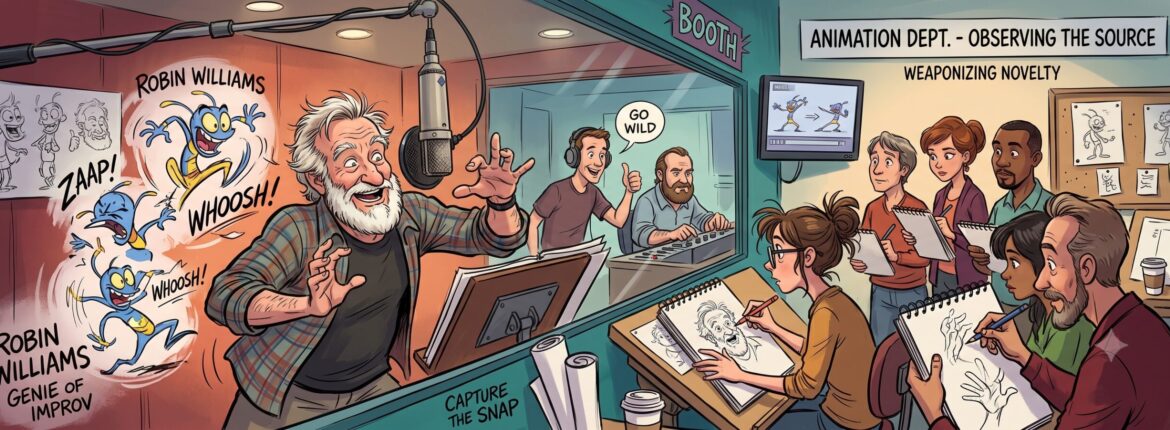
- Overwhelming the Animators (The Ultimate Finishers): Williams’ rapid-fire delivery was so volatile and full of novelty that the traditional animation pipeline had to completely reinvent itself. The animators became the ultimate finishers, meticulously shifting their drawings to keep up with the breakneck pacing of his vocal track.
Robin Williams didn't just voice a character; he weaponized an incredible mental bounce rate, turning what traditional workspaces consider "distractibility" into one of the most brilliant, hyper-focused, and iconic performances in cinema history.
7. The Visual Blueprint: From Booth Performance to Animation Frame
This hyper-dynamic booth environment triggers a profound secondary effect in the animation pipeline. Because an ADHD voice actor doesn’t just perform with their vocal cords—they perform with their entire body—the recording session becomes a living, breathing reference library for the visual artists.
Animators routinely study the video footage of these sessions to capture the physical essence of the performance:
[Kinetic Performance in Booth] ──> [Animator Observation] ──> [On-Screen Character Expression]
  - Extreme facial contortions       - Analyzing micro-expressions    - Matching the organic "snap"
  - Wild, instinctive hand gestures  - Mapping body weight shifts    - Blending voice with physics
- Capturing the Micro-Expressions: An ADHD actor in a state of deep hyper-focus or rapid-fire improvisation exhibits an incredibly volatile range of facial shifts. Animators watch the tape to catch the exact moment a smirk turns into a gasp, or how the eyes wide-track an intrusive thought. These real-world, kinetic quirks are what rescue a cartoon character from looking stiff, grounding them in organic human behavior.
- The Sensorimotor Translation: When an actor is physically throwing themselves around the microphone—gesturing wildly, shifting their weight, or contorting their posture to find a strange new vocal timbre—they are creating a spatial blueprint. The animators translate that raw, physical energy directly onto the frame, ensuring that the character's body language possesses the exact same "snap," rhythm, and momentum as the voice track.
By observing these uninhibited, high-stimulus physical performances, the animators are able to anchor a purely abstract drawing to an authentic, deeply expressive human anchor.