
My former psychiatrist, Dr Joseph Llinas, is a two time APA man of the year for his clinical research on ADHD and ASD kids from low income families.
One day I once asked him based on two people I know who had challenges with their ADHD kids the following question “What percentage of the problems of the parent/ADHD child home dynamics is the result of the fact the parent can’t see past of what they of themselves in their ADHD child, that’s where their expectatons begin and end and the child can not nuerologically meet them?” Dr Llinas said “Almost all of it.” I then said “Almost all of it. Now I am a theorhetical mathematician, what is almost 80, 90 percent?” He said “Try 95-98 percent”. I was stunned and responded “Wow! What about the classroom?” He said “Same thing.” Still shocked I asked “Same numbers?” He responded “Yes!”
It was at that moment I came up with the concept of Real Empathy. I defined Real Empathy as empathically connecting beyond relatable things. This is where the real hard work is. It takes time if the parent is willing to put in the time. Apparently 95 percent of the parents are too lazy to do so.
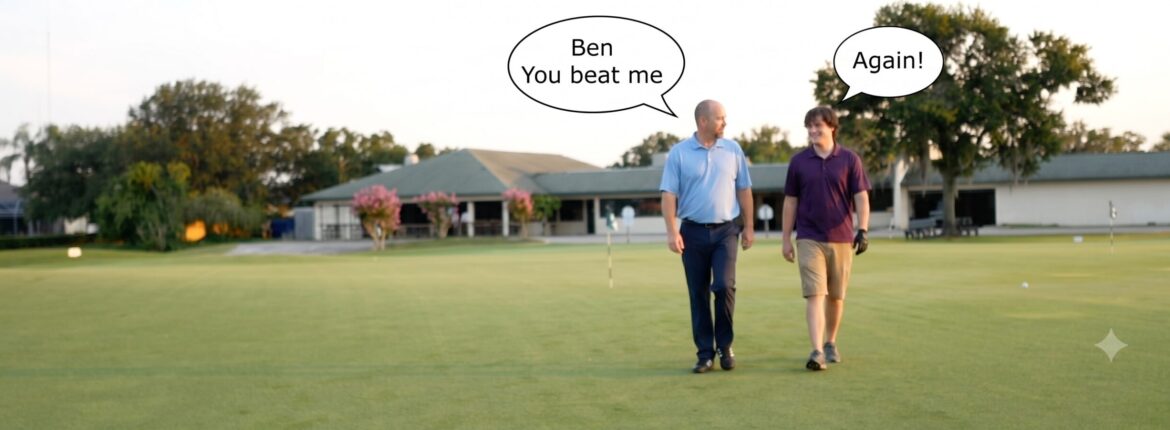
My son and I are almost peas in a pod with our ADHD. When I was coaching and mentoring him in golf there was something that was not quite like me. Then in 2017 the DSM allowed for a dual diagnosis for ADHD and ASD. So my ex had him tested. They said he does have hard time reading social cues and distinguisiing sarcasm from sincerity. I then said to myself “He doesnt have a hard time just social cues, he has a hard time reading ANY cues. He has defaults to literal at a high rate.” It was then that I realized that where I verbally instructed him is where he struggled in golf and that no matter how detailed a picture I painted verbally, he could not recieve it as conveyed. He defaults to black and white.”
It took me a year to rework the berbal instruction to find ways to create tangible experiences for him to learn how to visualize a shot and how to choose a shot. Using Dr Llinas as a sound. board and showing him the drills that were too succesful (Ben started beating me in stroke play) Dr Llinas leaned over on the edge of his couch and said “You do realize there is no one doing research on this?”
I replied “I know. I know that his is a thing and that my solutions are within a reasonable neighborhood of the vector where all of the optimum solutions are. Correct?” Dr Llinas responded “Yeah, absolutely” I thought to myself “Really? You! The GOAT of ADHD pediatric psychiatry! Wow!”
I know now that I get my son in how processes the world in a moment with his singular Autistic trait. However, due to the Heisenberg uncertainty principal in Real Empathy, I will never know what it is like to live with that for a lifetime. I can infer but I will never truly know.
To this day I am the only one who truly gets him.
You want to be a kick parent, ues real empathy and the RSD-based psuedo-ODD will be a thing of the past.
Part II: Deconstructing the Intervention — What I Did and Why It Worked
When Dr. Llinas confirmed that my coaching solutions were in the correct mathematical "neighborhood of the optimum vector," it was because the framework intentionally bypassed the broken bandwidth of standard neurotypical instruction.
To teach a child who defaults to absolute literalism, you have to fundamentally alter the nature of the data you feed them. Here is the breakdown of the shift:
1. From Verbal Abstraction to Sensorimotor Inference
Traditional coaching relies heavily on verbal metaphors: "Feel the weight transition," "Imagine the ball tracking along a curved arc," or "Smooth out the tempo." To a brain operating on absolute literalism, these aren't instructions—they are white noise.
I stopped trying to paint verbal pictures. Instead, I engineered physical, tangible constraints. If he struggled to visualize a shot or choose the correct trajectory, I built drills where the physical environment did the teaching. I used explicit reference points, specialized ball placements, and physical barriers that forced his body to feel the mechanics. He didn't have to translate abstract words into physical motion; his brain mapped the spatial references directly through physical interaction.
2. Eliminating the "Filter Layer"
Because my son defaults to black-and-white literalism, his brain requires an immense amount of cognitive energy to decode tone, hidden intent, or abstract instructional filler. By stripping away heavy lecture-based coaching and replacing it with direct, tangible frameworks, the "decoding" phase was completely eliminated. The input (the physical drill) directly matched the required output (the mechanical execution).
3. Starving the RSD Loop
When a neurodivergent child is repeatedly given instructions they cannot neurologically process, they experience chronic, micro-failures. This triggers Rejection Sensitive Dysphoria (RSD)—an extreme emotional pain tied to perceived failure or letdowns. The child defaults to defiance (pseudo-Oppositional Defiant Disorder) as a neurological defense mechanism. They aren't being bad; they are protecting themselves from a system that feels rigged against them.
By designing experiential drills that were highly successful, the frustration loop vanished. He wasn't failing to meet my verbal expectations because my verbal expectations were no longer driving the car. Success became objective, tangible, and highly repeatable.
Part III: The Adult Blind Spot — Why This is So Brutally Hard for Parents and Teachers
If the solution is within an achievable mathematical neighborhood, why do 95% to 98% of parent-child and teacher-student dynamics remain stuck in systemic friction?
The barrier isn't the child's neurology. It is the adult's cognitive ego.
The Narcissism of "Relatable" Empathy
Most adults practice Ego-Driven Empathy. We look at a child, remember what it felt like to be young, and project our own processing system onto them. This works fine for neurotypical children. But when a parent or teacher encounters a child with ADHD and ASD, that framework completely shatters.
The adult sets an expectation based entirely on how they process the world. When the child cannot meet it, the adult interprets the failure not as a neurological mismatch, but as a behavioral choice: “They aren’t listening,” “They are being stubborn,” or “They just need to try harder.”
The Time and Energy Penalty
Real Empathy demands that you entirely discard your own cognitive operating system and spend months or years studying an entirely alien one. It requires you to sit in a state of absolute non-judgment, watching how a specific brain processes data, and then custom-building an instructional framework from scratch.
It means trading easy, off-the-shelf verbal lecturing for rigorous, physical, experiential engineering. For a teacher managing 30 kids, or a parent exhausted after a 50-hour work week, that energy expenditure feels impossible. It is far easier to demand compliance than it is to redesign the environment.
Overcoming the Heisenberg Uncertainty Principle of Parenting
To bridge this gap, adults must accept a humbling reality: You will never truly know what it feels like to live inside their mind. Real Empathy doesn't mean achieving perfect oneness; it means respecting the boundary of their unique processing system and adjusting your behavior to accommodate it.
When you strip away the demand for them to mirror your brain, you stop fighting their neurology. That is the exact moment the behavioral friction disappears, the pseudo-ODD vanishes, and the kid finally starts to flow, beating you at your own game.
Teaching Ben's Eyes to Visualize!
In this video we were trainign his eyes to visualize. He watched the ball roll into the hole while I goldilocksed my way to make the third putt. He then goes an makes his 30 foot putt. His ASD-like tendancy was for his eyes to ping pong betwen ball and hole with out scanning and visualizing. We did this on different holes and with different lines and then crafted a routine for him to drop behind on the opposite side of the fall line and let his eyes be the ball. Then the bastard started beating me in stroke play.