
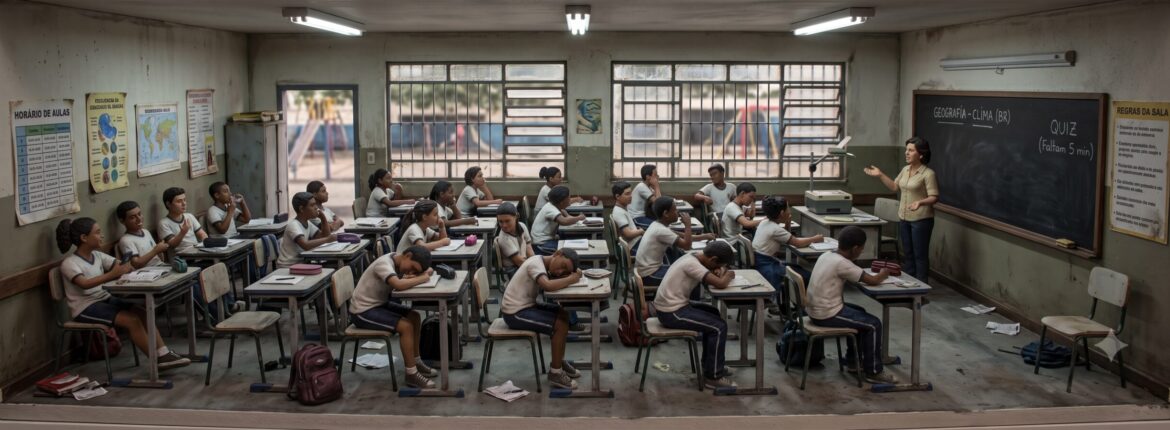
While the sports science and martial arts communities in Brazil have built structured, proactive environments to channel the ADHD brain, the transition into the traditional classroom environment is much more complicated. There is a distinct gap between Brazil’s sweeping legal frameworks, its elite athletic systems, and the daily realities of its public and private schools.
Sadly, the groundbreaking lessons learned in Brazilian sports psychology—which treat non-linear cognitive processing, high-energy instinct, and hyperfocus as competitive assets—never reach the Brazilian K-12 classroom. While a youth on the soccer pitch or the mats is coached to optimize their unique mind, that same student steps into a school system that defaults to mitigating friction, enforcing linear compliance, and managing a "deficit."
Here is a breakdown of how the intersection of neurodiversity and athletics functions in contrast to the rigid realities of Brazilian education today.
1. The Legal Milestone: Law No. 14.254
For a long time, ADHD sat in a legal gray area in Brazilian schools. Unlike physical disabilities or Autism Spectrum Disorder (ASD), which had ironclad, dedicated protections, ADHD was frequently left to the discretion of individual schools.
That changed with the passage of Federal Law No. 14.254.
- The Mandate: This law explicitly ensures that all students with ADHD or other learning disorders (like dyslexia) in both public and private school networks are entitled to early identification, pedagogical accommodations, and institutional support.
- The Healthcare Connection: It theoretically bridges education and healthcare, mandating that the state provide diagnostic services and treatment through Brazil’s free unified public health system (SUS).
2. Classroom Accommodations in Practice
When implemented correctly—more commonly seen in well-funded private institutions or progressive state programs (such as the widespread push for Individualized Educational Plans or PEIs in states like Tocantins)—accommodations mirror modern executive-functioning support rather than dynamic athletic optimization:
- Strategic Seating & Testing: Placing students away from high-distraction zones (windows, doors), breaking long exams into smaller chunks, and granting extra time.
- Alternative Assessment: Moving away from rote, long-form written memory tests toward oral presentations or practical, hands-on projects that allow a non-linear thinker to demonstrate mastery.
- The Intermittent Support Model: Rather than pulling students out of regular classes permanently, many systems utilize Specialized Educational Assistance (AEE). Students attend standard classes for one shift and receive targeted, after-school cognitive and structural support during another.
3. The Implementation Gap & Systemic Friction
Despite progressive legislation, the daily execution of these accommodations faces major bottlenecks, particularly within the massive public school system, entirely isolated from the fast-paced, strength-based strategies of the country's sports psychologists.
Teacher Training Overwhelm
While the law requires personalized pedagogical strategies, the Schools2030 global research initiatives in Brazil have noted that standard teacher-training programs rarely equip educators with practical, classroom-management tools specifically tailored for executive dysfunction. Teachers want to help, but are often managing overcrowded classrooms without a dedicated support aide, completely detached from the "instinct-over-overthinking" models used by athletic coaches.
The Diagnostic Bottleneck
To officially unlock legal academic accommodations in high-stakes environments—like university entrance exams (ENEM)—students need a formal neurodevelopmental diagnosis. Because SUS (the public healthcare system) faces immense backlogs, securing a multidisciplinary evaluation can take years for low-income families, creating an equity gap where wealthier students access accommodations far more easily.
The Afternoon Shift Dilemma
Brazil’s public system frequently splits the school day into distinct morning and afternoon shifts to accommodate massive student volumes. Recent behavioral studies on Brazilian youth explicitly show that while standard neurotypical performance steadies in afternoon shifts, students with high ADHD symptom presentation show significant drops in reading, writing, and focus during later hours, adding an invisible scheduling hurdle to their academic success.
The Big Picture: In the athletic arena or on the BJJ mats, the immediate physical feedback loop naturally anchors the ADHD mind, allowing sports scientists to turn impulsivity into lightning-fast instinct. In the classroom, where the feedback loop is delayed and the environment is inherently sedentary, the lessons of sports psychology are entirely absent. The management style shifts from utilizing hyperfocus to mitigatingfriction. The legal right to a tailored education exists in Brazil, but the practical K-12 infrastructure remains trapped in an old paradigm, entirely missing out on the brilliant cognitive strategies weaponized on the playing field.