
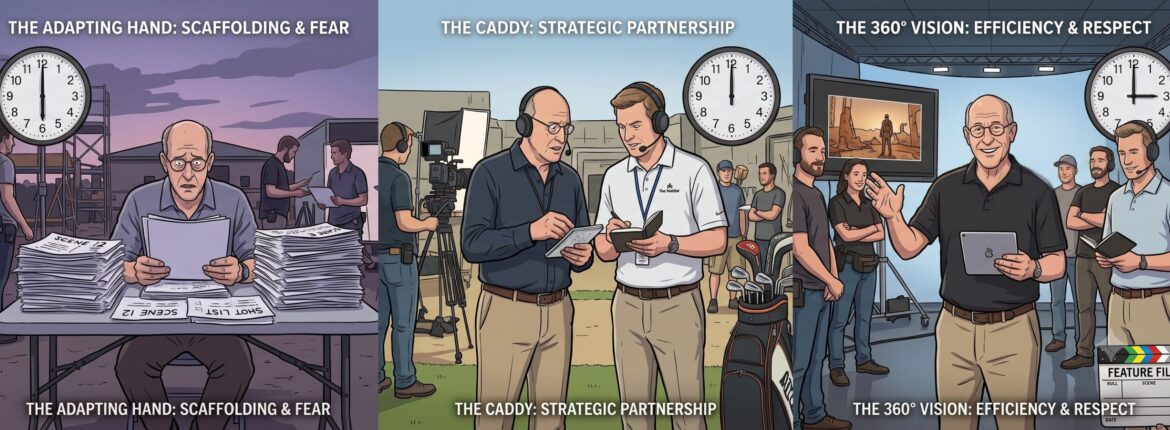
The traditional image of a Hollywood film director is an all-seeing auteur, a rigid general executing a flawless tactical campaign. But look closer at the actual mechanics of a film set—a highly pressurized, rapidly shifting environment of constant sensory input—and you find a workspace organically customized for the neurodivergent brain.
For Jack Sholder, a veteran of 14 feature films and episodic television, navigating a decades-long career wasn't just about mastering cinematic language. It was a masterclass in unconscious adaptation: building highly functional executive frameworks out of thin air to compensate for what they only later realized was undiagnosed ADHD.
The Armor of Over-Preparation: Mitigating Fear with Structure
A core hallmark of Adult ADHD is executive dysfunction (EF)—specifically, difficulties with working memory, prioritization, and sustained task focus under pressure. When thrust into the chaotic "stew" of a movie set, where dozens of people demand immediate answers simultaneously, an ADHD brain can easily misfire or short-circuit.
To survive, this director developed a brilliant, hyper-rigorous compensation strategy: obsessive pre-visualization.
"I spend all my spare time going through each scene, deciding what it’s meant to do, who it’s about and then how to stage it and then how to shoot it. I end up with a shot list for the entire movie. Initially, I did it out of fear because I thought I would get on the set and not know what to do..."
In the vocabulary of cognitive psychology, this is known as scaffolding. Because an ADHD brain struggles to self-regulate and organize in real-time amidst high-stimulus environments, this director exported their executive functioning onto paper before ever stepping onto set. The shot list functioned as an external hard drive for their working memory—an insurance policy against the terrifying possibility of freezing under stress.
[ Rigorous Pre-Planning ] ──> Creates Safety ──> Lowers Anxiety
                                                      │
[ Organic Set Interventions ] ◄── Unlocks Agility ────┘
  (Pivot to better ideas in real-time)
Once the safety net of the shot list was established, something fascinating happened. Rather than trapping the director in a rigid box, the extreme preparation actually unlocked the neurodivergent superpower of hyper-awareness and cognitive flexibility.
With the foundational mechanics written down, the director’s mind was freed up to observe the room in 360 degrees. ADHD brains are naturally wired for lateral thinking and novelty; they excel at recognizing spontaneous patterns or happy accidents that linear thinkers might overlook. Because the baseline work was secure, the director had the cognitive bandwidth to drop the script when an actor or cinematographer stumbled into a moment of organic genius.
The First AD as the Ultimate Tour Caddy
However, the day-to-day tactical management of a set still presented classic ADHD obstacles. Being admittedly "scattered" meant that micro-managing time, schedules, and logistical sequences was a losing battle. The director's solution? Strategic delegation.
To navigate this, Jack Sholder relied on a strong First Assistant Director (AD). Far from just an administrative manager or a loud voice with a megaphone, a great First AD functions exactly like an elite tour caddy standing beside a professional golfer on the fairway.
[ Director / Golfer ] ───────────────► Envisions & Executes the Shot (The Swing)
       ▲
       │ (Strategic Partnership / Executive Support)
       ▼
[ First AD / Caddy ]  ───────────────► Manages Environment, Pace, & Selection
- Managing "Time Blindness" and Pace of Play: A caddy keeps an eye on the clock, ensures the group doesn't fall behind the tournament pace, and calculates how much daylight is left. On a film set, the First AD constantly manages the ticking clock of a 12-hour shooting day, calculating setups so the director doesn't get sucked down a creative rabbit hole at the expense of finishing the day.
- Handing Over the Right Club: A golfer knows how to hit every shot, but a great caddy checks the wind, calculates yardage, and hands them the exact iron they need. The First AD does the heavy operational lifting—wrangling actors, ensuring the camera package is ready, and clearing the frame—essentially handing the director a perfectly prepared set so all they have to focus on is executing the creative "swing."
- Holding the Yardage Book: While the golfer visualizes the flight of the ball, the caddy tracks the macro-map of the course, noting where the hidden bunkers lie. The First AD keeps the "shot list yardage book" open, quietly acting as an external frontal lobe to remind a scattered director of the big picture when the chaos of the environment starts to cloud their immediate memory.
By outsourcing the tactical logistics to a trusted First AD, the director didn't have to waste precious, limited executive energy on tracking time or schedules, freeing them to stay entirely locked in their creative zone.
Hollywood Benchmarks: How the Story Lines Up
This director’s experience is far from an isolated anomaly in cinema history. When compared to other notable Hollywood figures who have navigated neurodivergence, a clear pattern emerges.
| Director / Creator | Shared ADHD Profile | The Functional Differentiation |
| Jack Sholder (Nightmare on Elm Street part II) | High anxiety-driven over-preparation; heavy reliance on an external operational anchor (First AD); struggled inside rigid templates. | Mastered the pivot from hyper-structured scaffolding to fluid, 360-degree real-time adaptation over a long 14-feature career. |
| Daniel Kwan(Everything Everywhere All at Once) | Diagnosed while researching his Oscar-winning film; described his brain as a chaotic landscape of processing everything at once. | Channelled the structural overwhelm directly into the aesthetic texture of the film itself, making maximalist chaos the literal text. |
| Alejandro González Iñárritu (The Revenant, Birdman) | Noted that his inability to stay anchored to a single subject for long was a distinct academic liability that became a creative asset. | Translated a lack of linear focus into a brilliant narrative device: masterfully directing multi-perspective, hyper-complex parallel storylines. |
| Greta Gerwig(Barbie, Little Women) | Spoke openly about growing up with an immense, boundless pool of scattered energy and deep emotional intensity. | Channels that massive creative bandwidth into intense, rapid-fire dialogue pacing and hyper-focused world-building. |
The Feature Film vs. Episodic TV Divide
Where this director’s story sharply diverges from the mainstream narrative of a typical "journeyman" director is their relationship with episodic television.
In modern TV, the showrunner and writers establish a rigid aesthetic template. The guest director’s job is to step in, replicate the formula precisely, and keep the train on the tracks. For an ADHD brain, a rigid template with zero room for novelty or systemic alteration is creative kryptonite. The urge to "change the template" isn't a lack of discipline; it’s an innate intolerance for stagnation—a deep-seated need to find a more efficient or visually interesting solution to a problem. This explains why they flourished beautifully in the feature film landscape, where the director is empowered to build the universe from scratch, but chafed under the constraints of episodic television.
The Path to Mastery: Building the 360-Degree Vision
The arc of this Jack Sholder's career beautifully illustrates how neurodivergent individuals achieve mastery through long-term adaptation and discovering compensation strategies.
Toward the latter half of their directing career, the underlying anxiety began to quiet down. While the structural need for a strong First AD remained a constant, the director developed a comprehensive, panoramic vision on set. They became significantly more efficient, earning deep respect from the crew not because they hid their scattered nature, but because they had fully integrated their compensation strategies.
They ceased being a director fighting against the current of their own brain, becoming instead a conductor who knew exactly how to use a meticulously prepared score to lead a beautifully improvised orchestra.