
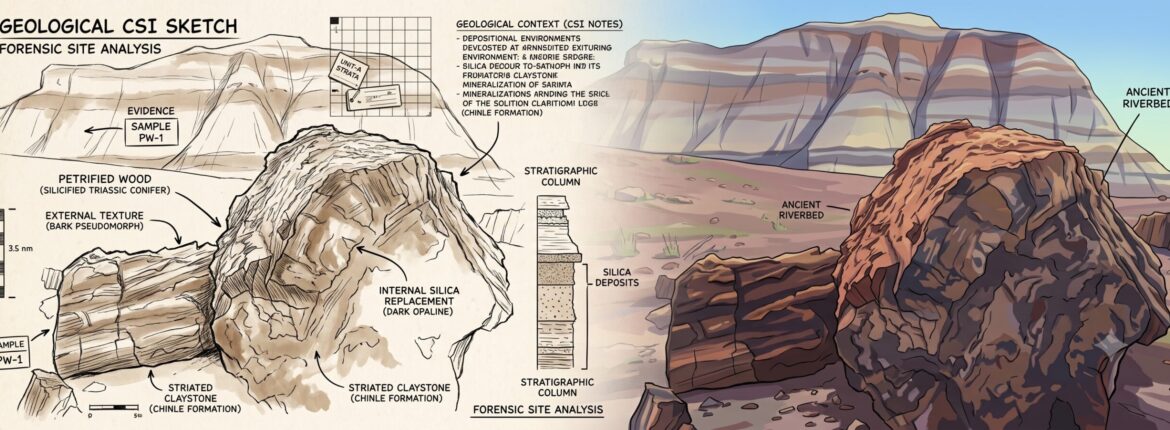
Every under-resourced high school classroom across the country has one: the "master doodler." This is the kid with a low GPA but a staggering, off-charts visual IQ, completely tuned out of a screen-heavy, vocabulary-memorize-and-dump science curriculum. Their notebooks are a chaotic tapestry of sprawling alien vistas, jagged fortresses, and comic book horizons sketched in the margins while the teacher reads from a slide deck. Traditional instruction calls it a distraction; the CSI Geology framework recognizes it as a brilliant, untapped spatial processing engine.
By reframing the study of the Earth as a deep-time forensic investigation and a raw architectural sandbox, this curriculum performs a spectacular piece of cross-disciplinary sabotage. It hijacks the creative drive of the disengaged artist, transforms them into an elite forensic sketch artist, and builds a direct structural pipeline straight to the conceptual design boards of modern 2D and 3D animation studios.
Stage 1: The Forensic Sketch Artist (The Hook)
The transformation begins by treating the natural world not as a list of definitions to memorize, but as an active, deep-time crime scene. When a master doodler is handed a camera or a hand lens, they aren't just looking at rocks—they are executing a genuine forensic autopsy on the landscape.
Instead of drawing generic, bumpy mounds for mountains, the student’s pen is forced to interact with actual structural mechanics:
- The Structural Grid: They map out how vertical volcanic plugs violently shear through flat sedimentary floors, or how a tilted fault-block lifts a billion years of history into the sky like a massive cellar door.
- The Mechanical Mark: When sketching the fluted grooves of a badlands hill, they aren't just shading lines; they are calculating the hydraulic runoff patterns of an impermeable, self-sealing clay matrix under a heavy storm.
- The Relief Ledger: They learn to visually differentiate a negative footprint mold from a raised, positive natural cast, understanding how millions of years of deep-time split-bed mechanics cleave a stone to reveal a perfect three-dimensional physical stamp of a prehistoric creature's anatomy.
By making the sketchbook the primary tool of scientific documentation, the student realizes that nature has already engineered architectures far weirder and more visually arresting than anything they could spawn from scratch. Science becomes the ultimate cheat code for their art.
Stage 2: The Maurice Noble Metamorphosis (The 2D Blueprint)
Once the student masters the geometric and physical laws of the earth, they are introduced to the legendary design principles of artists like Maurice Noble—the mid-century layout pioneer who defined the iconic look of classic Warner Bros. and early animated worlds.
Noble’s philosophy was simple: don't just copy nature; caricature its structural rhythms.
 [ THE CONCEPT DESIGN PIPELINE ]

   1. THE FORENSIC BLUEPRINT ➔ The student sketches the rule-straight boundaries
                                 and orthogonal joint patterns of a sandstone mesa.
                                      │
                                      ▼
   2. THE NOBLE CARICATURE   ➔ They exaggerate the vertical scale, pushing the horizontal
                                 caprock lines and rhythmically curving the erosion flutes.
                                      │
                                      ▼
   3. THE EMOTIONAL PALETTE  ➔ They dump traditional primary tubes of paint for the complex,
                                 chemical signatures of an changing planet—stained oxbloods,
                                 concrete-whites, and bruised, reduced purples.
The kid who once drew uninspired, flat backgrounds is now composing layout art with immense structural conviction. Because they understand why a canyon wall breaks at a precise ninety-degree angle or how a desert deflation lag terrace scatters gravel across a hardpan floor, their minimalist 2D backgrounds look profoundly heavy, ancient, and undeniably real. They are no longer just doodling; they are designing believable environments for animated features and stylized sci-fi television series.
Stage 3: The 3D World-Builder (The Pixar Destination)
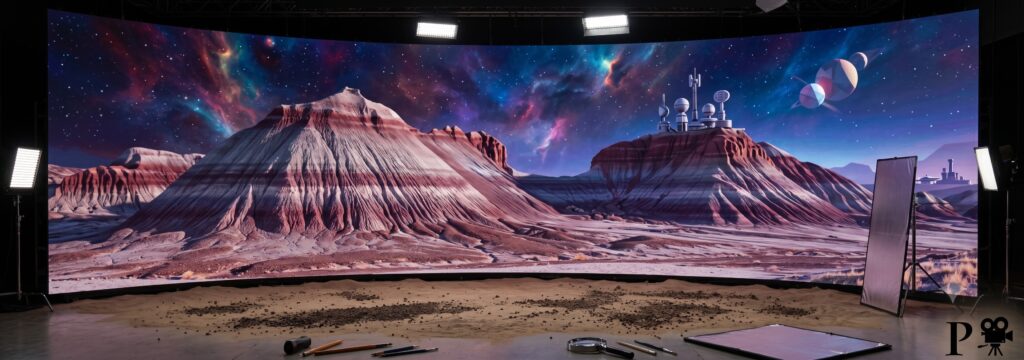
The final leg of the pipeline bridges the gap between classic ink-and-paint layout art and modern 3D digital environments. Studios like Pixar, Disney, and high-end streaming animation houses do not look for artists who can merely click buttons in a software engine; they look for designers who possess an intrinsic understanding of spatial scale, environmental weight, and weathering physics.
A master doodler trained in the CSI Geology bullpen transitions seamlessly into this arena:
- Environmental Shading & Texturing: When painting digital skins for a 3D asset, the student knows exactly how a young, un-eroded sheet of gas-charged vesicular basalt traps wind-blown desert sand into its open cracks from the bottom up. They don't just apply a generic "rock texture"—they map the thermodynamic cooling history of a pressurized lava flow.
- Procedural Landscape Generation: When building sprawling virtual worlds, they understand how a durable sandstone caprock acts as a bulletproof vest for a mesa, dictating how the landscape breaks down vertically into isolated buttes and retreating escarpments over time.
The Ultimate Cross-Disciplinary Sabotage
By stepping away from digital screens and putting pen to paper in the raw, exposed field laboratories of the high desert, CSI Geology entirely reshapes a student's relationship with science. It takes a kid who felt alienated by the traditional academic landscape and proves to them that their eccentric visual habit is actually a highly specialized, elite scientific asset.
They don't just learn to care about science; they use its fundamental laws to build an unstoppable professional identity. The next stop for the kid who used to get scolded for defacing their school desk isn't a remedial classroom—it's the conceptual environment department at a major animation studio, building the next great cinematic universe from the bedrock up.