
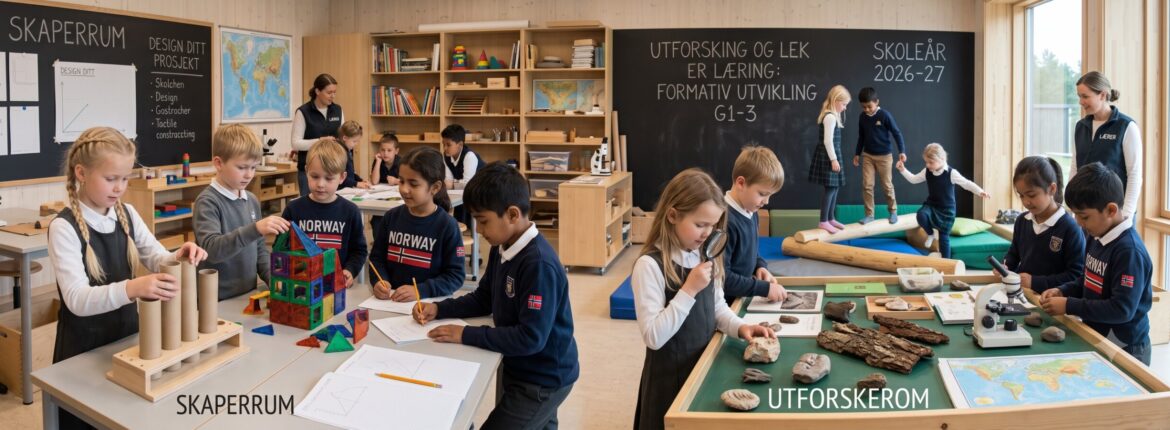
While the rest of the world rushes to accelerate childhood—substituting algorithms for teachers and turning elementary school recess into pressure-cooker sports academies—Norway has quietly launched a counter-revolution.
In a pair of structural moves, the Nordic nation has drawn a line in the sand to protect the sacred window of development up to age twelve. By enforcing a near-ban on generative AI in primary classrooms and legally anchoring its youth sports around inclusion and the "joy of sport," Norway is offering a masterclass in human-centric design. They aren't rejecting progress; they are protecting the foundational way the human brain connects with reality.
1. The Classroom: Moving From Prompts to Paper
In June 2026, Norwegian Prime Minister Jonas Gahr Støre announced a sweeping policy change: generative AI is effectively barred for grades 1 through 7 (ages 6 to 13), and heavily restricted for older students. Simultaneously, the government aggressively funded a massive return to physical, printed books, reversing a decade-long drift toward tablets.
The rationale wasn't born out of fear, but neurological reality. As Prime Minister Støre noted, over-reliance on automated tools tricks children into skipping crucial steps in learning to read, write, and reason.
When a child uses AI to generate an answer, they bypass the messy, essential cognitive friction of trial and error. True conceptual mastery requires tactile, somatic engagement—the precise physical feedback of pen to paper and the spatial permanence of turning a printed page. By removing the shortcut of the algorithmic prompt, Norway ensures that children build robust internal mental frameworks before they are handed tools meant to automate them.
2. The Playing Field: The "Joy of Sport" Blueprint
Norway's protective stance doesn’t end at the classroom door; it extends straight onto the mud, turf, and ice. Under the national framework known as Idrettsglede ("the joy of sport") and protected by a strict declaration of Children’s Rights in Sport, competitive structures look entirely different for kids up to age twelve:
- No public rankings or league standings are permitted.
- No official scorekeeping or national championships exist for the elementary age bracket.
- No early specialization or aggressive "travel teams" slice friend groups apart based on adult-defined talent metrics.
Instead, the system is designed to keep the nervous system of a child feeling entirely safe. In standard high-pressure sports cultures, a mistake equals a threat to a child’s status or belonging. In the Norwegian model, mistakes are just data points in play.
[Traditional System]  --> Focus on Outcomes  --> High Stakes & Selection --> Early Burnout
[Norwegian Blueprint] --> Focus on Play/Joy --> Broad Multi-Sport Base  --> Lifelong Mastery
Supporting the Neurodivergent Mind
This deliberate "slow path" is an absolute sanctuary for neurodivergent children—those navigating ADHD, autism, or sensory processing differences.
In rigid, hyper-competitive systems, a child who struggles with executive dysfunction or dyspraxia (motor coordination challenges) is quickly flagged, bench-warmed, or weeded out. Norway’s model flips the script. Because the environment values varied multi-sport sampling and strips away the anxiety of conditional approval, it allows a neurodivergent brain to explore spatial mechanics, build proprioception (body awareness), and form peer relationships at its own organic pace.
When your status on a team isn't tied to a scoreboard, the playground changes from an arena of judgment into a laboratory of belonging.
The Staying Power Paradox
By refusing to "win childhood," Norway ironically ends up winning adulthood. This inclusive, low-pressure ecosystem keeps the maximum number of children moving and playing for the maximum amount of time.The result? Norway routinely dominates global athletics, proving that protecting a child's well-being early creates unmatched resilience and elite capability later.
Reclaiming the Real World
Norway's tandem approach to technology and play sends a clear signal to the global community: foundational development cannot be optimized, accelerated, or outsourced.
By trading tablets for physical books and replacing high-stakes tournaments with open, unranked play, they are preserving the exact environment the human brain needs to form deep attention spans, critical thinking skills, and genuine social bonds. It is a brilliant reminder that before we teach children how to navigate digital worlds or professional metrics, we must first give them the space, time, and safety to learn the real one.