
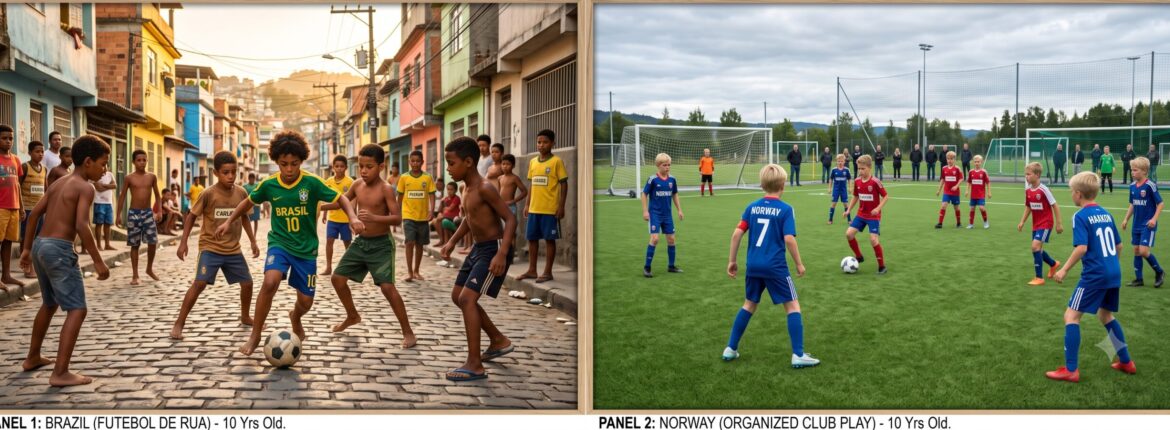
For nearly a century, Brazil stood as the undisputed global superpower of soccer. Its secret weapon was never a state-of-the-art training complex, corporate sponsorship, or a rigid tactical playbook. It was futebol de rua—street football.
Within the favelas and urban avenues of Brazil, children spent hours playing unsupervised on uneven cobblestones, beaches, and narrow alleyways. This unstructured environment served as a natural incubator for athletic mastery, forcing the brain to adapt dynamically to erratic bounces, tight spatial constraints, and shifting numbers of opponents.
However, as globalization, urbanization, and screen-time swept across South America, Brazil’s historic street culture began to recede. Private academies, rigid club systems, and monetization filled the vacuum, locking childhood development behind paywalls and standardized drills.
Paradoxically, it is Norway—a country covered in snow for half the year—that has successfully reverse-engineered Brazil’s historical street advantage. Through structural design, such as legally banning scoreboards and early talent selection in youth sports, Norway has built a mechanized version of the Brazilian street. They are proving that the street is not a geographic location, but a psychological state.
The Neuroscience of the Alleyway
What made Brazil’s historical street play so effective? Viewed through the framework of Jeff Hawkins’s Thousand Brains Theory, uncoached street play operates as an elite engine for building high-dimensional mental maps.
When a child plays in an unmanaged street game, their cortical columns are continuously flooded with chaotic, non-linear sensory input:
- Dynamic Problem Solving: The ball ricochets off a curb or uneven ground; the brain must instantly compute and react.
- Autonomous Prediction: A larger opponent closes in; the player must improvise a novel escape route.
- Pure Sensorimotor Inference: Free from coaches shouting positional instructions from the sideline, the child's brain runs closed-loop predictions—executing a motor movement and instantly processing real-time physical feedback.
When youth sports are prematurely formalized with adult referees, rigid tactical positions, and visible scoreboards, the environment becomes homogenized. The brain stops building complex, adaptive reference frames and instead begins memorizing static, risk-averse scripts.
Institutionalizing Chaos: The Norwegian Sandbox
Norway’s youth sports model is anchored by the framework of Idrettsglede (the joy of sport). Governed by the national Children’s Rights in Sports charter—introduced in 1987 and refined over decades—Norwegian youth athletics act as a legal shield for exploratory chaos.
Until children turn 13, official standings cannot be kept, league tables cannot be published, and player rankings or national championships are prohibited. This infrastructure effectively mimics a neighborhood alleyway:
- Erasing the Fear of the Bench: In traditional outcome-driven systems, a player attempting an audacious, high-risk maneuver risks being benched for a turnover that causes a loss. The system penalizes exploration.
- The Street Rules Sandbox: In Norway's unranked environment, a child can try that same risky maneuver repeatedly. Without a scoreboard to ruin or metrics tracked by parents, the penalty for failure is zero, preserving the courage required for true innovation.
The Evidence: Scaling to the Global Stage
The results of this cultural and structural shift are visible on the world stage. While Brazil has faced challenges producing the freewheeling, hyper-creative virtuosos of its past, Norway—with a population of roughly 5.6 million compared to Brazil’s 213 million—produces dominant, world-class athletes across multiple disciplines.
On the soccer pitch, this philosophy has translated directly into historic performances. Norway holds an unblemished competitive record against Brazil in FIFA World Cup history, famously defeating the five-time champions 2–1 during the 1998 group stage in France and repeating the exact same 2–1 scoreline against Brazil in the Round of 16 at the 2026 FIFA World Cup, propelled by a decisive brace from Erling Haaland.
Comparative Framework
| Feature | Historic Brazil (Street Play) | Modern Formalized Systems | Norway's Reengineered Model |
| Environment | Chaotic, organic streets | Hyper-structured academies | Organized clubs, chaotic rules |
| Primary Driver | Peer-to-peer play & joy | Scoreboards, rankings, ROI | Idrettsglede (Joy of Sport) |
| Risk Profile | Zero-cost mistake exploration | High-stakes performance anxiety | Protected, zero-cost exploration |
Conclusion
Norway’s masterstroke was recognizing that the street isn't a geographical location—it's a psychological state. By protecting childhood from premature professionalization, technological shortcutting, and outcome-obsessed scorekeeping, they preserved the messy, joyful, and chaotic laboratory where true human genius is born.
References
- Breen, Mick. (2026). Norway Banned Scores in Kids' Sport Until Age 13 — Then Won the Olympics. Natural Born Running. Available at: Natural Born Running Blog.
- Norges Idrettsforbund (NIF). The Children’s Rights in Sports (Barneidrettsbestemmelser). Official governance framework for Norwegian youth athletics, establishing guidelines on unranked play and Idrettsglede.
- FIFA World Cup Historical Archives. Head-to-head match records and tournament summaries for Brazil vs. Norway (including the 1998 group stage and the 2026 FIFA World Cup Round of 16 encounter at MetLife Stadium).
- Hawkins, Jeff. (2021). A Thousand Brains: A New Theory of Intelligence. Basic Books. (Referenced conceptually regarding cortical columns, predictive processing, and sensorimotor inference models).
- Nelson, January. (2026). Norway Doesn't Keep Score in Youth Sports Until Kids Turn 13. Thought Catalog.