

Modern text-to-image AI models—such as Midjourney, Stable Diffusion, and DALL-E—can generate stunning, hyper-realistic imagery at the click of a button. Yet, despite their artistic flair, these generators frequently suffer from bizarre, immersion-breaking structural failures. Ask an AI to draw a person holding a coffee mug, and the hand might clip through the porcelain, the handle might attach inside the cup, or a variable number of extra fingers might emerge from the skin.
To the casual observer, these mistakes seem like silly rendering glitches. To neuroscientists and AI architects, they point to a foundational absence in modern neural networks: current AI lacks a structural understanding of physical objects.
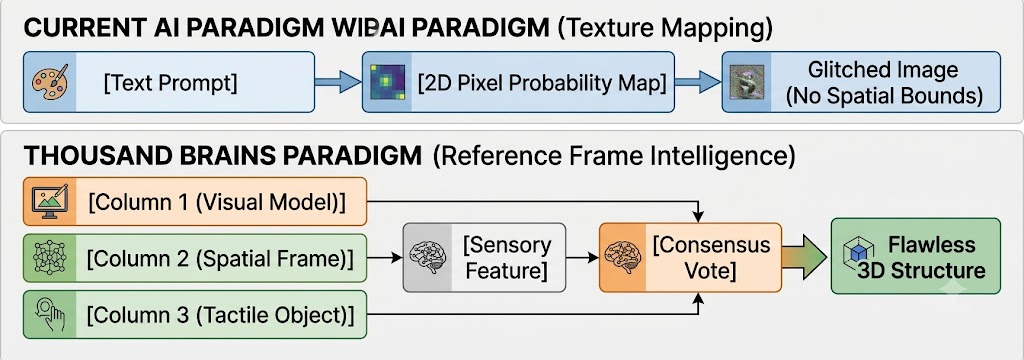
By analyzing these errors through the lens of Jeff Hawkins’ Thousand Brains Theory of Intelligence, it becomes clear that AI image generation hits a "compositional wall" because it entirely lacks allocentric reference frames and a parallel, sensorimotor-driven world model.
1. The Core Problem: Pixel Patterns vs. Structural Reality
Traditional image generation models are built on deep neural networks trained via huge, static datasets of 2D images and text descriptions. When given a prompt, they use statistical diffusion to arrange pixels into textures that match the patterns they have memorized.
The Illusion of Form
Because generative AI operates primarily on textures and pixel associations, it does not actually know that an arm is a three-dimensional cylinder connected to a shoulder joint, or that a handle is an independent sub-object attached to the exterior of a mug. The model only knows what a mug looks like from a flat, two-dimensional statistical perspective.
This lack of geometric grounding causes the model to fail at object compositionality—the ability to cleanly arrange independent parts into a structurally coherent whole. Because the AI is guessing the next pixel rather than calculating spatial coordinates, it routinely fumbles structural physics, spatial orientations, and interlocking human anatomy.
2. What Is Missing? The Thousand Brains Reference Frame
The human brain avoids these rendering mistakes completely. When you see or touch an object, your neocortex is not just processing flat visual textures; it is instantly plotting those inputs onto an internal map. According to the Thousand Brains Theory, the neocortex is divided into roughly 150,000 independent computing units called cortical columns. Each individual column acts as a semi-independent sensorimotor system that constructs a complete 3D model of the world.
The core data structure making this possible is the allocentric reference frame—an internal, explicit coordinate system that maps where features belong relative to the object itself, completely independent of the viewer's angle.
To coordinate this spatial intelligence, the brain relies on specific neural mechanics:
- Cortical Grid Cells: Derived from evolutionary navigation hardware, these track positions within an object's reference frame, ensuring that sensory features are always locked to a strict physical coordinate.
- Displacement Cells: These calculate the exact spatial distance and directional vector between different reference frames. They allow the brain to register a "handle" as an autonomous object and place it precisely onto the reference frame of a "mug" without causing clipping, structural inversion, or spatial clipping.
- Consensus Voting: Columns cross-reference their localized spaces via long-range lateral connections. If one column notices a structural mismatch (e.g., a floating finger), the system "votes" down the impossible hypothesis, creating a singular, flawless perception.
3. How Reference Frame Intelligence Will Revolutionize Image Generation
If next-generation image models replace standard flat layers with a Thousand Brains architecture, the entire paradigm of asset generation will change from superficial texture replication to structural spatial generation.
True Generative 3D Modeling
Instead of predicting flat pixels, a reference-frame-driven generative AI would first construct the underlying 3D reference spaces for the subjects in a prompt. If told to generate "a hand gripping a sword," the AI would map the explicit geometric constraints of the sword's hilt and use its internal displacement mechanics to wrap the fingers seamlessly around those coordinates.
Total Spatial Invariance
An image AI grounded in reference frames would inherently understand object geometry and symmetry. Once it learns the structural form of an object, it can instantly render it at any angle, depth, or lighting condition. This would completely eliminate instances where characters look radically different across multiple panel generations or possess anatomically warped limbs.
Perfect Object Compositionality
By utilizing simulated displacement metrics, the AI would cleanly recognize complex scenes as assemblies of discrete sub-objects. Buttons would sit strictly on top of coat fabric; glasses would align perfectly with the bridge of a nose; and structural columns would obey the hard constraints of perspective and depth.
The Horizon of Spatial Intelligence
The persistent glitches in modern image models serve as proof that scaling up dataset size and computing power cannot fix an architectural lack of world understanding. For AI image tools to mature past superficial approximation and master complex compositions, they must abandon the pure statistical distribution of 2D pixels.
By building multi-column networks that process information via explicit allocentric reference frames, the AI industry can transition from brittle texture synthesizers to robust engines of true spatial intelligence—capable of creating art that is not only visually striking, but structurally flawless.