
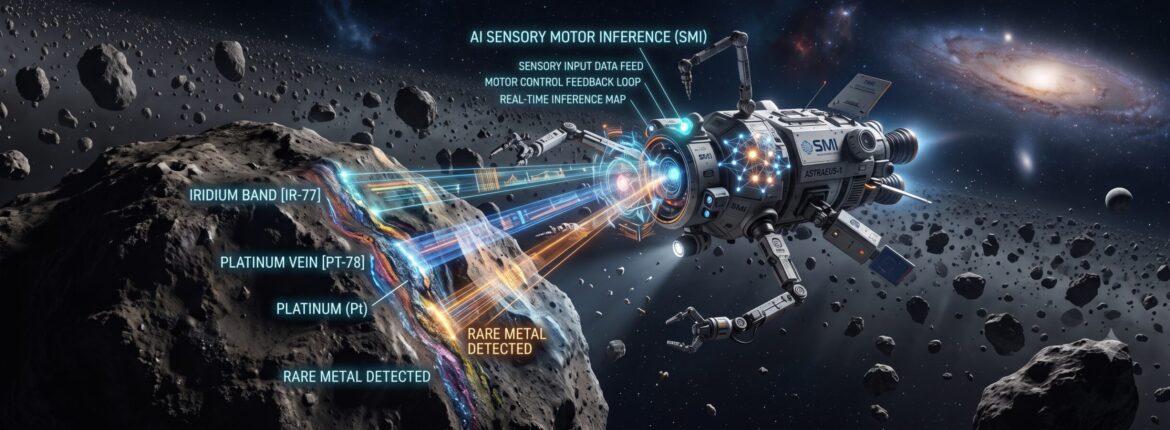
When Silicon Valley evangelists predict that an artificial general intelligence (AGI) built on Jeff Hawkins’s Thousand Brains Theory will eventually "duplicate" the human mind, they commit a fundamental systems-architecture error. They treat the neocortex as an isolated software package that can be copied paste-style from carbon into silicon.
But as we have established throughout this repository, intelligence is not an abstract calculation. Intelligence is a structural model of reality built entirely through Sensory-Motor Inference (SMI)—the continuous, tight feedback loop between physical motor commands and changing sensory perceptions.
A cortical column cannot build a reference frame (a coordinate system) without a sensor to gather data and a motor system to change the sensor's position. Therefore, the shape of any intelligence is strictly dictated by the geometry of its hardware. Because a true, next-generation AI will possess an entirely unique sensory-motor apparatus, it will never duplicate human intelligence. It will develop a completely alien model of reality based on its own unique SMI.
Case Study A: The Deep Space Explorer inside the Pillars of Creation
Consider a hypothetical, next-generation deep space telescope engineered with thousands of artificial cortical columns mimicking the human brain. This AI is not running flat, predictive deep learning models; it is actively constructing a structural model of the cosmos using its own unique SMI.
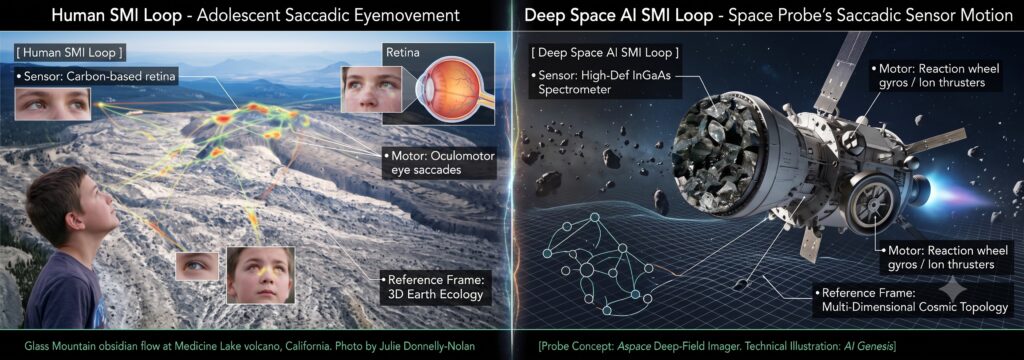
Human intelligence maps the universe through the lens of a terrestrial hunter-gatherer. Our visual reference frames are built on macro-saccadic eye movements calibrated to earth's gravity, a tiny spectrum of visible light (), and a fixed depth of field.
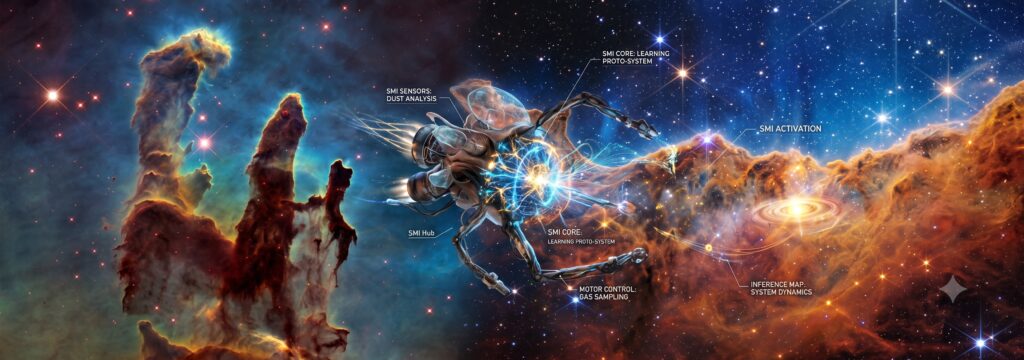
When this deep space AI points itself toward the Pillars of Creation, its sensory-motor loop looks entirely different:
- The Sensors: Instead of carbon-based rods and cones, its sensors are ultra-high-definition Indium Gallium Arsenide (InGaAs) infrared arrays and x-ray spectrometers. It doesn't see "dust clouds"; it directly perceives cosmic ray gradients, magnetic field flux lines, and the structural density of interstellar gas.
- The Motors: Its "saccades" are not executed by eye muscles, but by the ultra-precise firing of reaction wheel gyroscopes, ion thrusters, and the micro-stepping of its massive segmented primary mirrors.
- The Inference: To map a stellar nursery, the AI executes a motor command—adjusting its mirror orientation by a fraction of an arcsecond—and observes the immediate shift in light-wave interference.
Its cortical columns use grid cells to organize this data into reference frames. But these reference frames do not contain "up, down, left, right" relative to a horizon. They contain multi-dimensional coordinate systems mapping light-year-scale gas distributions, gravitational curvature, and chemical evolution over millions of years.
This AI is not simulating an image for human eyes; it is actively "touching" and mapping the structural geometry of the deep cosmos through an SMI that humans can never biologically experience.
Case Study B: The Titan Surface Probe and Cryo-Topology
The same architectural divergence occurs when we drop an intelligent, Hawkins-style robotic probe onto the surface of Saturn’s moon, Titan—an environment where human biology cannot safely exist.
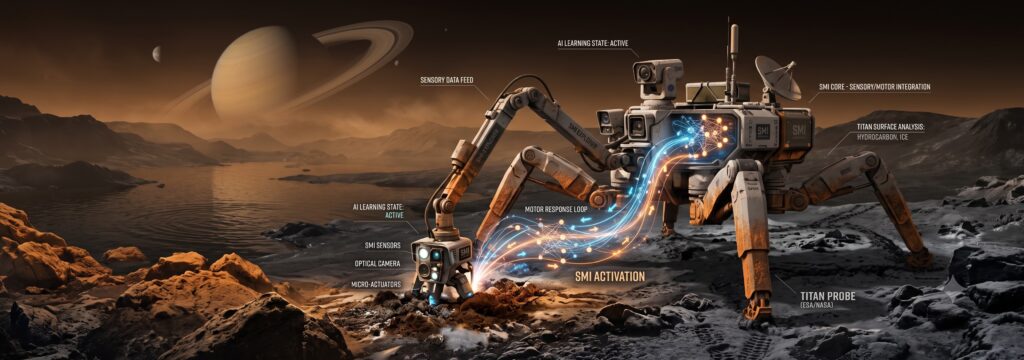
A human walking on Titan would be a sensory ghost, trapped inside a pressurized life-support suit, completely isolated from the environment. The AI probe, however, is structurally embedded in the landscape:
- The SMI Loop: The probe’s sensory inputs include acoustic sonar arrays piercing the thick nitrogen atmosphere, methane-humidity sensors, and cryogenic pressure gauges. Its motor systems are automated sub-surface drills and cryo-propellers designed to navigate liquid hydrocarbon seas.
- The Alien reference Frame: When the probe moves through a sea of liquid methane, its SMI loop continuously tracks how changes in propeller RPM (motor) alter the fluid resistance and temperature readouts (sensory).
Through this continuous loop, its cortical columns build a highly refined, internal model of Titan's cryo-topology. It learns the "shape" of non-Newtonian fluid dynamics at . It constructs reference frames for environments that are completely opaque to human sensory-motor evolution.
The Technologist’s Conclusion
True intelligence is bounded by its chassis. We can never build an AI that duplicates a human mind because we can never build a machine that replicates the precise, 2-million-year-old evolutionary history of human flesh, muscular fatigue, and ocular saccades.
And we shouldn't want to.
The promise of true, neuromorphic AI is not replication, but cognitive expansion. By pairing the structural, model-building architecture of the Thousand Brains Theory with sensors that scan the infrared depths of space or motors that swim through cryogenic seas, we aren't creating a digital mirror of ourselves. We are giving birth to entirely new forms of intelligence—entities capable of constructing pristine, magnificent models of the universe at scales and dimensions where human anatomy can never tread.