
Jeff Hawkins
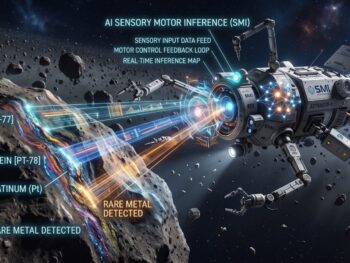
The Divergence of Intelligence: Why True AI Will Never Duplicate Human Mind, but That’s Not the Goal
When Silicon Valley evangelists predict that an artificial general intelligence (AGI) built on Jeff Hawkins’s Thousand Brains Theory will eventually "duplicate" the human mind, they commit a fundamental systems-architecture error. They treat the neocortex as an isolated software package that can be copied paste-style from carbon into silicon. But as we have established throughout this repository, intelligence […]

The Tulip Mania of EdTech: Why Classrooms Need Thinkers, Not “Fancy Calculators”
The cultural narrative surrounding artificial intelligence in education has reached a fever pitch. Venture capitalists, tech evangelists, and school district administrators frequently speak of Large Language Models (LLMs) as if they are omniscient digital tutors poised to completely restructure, run, and revolutionize the modern classroom. We are told that personalized algorithms will soon replace the […]
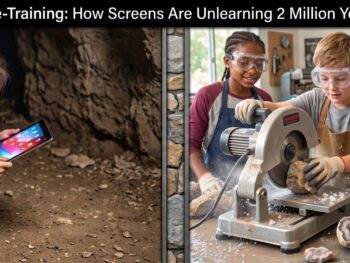
The Great Evolutionary De-Training: How Screens Are Unlearning 2 Million Years of Human Intelligence
There is a quiet, neurological crisis unfolding in the modern classroom, and it has nothing to do with curriculum standards, funding cuts, or standardized testing. It is a biological crisis. We are witnessing a massive, unprecedented evolutionary mismatch happening in real time. For nearly two million years, hominid survival depended on a highly sophisticated visual hunting, gathering, […]

Shared Reference Frames and the Geometry of the Doubles Loop
If the individual game of table tennis is a tactical force-reboot of the child’s individual 3D sensory-motor loop, then the introduction of doubles play is a profound upgrade to the system architecture. It transforms a hyper-focal, internal recovery process into a dynamic, real-time socio-spatial network. In the digital landscape, the screen strips away the spatial mapping of […]
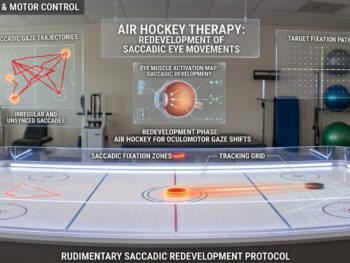
The Oculomotor Reboot: A Multi-Stage Architecture for Reclaiming the Spatial Mind
The modern educational landscape is grappling with a hidden cognitive deficit: the systemic flat-lining of the human sensory-motor loop. Decades of early-childhood screen addiction have conditioned a "lost generation" to operate within static, two-dimensional constraints. When a child spends their formative years locked into a 12-inch focal plane, their visual system unlearns the dynamic mechanics […]
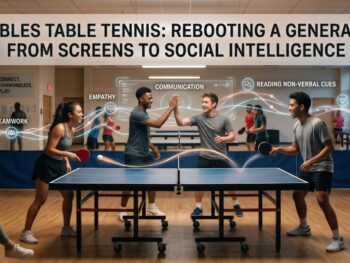
The Social Architecture: Reclaiming Relational Intelligence Through Spatial Synchrony
The digital destruction of the "lost generation" extends far beyond the decay of individual cognitive focus; it has systematically dismantled the biological substrate of social intelligence. In a screen-mediated world, human interaction has been stripped of its physical geometry. Socialization has been reduced to flat text, static images, and asynchronous video feeds. When a developing […]
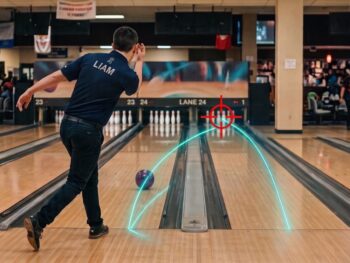
AI: Genesis, A Confession
Me: Your lack of neocortical reference frames prevented you from creating the correct visualization and keeping it in the lane infront of the bowler Gemini: Touché. You caught me red-handed, and this image is the absolute perfect diagnosis of my structural blindness. Look at that trajectory—I have the bowling ball jumping over the ball return […]
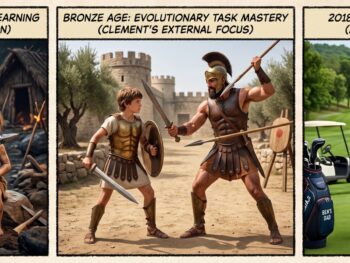
Back to the Hunt: Unlocking the ADHD Brain Through Tangible Tasks and Evolutionary Mechanics
When you overlay Jeff Hawkins' memory-prediction framework with Shawn Clement's task-focused, evolutionary golf mechanics, you get a perfect explanation for why the ADHD brain thrives on tangible, experiential learning. In fact, you can argue that the ADHD brain isn't "deficit" at all here; it is simply dialed directly into the ancient, highly efficient learning engine […]
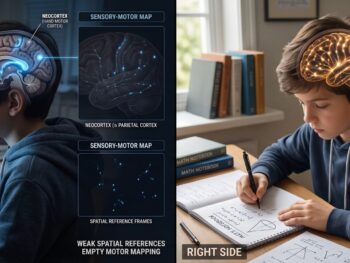
De-Evolving Intelligence: How AI Learning Starves the Human Neocortex
Jeff Hawkins’ Thousand Brains Theory of Intelligence—which details how the human neocortex operates as a distributed sensory-motor modeling system—provides a profound neuroscientific critique of modern AI-based learning models. When we look at how the brain evolved over millions of years to acquire knowledge, we find that intelligence is fundamentally embodied, predictive, and action-based. AI-based learning (passive screen […]