

There is a quiet, neurological crisis unfolding in the modern classroom, and it has nothing to do with curriculum standards, funding cuts, or standardized testing. It is a biological crisis. We are witnessing a massive, unprecedented evolutionary mismatch happening in real time.
For nearly two million years, hominid survival depended on a highly sophisticated visual hunting, gathering, and mapping mechanism. Our eyes evolved to scan vast, three-dimensional landscapes—spotting camouflaged patterns, tracking moving targets, and calculating complex spatial trajectories. This active, exploratory physical movement is the literal engine of human thought.
Yet, under the guise of "digital babysitting" and well-intentioned edtech integration, we have trapped this magnificent biological engine inside a tiny, static, two-dimensional box. By handing toddlers and young children electronic devices, we are forcing them to actively unlearn the baseline neurological skills that took millennia to evolve—skills that are foundational to high-level critical thinking, advanced mathematics, and deep reading.
To understand exactly how screens are dismantling our children's minds, we must look to the cutting edge of neuroscience: Jeff Hawkins’s Thousand Brains Theory of Intelligence.
The Biological Truth: Thinking is a Form of Movement
In his pioneering research on the human neocortex, neuroscientist Jeff Hawkins argues that true intelligence is not a passive data-processing reservoir. It is an active, physical exploration. The brain achieves intelligence by building a dynamic, structural model of the world inside its cortical columns.
This model is constructed through Sensory-Motor Inference (SMI)—the continuous, chaotic feedback loop between physical movement and sensory perception.
- The Biological Engine: When a child interacts with the real world, their eyes execute rapid, ballistic jumps called saccades, their neck muscles fire to adjust their head orientation, and their body shifts weight.
- The Internal Map: The neocortex hijacks the exact same evolutionarily ancient GPS structures (grid cells and place cells) used for physical navigation to map abstract concepts.
According to Hawkins, the brain stores all knowledge topologically using reference frames (coordinate systems). When a mathematician steps through a complex theoretical proof, or when a student hunts for an obscure theorem to justify a step in geometry, their focus is literally "saccading" across a mental map of ideas. Saccadic thought is a direct downstream reflection of physical motor architecture. You cannot have fluid, high-level abstract thought if you degrade the physical sensory-motor engine that builds the coordinates.
The Screen Bottleneck: Flattening the 3D Reference Frame
When a young child spends hours staring at a smartphone or tablet, a catastrophic biological freezing occurs. The rich, 3D sensory-motor loop collapses into a closed, linear dead-end.
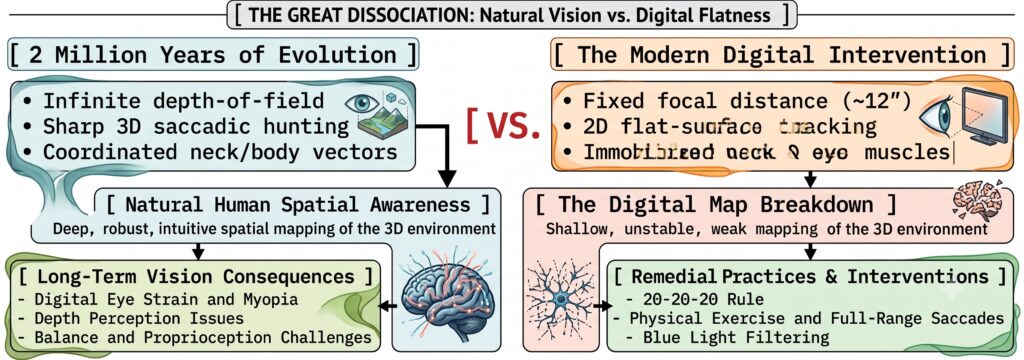
This evolutionary de-training breaks down child development across three profound vectors:
1. The Erasure of the Z-Axis (Depth of Field)
In the real world, a child builds reference frames by grabbing a block, dropping a cup, and moving through space. Their eyes constantly recalculate vergence (the inward/outward turning of the eyes) and accommodation (changing the lens focus). This mastery of the Z-axis gives abstract logic a "shape" in the neocortex.
A screen completely eliminates the Z-axis. No matter how much hyper-stimulating action occurs on a display, the physical glass remains a flat plane exactly 12 inches from the face. The brain's depth-mapping architecture is left entirely unexercised, leading to what researchers call the "video deficit"—an inability to transfer flat, digital inputs into real-world comprehension.
2. Saccadic Fatigue and the "Hypnotic Fixation"
Deep reading and structural thinking require highly disciplined, active saccadic jumps (sharp, rapid eye movements across text) followed by steady fixations. But modern screen media—built on algorithmic, rapid-fire video edits—requires zero scanning. Instead, it exploits our primitive orienting reflex, locking the child's eyes into a passive, hypnotic fixation. The screen does the scanning for them.
Over time, the brain prunes away the neural pathways required to launch controlled saccades. When trained on a screen, the eye movements default to a shallow, lazy skimming pattern.
3. Proprioceptive Amnesia (Locked Neck, Locked Mind)
Watch a child on an iPad: their neck is locked, their torso is rigid, and their body is immobilized. In nature, every eye movement is validated by a micro-shift in the neck muscles (which are packed with spatial sensors called proprioceptors). This multi-sensory feedback loop is what makes internal reference frames stable. Without body and neck movement, the brain is attempting to map the universe with a floating, unstable camera. The physical saccadic system stalls, and the cognitive saccadic thought stalls with it.
The EdTech Delusion: Valuing the "Fancy Calculator"
This biological de-training explains why the current rush to run classrooms via algorithmic, LLM-driven software is a form of irrational exuberance reminiscent of the 17th-century Dutch Tulip Mania. Tech evangelists treat education as a data-transmission problem to be optimized by machines, attributing an almost mystical capability to Large Language Models simply because their output looks dazzling on the surface.
But as Hawkins notes, these deep learning models are fundamentally ungrounded. They possess no model of reality, no sensory-motor inference, and no structural reference frames. They are incredibly sophisticated, brute-force "fancy calculators" predicting the next most probable word based on static text.
When we rely on these flat, predictive engines to babysit or instruct our youth, we are swapping out human pedagogy—which is fundamentally relational, spatial, and adaptive—for shallow data-skimming. We are asking children who have unlearned how to execute disciplined, saccadic tracking to learn from a medium that rewards a fragmented attention span.
Reclaiming the Director's Chair
We do not look upward when searching for an elusive thought because the answer is written on the ceiling; we look upward to break our physical fixation on immediate objects, clearing the visual canvas so our neocortex can deploy its internal spatial coordinates to hunt through memory.
If we continue to anchor our children's biology to fixed, flat screens from infancy, we strip them of the very engine that allows them to scan their own minds. By the time they enter high school math or science, they hit a cognitive wall. They get frustrated and abandon complex proofs not because they lack the raw intellect, but because their physical eye and neck tracking systems have atrophied. They can no longer hold the geometry of logic together.
It is time to pop the digital bubble. Technology is an exceptional tool for the human "Director" to use when automating administrative minutiae or crunching rote numbers. But the human mind must remain in the director's chair. To raise thinkers capable of navigating the complex, abstract topologies of tomorrow's breakthroughs, we must first protect the 2-million-year-old biological engine that makes thinking possible. Our kids need to move, to scan, and to explore a three-dimensional world—because human intelligence cannot be simulated on a pane of glass.