
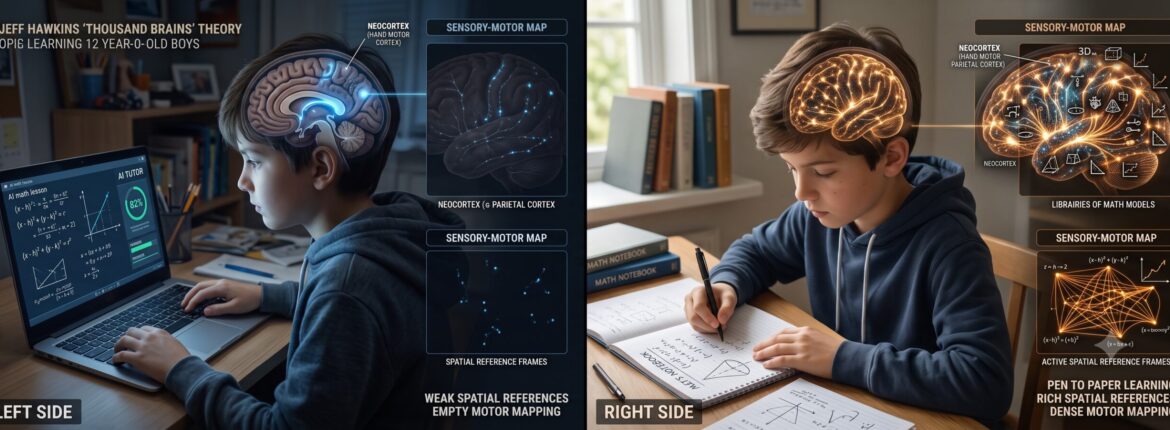
Jeff Hawkins’ Thousand Brains Theory of Intelligence—which details how the human neocortex operates as a distributed sensory-motor modeling system—provides a profound neuroscientific critique of modern AI-based learning models.
When we look at how the brain evolved over millions of years to acquire knowledge, we find that intelligence is fundamentally embodied, predictive, and action-based. AI-based learning (passive screen consumption, text-heavy generative modules, and static algorithmic software) directly contradicts this architecture.
"You can't fight 2 million years of human neocortical evolution." When school systems swap out real-world engagement for AI-driven interfaces, they create severe learning deficits by trying to bypass how the human brain actually constructs reality.
1. The Core of Hawkins' Theory: Sensorimotor Inference
Traditional neuroscience assumed that the brain was a passive receiver: data enters the eyes or ears, moves up a hierarchy, and eventually constructs a picture of a cup or a math formula. Hawkins and his team at Numenta proved the opposite: the brain cannot decouple sensory input from physical action.
- The Neocortex is a Movement Machine: Every one of the roughly 150,000 cortical columns in the neocortex is a complete sensorimotor learning loop. We learn what a cup is because our fingers move across it, predicting what texture or edge comes next based on that movement.
- Thinking is Internalized Movement: Hawkins argues that "thinking" itself is literally just the neocortex moving through abstract reference frames the same way a body moves through physical space.
The AI Learning Deficit:
AI-driven learning platforms treat the human brain like a passive vessel to be filled with data. They assume that if a child stares at a screen long enough or interacts with a chatbot, learning happens. But because the screen lacks physical orientation, depth, and genuine kinetic feedback, the cortical columns are starved of the sensorimotor data they require to map information effectively.
2. Reference Frames vs. Data Ingestion
Hawkins discovered that the neocortex utilizes cortical grid cells (similar to the GPS system found in the primitive navigation parts of the brain) to build structured, multi-dimensional "reference frames" for everything we learn—from a physical coffee cup to an abstract mathematical equation.
- Human Learning: We map concepts like variables, geometry, or logic onto internal, spatial-like reference frames.We navigate concepts much like walking through an environment. This allows humans to learn a concept from just a few active, self-directed examples and apply it universally.
- AI Learning: Current generative AI does not use reference frames; it uses statistical probabilities over massive matrices of static data.
The AI Learning Deficit:
When students consume "personalized" AI lessons, they are fed pre-digested linear data pathways. The child's brain isn't allowed to struggle, navigate, orient, or build its own reference frames. It completely bypasses the biological necessity of Predictive Coding—where the brain makes an active guess, fails, experiences a prediction error, and physically rewires itself to correct the model. AI learning removes the friction required for neural plasticity.
3. The "Voting" Disconnect
In the Thousand Brains Theory, separate parts of your brain are building independent models of the same object simultaneously. Your eyes see the cup, your hands touch it, your auditory system hears it clink. These columns then "vote" across long-range neural connections to create a unified, robust understanding.
[Sensory Input] ──> [Cortical Columns Build Models] ──> [Long-Range Voting] ──> [Unified Understanding]
The AI Learning Deficit:
AI interaction is intensely hyper-focused on a single, isolated stream: visual text or a flat 2D image. By trapping a child in a sterile, screen-mediated environment, the brain's multi-sensory "voting mechanism" becomes entirely useless. The knowledge gained becomes brittle, fragile, and highly contextualized to the screen itself—which is why children can often ace an automated AI math quiz but fail completely when asked to apply that same math to a physical, real-world project.
4. The Evolutionary Backlash: ADHD & Neuro-emotional Rejection
Evolution did not design the human neocortex to sit motionless in a chair staring at an illuminated pane of glass for hours on end, absorbing algorithms. This is doubly true for the ADHD nervous system, which relies explicitly on high-interest, tactile, highly engaging feedback loops to drive focus.
- When schools outsource education to software, they force the evolutionary biology of a child to fight against its own anatomy.
- The child’s brain interprets this static, non-sensorimotor environment as sensory deprivation. It responds with hyperactivity (an instinctual drive to move and force sensorimotor input) or executive shutdown.
Summary for the ADHDEscapeRoom Narrative
If the goal of education is to cultivate deep, adaptive intelligence, we have to respect the biology of the machine running the software. As Hawkins' research proves, the neocortex is a biological device built to explore, manipulate, fail, move, and synthesize.
Replacing human-to-human, object-to-hand sensorimotor teaching with AI learning tools doesn't optimize education; it strips away the exact environmental variables that our brains have spent 2 million years relying on to become smart in the first place.
For a deeper look into how the brain actively constructs these parallel models of the world through movement, check out this talk on The Thousand Brains Theory by Jeff Hawkins, which outlines the foundational mechanics of sensorimotor intelligence.