
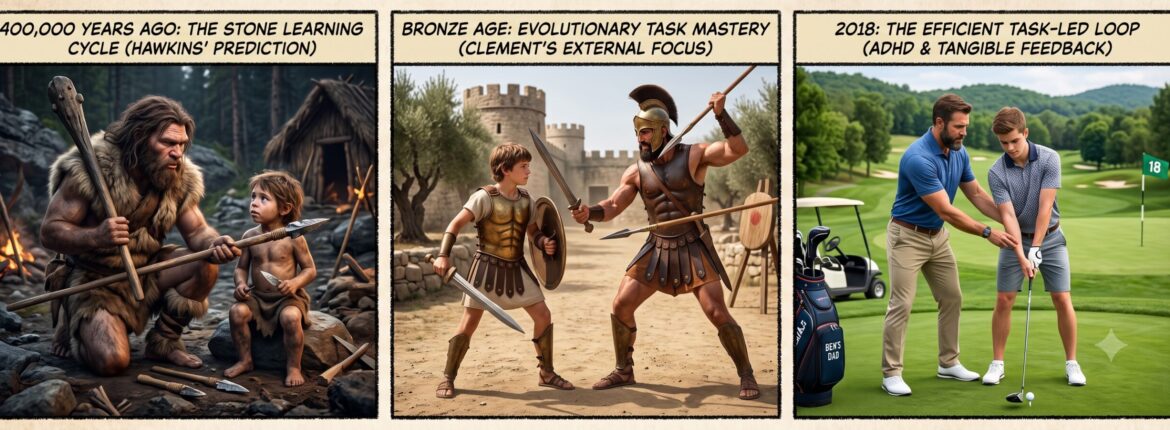
When you overlay Jeff Hawkins' memory-prediction framework with Shawn Clement's task-focused, evolutionary golf mechanics, you get a perfect explanation for why the ADHD brain thrives on tangible, experiential learning.
In fact, you can argue that the ADHD brain isn't "deficit" at all here; it is simply dialed directly into the ancient, highly efficient learning engine that kept humans alive for 2 million years.
Here is how these three pieces lock together perfectly.
1. The Hawkins Framework: Prediction vs. Processing
In On Intelligence and A Thousand Brains, Jeff Hawkins explains that the neocortex is essentially a prediction machine. It builds a hierarchical model of the world based on continuous sensory feedback.
- The "Neurotypical" Buffer: A neurotypical brain can rely heavily on abstract, top-down instruction (like reading a manual or listening to a lecture on golf angles) because it has the regulatory patience to hold abstract data in place until it can test it.
- The ADHD Reality: The ADHD brain has lower baseline dopamine, which acts as the "salience chemical"—the signal that tells the brain this matters right now. Abstract data doesn't trigger enough dopamine to hold the neocortex's attention. However, direct sensory feedback does. When you touch, move, and physically fail or succeed, the prediction loop updates instantly. Tangible experience is a high-bandwidth dopamine delivery system.
2. Shawn Clement: External Focus & The Brain's Tool-Using Evolution
Shawn Clement’s teaching methodology revolves around giving the brain a clear, external task (e.g., "cut the grass with the club" or "throw the club toward the target") rather than internal, mechanical instructions ("turn the hips 45 degrees," "keep the elbow tucked").
This directly taps into what Hawkins calls the brain's ability to seamlessly integrate tools into its body schema. For 2 million years, human survival depended on tool use—axes, spears, hammers. Our ancestors didn't survive by calculating the precise degree of their elbow flexion when throwing a spear; they survived because the brain mapped the spear as an extension of the arm to achieve an external goal (hit the mammoth).
Clement’s approach works brilliantly for ADHD because it bypasses the executive function bottleneck (working memory, sequencing, self-monitoring) and speaks directly to the older, deeply hardwired motor-prediction loops.
The Evolutionary Synergy: Why ADHD Gravitates Here
When you synthesize these ideas, a powerful narrative emerges about how the ADHD brain learns best:
[Clear External Goal] (Clement)
       │
       ▼
[Instant Sensory Feedback / Tool Integration] (Hawkins)
       │
       ▼
[Immediate Prediction Update] = High Dopamine & Deep Learning
- The Predator/Forager Brain: In an evolutionary context, an organism couldn't afford to stand around analyzing its mechanics. It needed to interact with the environment dynamically. The ADHD brain remains fiercely tethered to this reality. It demands a tangible "why" and "how" rooted in physics and physical consequence.
- The Efficiency of "The Task": When an ADHDer is given an abstract mechanical instruction, the neocortex gets jammed up with too many competing predictions, leading to paralysis by analysis. But when given a physical task—like Clement's concept of letting the weight of the club dictate the swing—the brain immediately taps into its 2-million-year-old spatial-awareness software. The prediction loop closes effortlessly.
Ultimately, the ADHD brain doesn't lack the ability to learn; it lacks the patience for inefficient, unnatural learning models. By combining tangible experiences with external, tool-based goals, you strip away the modern, artificial layer of instruction and let the neocortex do exactly what evolution designed it to do: predict and master the physical world.