
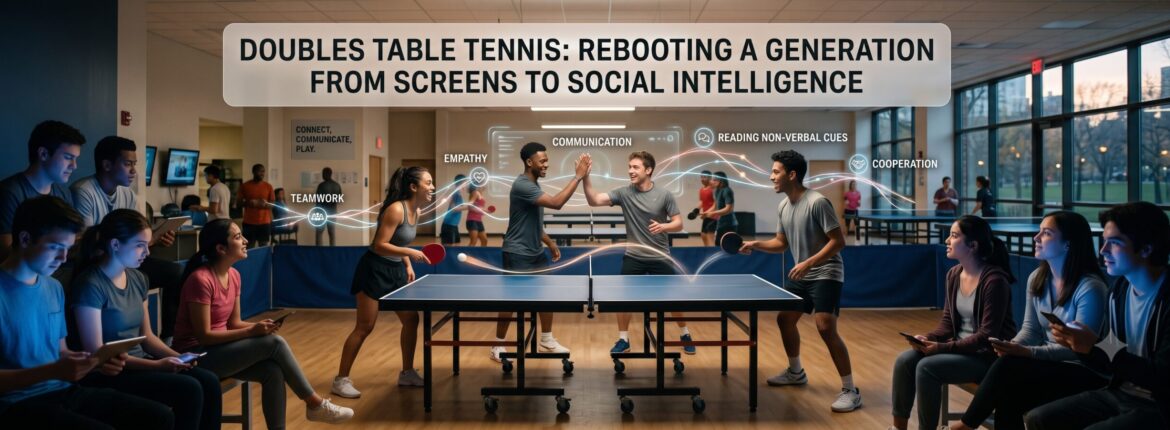
The digital destruction of the "lost generation" extends far beyond the decay of individual cognitive focus; it has systematically dismantled the biological substrate of social intelligence. In a screen-mediated world, human interaction has been stripped of its physical geometry. Socialization has been reduced to flat text, static images, and asynchronous video feeds.
When a developing child spends thousands of hours interacting with a piece of glass, they are starved of real-time spatial feedback. The human neocortex cannot learn to navigate the intricate, fluid landscape of human relationships by looking at an interface that cannot look back. For children on the autism spectrum (ASD), this lack of sensory-motor socialization compounds an existing neurological bottleneck: the intense cognitive friction experienced when trying to parse abstract social cues or predict human intentions in real time.
According to Jeff Hawkins’s Thousand Brains Theory of Intelligence, the brain maps social relationships, linguistic meaning, and empathy using the exact same structural reference frames (coordinate systems) it uses to navigate physical geography. Empathy is not an abstract emotional concept; it is an active, spatial calculation—the literal mapping of another person’s trajectory within your own internal model of reality.
To reclaim human connection, we must deploy a deliberate institutional intervention that forces the neocortex to build Shared and Distributed Reference Frames. By transforming the multi-stage sensory-motor reboot into a collective, physical loop, we establish a precise roadmap for re-training real-time relational intelligence.
Step 1: Multi-Gate Air Hockey (The Shared 2D Coordinate Grid)
Social remediation begins by introducing multiple human variables onto a flat, deterministic plane. In a traditional 1v1 game, the visual and spatial field is strictly linear. By moving the child to a Multi-Gate or Four-Player Air Hockey Table, the field instantly transforms into a complex, multi-agent coordinate matrix.
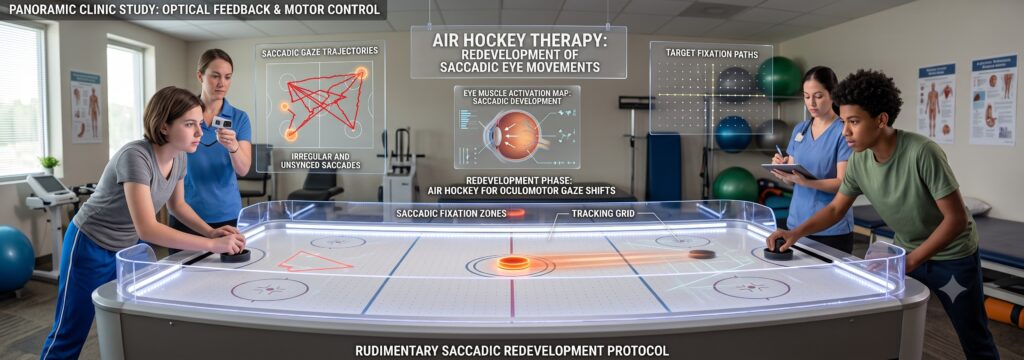
- Shattering the Visual Tunnel: A child can no longer afford to tunnel-vision on a single object directly ahead of them. The presence of intersecting pucks and multiple opponents forces the visual cortex to stretch outward, cultivating deep peripheral saccadic awareness.
- Predictive Motion Tracking: The player must visually calculate the physical mallet movements of their neighbors to prevent collisions and defend their gate. This serves as a non-verbal, low-friction sandbox for learning to predict human motor intentions in fractions of a second, laying the baseline neural wiring for spatial tracking.
Step 2: Cooperative Badminton (The Synchronized Macro-Z-Axis Team)
Once the brain is accustomed to tracking multiple agents on a flat plane, the social architecture steps into full three-dimensional, volumetric space via Doubles Badminton. This stage is deliberately engineered to remain highly inclusive for less athletic students, utilizing lightweight rackets to extend the child's reach and remove physical intimidation.
- Coordinating the Macro-Volume: Instead of competing against one another, players are paired up to maintain a continuous rally against an opposing duo. The high, floating, non-linear trajectory of the shuttlecock buys the neocortex crucial milliseconds of processing time.
- Spatial Synchrony: Teammates must move in harmony to cover a large, room-sized volume of space. If one player lunges forward to drop-shot a falling shuttlecock, the other must instinctively drop back to cover the deep court. This requires the brain to anchor its internal reference frames to a moving teammate, forcing a total physiological reversal of the isolated "screen slouch" while fostering basic physical cooperation.
Step 3: Mini Two-Person Volleyball (The Distributed Coordinate Construction)
The intervention scales up the athletic and cognitive complexity by transitioning students to Mini 2v2 Volleyball on a condensed court footprint. Stripped of a racket tool extension, this stage demands direct, high-impact physical interaction to absorb, control, and elevate a ball entirely in open, volumetric space.

- The Intentional Intercept: Unlike tennis or badminton—where the objective is to deflect the object away from you—volleyball demands that you purposefully intercept an incoming force and lift it safely to your partner.
- Building the Distributed Frame: To set your teammate up for a successful play, your neocortex must construct a Distributed Coordinate Frame. You cannot just watch the ball; you must peripherally read your partner's real-time velocity, height, and body orientation, translating the incoming kinetic energy into a clean, predictable parabola suspended in space exactly where they are going to be. It is the physical genesis of real-time operational trust.
Step 4: Doubles Table Tennis (The High-Resolution Social Loop)
The capstone of the social architecture focuses the macro-spatial coordinate maps reclaimed in volleyball down into a lightning-fast, high-resolution micro-matrix: Alternating Doubles Table Tennis. Played in a highly condensed, classroom-deployable footprint, this stage represents the absolute peak of socio-spatial engineering.
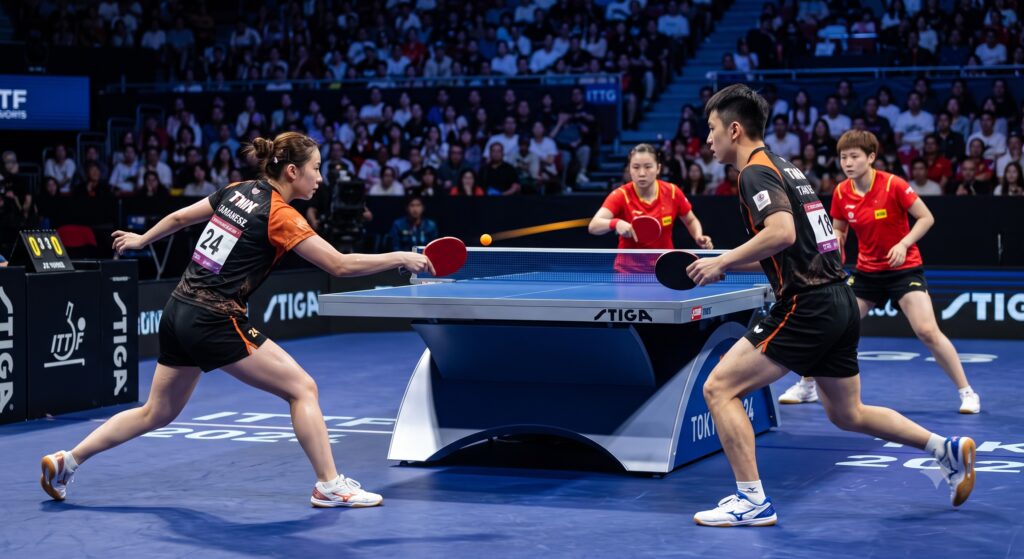
The strict mechanical rule of alternating hits introduces an extraordinary computational load onto the neocortex. After executing a hyper-precise micro-stroke to counter a high-velocity spinning ball, a player cannot remain static. They must instantly execute a physical displacement vector—clearing out of the active coordinate zone so their teammate has an unobstructed path to hit the next return.
- The Physical Basis of Empathy: To survive the alternate loop, your cortical columns must continuously model your partner’s internal sensory-motor inference. Are they off-balance? Did they over-extend on the last slice? What angle do they need to recover?
- Targeting the ASD Processing Bottleneck: This loop directly bypasses the barrier of traditional, language-heavy social training. For an ASD student, doubles table tennis turns social interaction into pure, non-verbal geometry. By forcing the brain to peripherally track a teammate's torso, wrist calibration, and physical recovery speed while simultaneously decoding the spin signature of a millimeter-scale ball, the neocortex rapidly builds the precise neural architecture required for real-time human prediction.
The Relational Blueprint
Social awareness is not a concept that can be memorized from a textbook or simulated via an LLM chatbot interface. It is a biological capability forged in the crucible of physical space, built on millions of micro-saccades, shared reference frames, and synchronized motor predictions.
By implementing this progressive, low-threshold institutional framework, we give the lost generation an actionable ladder out of digital isolation. We use a high-density, low-footprint physical progression to systematically re-train the biological hardware of connection. We move our children away from the flat, narcissistic echo-chambers of the screen and lead them step-by-step back into the rich, shared, collaborative geometry of the real world—ensuring they possess the spatial intelligence required to truly understand, empathize, and cooperate with one another.