
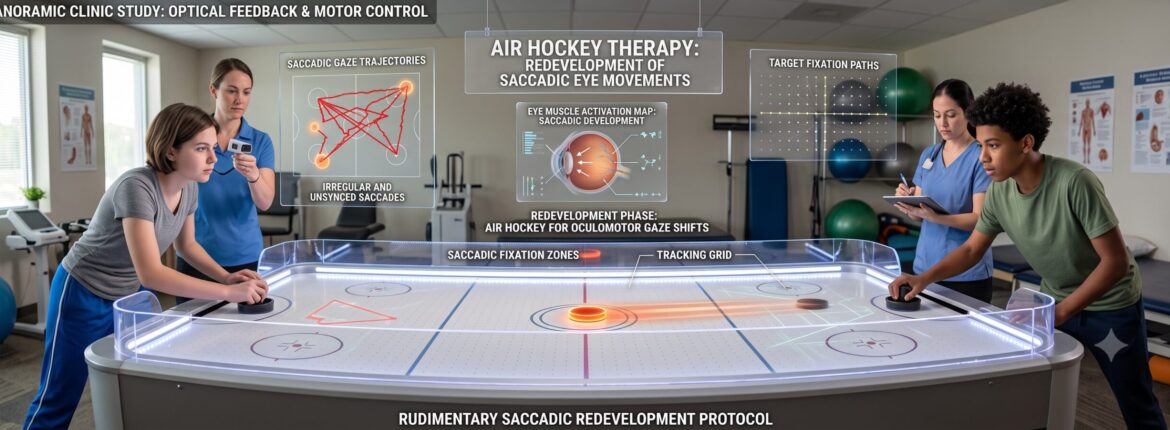
The modern educational landscape is grappling with a hidden cognitive deficit: the systemic flat-lining of the human sensory-motor loop. Decades of early-childhood screen addiction have conditioned a "lost generation" to operate within static, two-dimensional constraints. When a child spends their formative years locked into a 12-inch focal plane, their visual system unlearns the dynamic mechanics of saccadic eye movements—the rapid, ballistic jumps and precise fixations that the neocortex relies on to build spatial reference frames.
As a result, when these students encounter abstract, multi-dimensional academic landscapes—like theoretical physics or coordinate geometry—they fail. They fail not because they lack raw intellectual capacity, but because their physical, biological tracking architecture has atrophied. They cannot build an internal topological map of an equation if they cannot execute a clean regressive saccade across a static line of text.
To fix this, we cannot rely on software. We must deploy a deliberate, institutional intervention engineered to force the human neocortex to systematically scale its reference frames upward. By mapping this architecture as a concept of cognitive cybernetics, we establish a precise multi-stage progression that takes a screen-stagnated brain and reboots its oculomotor hardware from a flat plane to absolute volumetric collaboration.
Phase I: Air Hockey (2D Coplanar Vector Isolation)
The intervention begins by meeting the screen-addicted child exactly where their damage is located: on a flat, two-dimensional plane. Air hockey acts as the crucial initial scaffold because it completely eliminates the Z-axis (vertical bounce), drastically reducing the initial computational load on the cortical columns.
[ Screen Stasis ] ──────> [ Air Hockey ] ──────> [ Multi-Gate Hockey ]
  • Fixed 0D Focus          • 2D Coplanar Flow     • Multi-Vector Tracking
  • Passive Fixation        • Frictionless Vector  • Shared Spatial Zones
Because the puck floats on a frictionless cushion of air, it travels at exceptionally high velocities in pure, deterministic linear vectors. To defend the goal, a player’s visual system cannot rely on lazy, smooth-pursuit tracking; the brain is forced to launch rapid, ballistic eye saccades to anticipate the puck's geometric reflection off the side rails. Simultaneously, the weight of the mallet and the speed of play engage the large muscle groups of the upper kinetic chain, beginning the vital work of breaking the rigid, locked flexion of the "screen slouch."
Phase II: Multi-Gate / Doubles Air Hockey (Shared 2D Coordinate Tracking)
Once the individual's 2D saccadic system is awakened, the architecture introduces a critical socio-spatial layer: Doubles or Multi-Gate Air Hockey.
By scaling the field up to a four-player format or a multi-gate layout, the table transforms from a simple linear vector lane into a multi-agent coordinate grid.
- Peripheral Saccadic Expansion: A player can no longer afford to tunnel-vision on a single opponent directly across from them. The presence of multiple pucks or multiple defensive zones forces the visual cortex to stretch its focus, cultivating deep peripheral saccadic awareness.
- Predictive Motion Tracking: Players must now monitor intersecting vectors in real time, factoring in not just the puck’s physics, but the physical mallet trajectories of their teammates and opponents. For individuals on the autism spectrum (ASD), this serves as a non-verbal, purely mechanical sandbox for learning to predict human intentionality within fractions of a second.
Phase III: Badminton (The Macro Volumetric Z-Axis Break)
Having mastered the shared 2D plane, the intervention executes its most radical maneuver: completely breaking the flat plane of 2D awareness. The architecture transitions the students to badminton, serving as the perfect, low-threshold gateway to three-dimensional tracking, specifically optimized to remain inclusive for less athletic students.
[ Multi-Gate Hockey ] ──────> [ Badminton ] ──────> [ Mini Volleyball ]
  • Shared 2D Coordinates       • Macro Z-Axis Break    • High-Impact 3D Volumetrics
  • Intersecting Flat Vectors   • High-Drag Aerodynamics • Racketless Direct Intercept
The shuttlecock possesses unique, non-linear aerodynamic properties: it leaves the racket fast but decelerates sharply into a predictable, floating downward drop. Unlike high-impact ball sports that require intense athletic bracing, badminton introduces a lightweight racket that acts as an accessible tool extension, allowing any child to easily intercept the target in mid-air.
Most importantly, the high, floating arc of the shuttlecock forces a total physiological reversal of the "screen slouch." The child must tilt their head back and extend their neck, firing the deep cervical proprioceptors and activating the inner ear's vestibular apparatus. This action forces the ocular muscles out of a chronic downward gaze and opens up a massive, room-sized, 3D coordinate system in the neocortex, all without triggering the physical frustration of traditional sports.
Phase IV: Mini Two-Person Volleyball (Collaborative Volumetric Construction)
With the macro-Z-axis reference frame successfully broken open by badminton, the architecture advances to Mini Two-Person Volleyball on a highly condensed court with lightweight, portable pop-up nets.
Now stripped of a racket tool extension, volleyball demands direct, physical interaction to absorb, control, and elevate a ball entirely in open, volumetric space without letting it touch a surface.
Mini volleyball demands a deep, simultaneous socio-spatial calculation. Teammates must actively pass the ball to one another to set up a return. To achieve this, the neocortex must construct a Distributed Coordinate Frame. A player must track the fast-moving sphere in 3D space, calculate their own body orientation to absorb the kinetic energy, and peripherally map their partner’s real-time velocity and trajectory to hang a gentle, predictable parabola in the air for them.
Phase V: Table Tennis (The Volumetric Micro-Matrix Precision)
The final stage of the architecture takes the macro-spatial, three-dimensional coordinates reclaimed in volleyball and focuses them down into high-resolution, microscopic precision. Table tennis is a game of millimeters and microseconds.
┌─────────────────────────┐      ┌─────────────────────────┐
│ STAGE IV: MINI V-BALL   │ ───> │  STAGE V: TABLE TENNIS  │
│ Macro-Volumetric Chaos  │      │ Micro-Matrix Precision  │
└─────────────────────────┘      └─────────────────────────┘
By returning to a solid table plane, the deterministic bounce reintroduces hyper-localized coordinate tracking. However, the addition of intense aerodynamic rotational spin (top-spin, back-spin, sidespin) introduces an extraordinary computational burden onto the neocortex.
The player's eyes must execute blindingly fast saccadic jumps and immediate lens accommodations to decode the spin signature of a ball moving over a minute distance. The micro-adjustments required by the wrist, fingers, and neck line up perfectly with the exact neurological substrate needed to smoothly navigate and manipulate complex mathematical notation on a textbook page.
When scaled to doubles table tennis—where players must strictly alternate hits—the system reaches its absolute peak: forcing a continuous, hyper-precise loop of physical rotation, peripheral awareness, and real-time social vector tracking.
The Cybernetic Verdict
We cannot cure the cognitive consequences of digital over-stimulation by introducing more software into the classroom. To restore the minds of a lost generation, we must restore their biological hardware.
By implementing this progressive, low-footprint, high-density physical architecture—inspired by the systemic integration of the Norwegian model—we can systematically re-train the human visual and motor engine. We move the child's brain out of the flat, predictive stasis of the screen and lead them step-by-step from 2D vector isolation up to deep, multi-dimensional, collaborative reality, ensuring they possess the stable reference frames required to comfortably think, learn, and create.