

We have all experienced the sudden, almost violent transition. One moment, your mind is a scattered mess—a dozen browser tabs open in your brain, jumping from a half-written email to a stray noise outside, to an impending deadline. Then, a trigger hits. A sudden realization, a looming cutoff, or a captivating problem locks into view.
Instantly, the noise vanishes. You enter a state of absolute hyperfocus.
In this post-trigger state, it feels as though your "working memory" has suddenly been supercharged. The mental scratchpad that usually struggles to hold a phone number now feels like a vast, illuminated warehouse where you can see the entire architecture of a complex project all at once.
But if you stop to ask how you got there, you realize something unsettling: the bridge between your scattered mind and your hyperfocused mind doesn't exist. There is no gradual ramp, no step-by-step transition. You are simply in one world, and then you are in the other.
To understand why this transition feels so miraculous—and why it feels like "pure working memory"—we have to throw out the old psychological metaphors and look at how the brain actually maps reality.
The Scattered Mind: A Collision of Maps
To understand the hyperfocused state, we must first look at the scattered one. Cognitive psychology used to tell us that being distracted just means your central "working memory box" is overloaded with too many items.
But frameworks like Jeff Hawkins’ Thousand Brains Theory offer a far more physical explanation. Every single cortical column in your neocortex uses internal reference frames—the same neural mechanics ancient brains used to navigate physical space—to map abstract concepts.
When your mind is scattered, your brain isn't overloading a single storage box; it is rapidly violently switching between entirely different maps.

Because your attention is jumping across completely unrelated spaces, the brain's mechanism for continuity—temporal pooling—never gets a chance to lock in. The snapshot of "right now" (spatial pooling) changes so fast that the brain cannot build a stable sequence. Your mental RAM feels tiny because the signal keeps getting dropped.
The Phase Shift: The Non-Existent Bridge
The reason the "bridge" into hyperfocus feels non-existent is because it isn't a highway; it is a phase shift. It is water turning instantly to ice when the temperature drops.
When the trigger occurs, it forces an abrupt, total collapse of all competing reference frames. The brain stops trying to navigate three maps at once. It drops Map A and Map B entirely, dedicating its massive, uniform architecture to Map C alone.
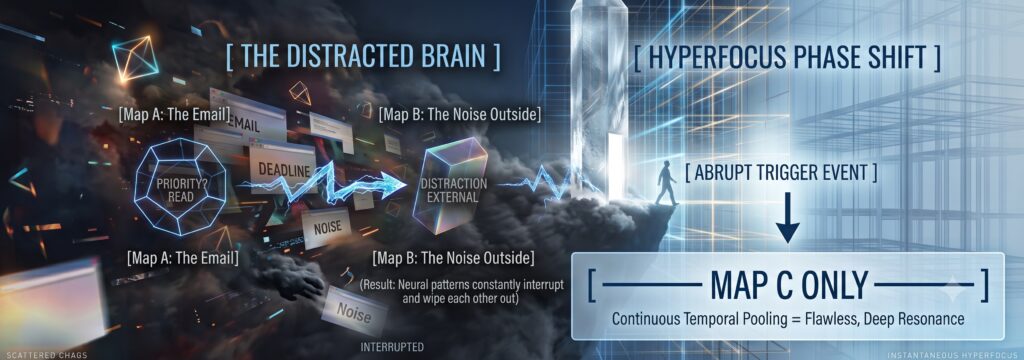
Because there is no gradual ramp-down of the other tasks—just a sudden, singular lock-in—your brain doesn't record a transition. The bridge doesn't exist because you didn't walk anywhere; the brain simply changed the geometry of the space it was simulating.
Why Hyperfocus Feels Like "Pure Working Memory"
Once you are on the other side of that non-existent bridge, the perception of "pure working memory" takes over.
Without competing inputs or context-switching, every active neuron within that single reference frame begins to perfectly predict the next step in the sequence. The temporal pooling becomes perfectly resonant. The cells fire in a continuous, uninterrupted loop, holding the structure of the idea alive across time.
This is the great illusion of the post-trigger state:
- The Illusion: You think your brain has magically expanded its storage capacity, giving you more "RAM" to hold data.
- The Reality: The capacity hasn't changed at all. The network has simply stopped dropping the signal.
The working memory feels limitless because the persistence of the active pattern is completely flawless. You aren't holding more pieces of information; you are navigating a single, perfectly stabilized mental landscape.
The Architecture of Clarity
When you emerge from a deep state of hyperfocus, the scattered world returns, and the lucid space you just occupied feels like a ghost. You look back for the path that led you there, but you find nothing.
This is the ultimate proof that working memory isn't a physical storage box in the prefrontal cortex, but a dynamic state of tracking. Hyperfocus isn't about filling a mental workspace with more data; it is about clearing the field so entirely that the brain's natural spatial navigation systems can do what they do best.
The bridge doesn't exist because you don't need a bridge to see clearly. You just need the noise to stop, allowing the brain to fully inhabit the coordinate space of a single, brilliant idea.