
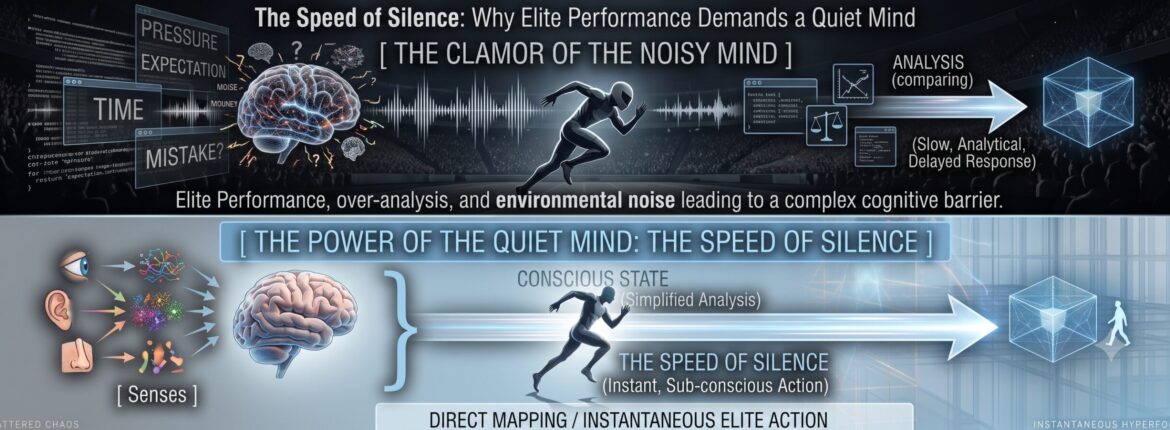
In the high-stakes worlds of professional sports, concert halls, and live theater, there is a distinct difference between a performer who is practicing and a performer who is flying.
When a goalkeeper faces a point-blank shot, a jazz pianist improvises a lightning-fast run, or an actor commands a stage, they enter a state of execution so rapid and fluid that deliberate thought becomes an active hindrance. For decades, we have praised the human "conscious mind" as our greatest evolutionary tool. But in the arena of optimum performance, consciousness is a bottleneck.
To achieve true mastery, the prefrontal cortex must step down, leaving the ancient, highly sophisticated subconscious engine to run the show.
The Speed Penalty of Deliberate Thought
The primary flaw of the conscious mind in peak performance is simple physics: it is too slow.
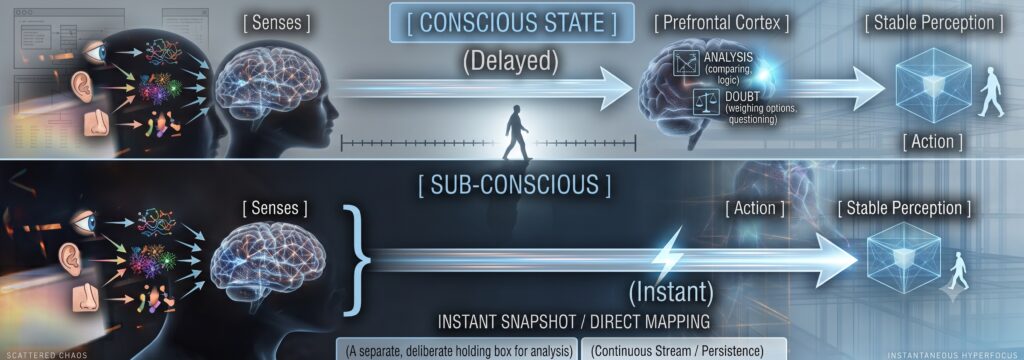
Conscious, analytical thought requires a massive neural loop. Data must travel from the senses, pass through the thalamus, hit the primary sensory cortices, map to the prefrontal cortex for evaluation, select a strategy, and finally signal the motor cortex to move. This deliberate pathway takes roughly 200 to 300 milliseconds.
In elite fields, that delay is catastrophic:
- The Athlete: A soccer ball struck from the edge of the box travels at speeds that require a goalkeeper to react in under 100 milliseconds.
- The Musician: A concert violinist playing a rapid allegro passage executes dozens of precise finger placements per second.
- The Dancer: A prima ballerina adjusting mid-air to a partner's slightly off-center lift has fractions of a second to recalculate her center of gravity.
If any of these performers stop to consciously analyze the trajectory, the musical notation, or the physical physics of the room, they will fail. The subconscious sensory-motor loops, relying on deep subcortical pathways and the cerebellum, can bypass this analytical detour entirely, executing complex physical corrections in a fraction of the time.
Transient Hypofrontality: Shaking Off the "Self"
Neuroscientists use the term Transient Hypofrontality to describe the brain state of optimal performance—popularly known as the "flow state" or being "in the zone."
During these moments of peak execution, the prefrontal cortex (PFC)—the seat of our executive function, abstract planning, and self-awareness—temporarily down-regulates its activity. It goes quiet.
When the PFC steps aside, the internal monologue stops. The abstract anxieties that plague performers—"What if I miss?", "What will the critics say?", "Did I miss a step?"—are instantly silenced. The brain stops trying to construct a narrative "self" and instead becomes a pure, unhindered spatial-prediction machine. The performer stops thinking about the geometry of the stage or the instrument; their subconscious motor system directly lives it.
The Power of the Subterranean Engine
This state is far from mindless automation. Instead, it is the liberation of years of intense, repetitive physical preparation.
Through thousands of hours of deliberate practice, a performer hardcodes complex movements, spatial relationships, and sensory cues into the basal ganglia and the cerebellum. They build a highly detailed internal model of their craft.
| Performer | What the Subconscious Controls |
| Athlete | Micro-adjustments to spatial coordinates, body lean, and reflex reaction times. |
| Musician | Complex muscle memory, auditory feedback loops, and micro-timing adjustments. |
| Dancer / Actor | Proprioception (awareness of the body in space), emotional resonance, and real-time pacing adjustments. |
When the conscious mind goes quiet, this subterranean engine is finally allowed to run without interference. The actor doesn't just recite lines; they inhabit the space, responding with instinctual, split-second emotional authenticity to their scene partner. The jazz musician doesn't calculate chord scales; their fingers execute fluid sensory-motor inferences across the keys, translating emotion directly into sound.
The Paradox of Mastery
The ultimate paradox of human performance is that our most complex, highly coordinated physical and creative feats are achieved only when we silence our conscious self-awareness.
Consciousness is an incredible tool for analyzing mistakes after the curtain falls or planning a training regimen weeks in advance. But when the lights go up and the game is on the line, consciousness is just noise. The best performers don't succeed because they think better than the rest of us; they succeed because they have built a subconscious engine so robust that they can confidently step out of its way.