
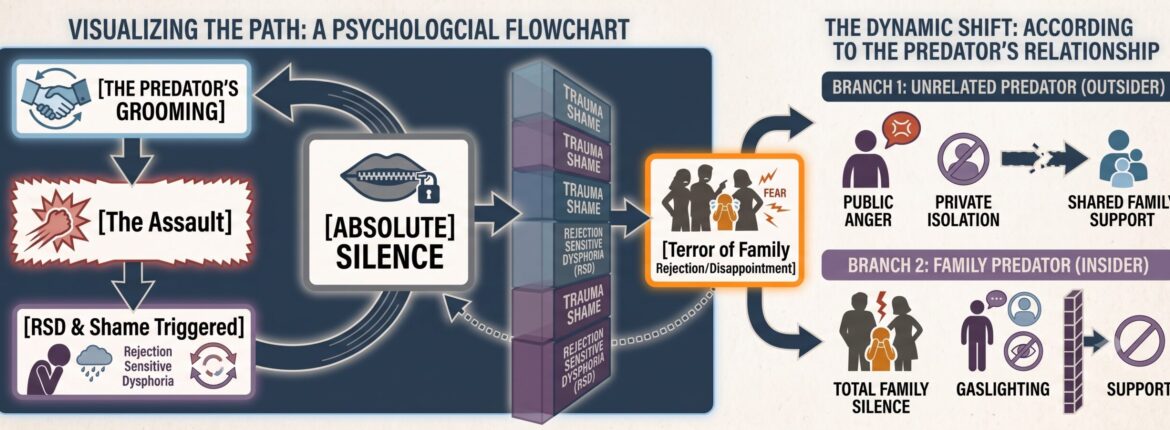
When an ADHD young adult is carrying the weight of sexual assault trauma, opening up to family isn't just a matter of "finding the right words." The combination of Trauma Shame and Rejection Sensitive Dysphoria (RSD) creates a severe psychological barrier.
Because the ADHD nervous system experiences emotions at an extreme volume, the thought of exposing these vulnerabilities feels less like a difficult conversation and more like stepping onto an emotional landmine.
Here is why this combination creates an invisible wall between an ADHDer and their family, followed by how that dynamic drastically shifts depending on who the predator was.
The Internal Wall: Shame + RSD vs. The Family
To understand why it is so difficult to tell a family, you have to look at how RSD and shame warp the ADHDer's perception of their family's potential reaction.
- The RSD "Worst-Case" Simulator: RSD causes the brain to instantly predict the absolute worst emotional outcome—complete rejection, disgust, or disappointment. The ADHD brain, which already struggles to regulate emotional impulses, floods the individual with the actual pain of that rejection before they have even said a single word. To protect themselves from this agonizing feeling, they stay silent.
- The "Flawed Child" Narrative: Many ADHDers grow up constantly hearing that they are "too much," "too sensitive," lazy, or careless because of their executive dysfunction. If they already feel like the family disappointment, the trauma shame convinces them: “If they find out about this, it will just prove to them that I really am completely broken.”
- Predicting the ADHD Blame Game: Because ADHD impulsivity or perceived lack of awareness is often criticized by family ("Why don't you pay attention?"), the young adult intensely fears the family will retroactively blame their ADHD for the assault: "Why weren't you paying closer attention to your surroundings?" or "You were being too reckless."
- Protecting the Family (Fawning): Paradoxically, the young adult may remain silent out of a trauma-driven need to keep the peace. They fear their family's grief, anger, or secondary trauma will be so massive that they, the ADHDer, will end up having to manage their parents' or siblings' emotional crises—a task their already overloaded executive functioning cannot handle.
The Difference: Stranger Danger vs. The Enemy Within
The difficulty of opening up changes completely based on the identity of the perpetrator. The psychological math shifts from managing external reactions to surviving a systemic collapse.
Scenario A: The Predator Was a Total Stranger
When the assault was committed by a stranger, the family home is theoretically a "safe zone," but RSD and shame still distort the communication.
- The Fear of "Damaged Goods" Status: The primary RSD fear here is a permanent shift in how the family views them. The ADHDer worries that their family will no longer see them—they will only see a "victim." They dread the hyper-fragile pity, the sudden overprotectiveness, or the constant walking-on-eggshells, all of which feel like a secondary form of rejection.
- Overwhelming External Chaos: An ADHD brain already struggles to process high-stress environments. Opening up about a stranger assault often sets off a chaotic sequence of events: police reports, medical questions, legal discussions, and intense parental fury. The sheer logistical and emotional overwhelm of this track can cause an ADHDer to freeze and keep the secret just to avoid the executive chaos.
Scenario B: The Predator Was a Family Member (Incest/Interfamilial Trauma)
If the perpetrator is inside the family, the barrier to opening up becomes almost insurmountable. This is where single-event trauma instantly converts into Complex PTSD, and RSD turns into an existential threat.
- The Threat of Total System Collapse: Opening up doesn't just mean sharing a personal secret; it means dropping a bomb on the entire family structure. The RSD terror isn't just about a parent being disappointed; it’s the realistic fear that the family will split apart, take the perpetrator's side, or accuse the young adult of lying to destroy the family. To an RSD mind, this level of potential banishment feels like actual death.
- The "Gasping for Air" Gaslighting: Because the perpetrator is a family member, the young adult has likely spent years enduring subtle gaslighting ("They didn't mean it that way," "We are just a close family"). Because ADHDers already struggle with self-doubt and executive memory tracking, they are highly vulnerable to doubting their own reality. Shame whispers that they misread the situation, and RSD ensures they won't risk speaking up if they aren't 100% sure they will be believed.
- No Safe Baseline: When a stranger attacks, you run home to safety. When home is the danger, the nervous system never drops out of a high-alert survival state. The young adult cannot open up to the family because the family is the trauma container.
The Takeaway: For an ADHD young adult, breaking the silence requires a level of emotional regulation and executive control that their trauma and ADHD are actively draining away. Whether the predator was a stranger or a relative, the fear of the family's reaction—driven to an agonizing extreme by RSD—makes silence feel like the only reliable shield they have left.