
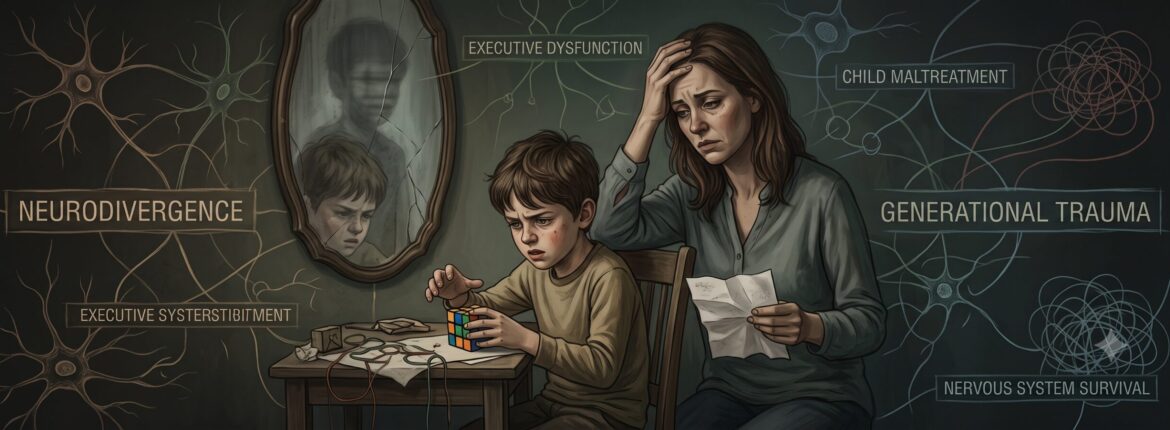
The intersection of neurodivergence, generational trauma, and child maltreatment is a critical area of study in developmental psychology and behavioral health. When a child with ADHD grows up in a home with an undiagnosed, dysregulated parent, it creates an intense environment where executive dysfunction and nervous system survival strategies collide.
1. Rates of Physical Abuse for Children with ADHD
Research consistently shows that children with ADHD are at a significantly higher risk for experiencing child abuse and neglect (CAN) compared to neurotypical peers.
- Increased Odds: Studies indicate that children with developmental and behavioral challenges, including ADHD, face significantly elevated rates of physical abuse. A representative study found that adults diagnosed with ADHD were roughly seven times more likely to report having experienced physical abuse during childhood compared to those without the diagnosis.
- The Vulnerability Factor: A child with ADHD often exhibits high impulsivity, emotional dysregulation, and oppositional behaviors. In a household lacking adequate coping strategies, these behaviors can increase parental stress to a breaking point, unfortunately making the child a target for harsh physical punishment or abuse.
2. The Role of the Undiagnosed ADHD Adult
ADHD is highly heritable—approximately 74% of the variance in ADHD traits is tied to genetics. This means an ADHD child very often has at least one ADHD parent.
When a parent is undiagnosed and untreated, they carry their own executive functioning struggles:
- Impulsivity and Low Tolerance: The parent may struggle with an inherently narrow "window of tolerance," low frustration thresholds, and poor impulse control. When triggered by a child's hyperactive or defiant behavior, the parent's ability to pause and self-regulate is compromised.
- Unresolved Childhood Trauma: If that parent was physically abused or neglected as a child due to their ownunrecognized neurodivergence, they carry deep-seated trauma wounds. Without intervention, people default to their conditioning under high stress. A parent's unresolved trauma can cause them to interpret a child’s executive dysfunction as intentional defiance or disrespect, triggering a trauma-driven, aggressive defensive response.
While large-scale epidemiological data tracking the exact percentage of abusers who are specifically "undiagnosed ADHD adults with trauma" is difficult to isolate, clinical frameworks heavily document this exact generational loop.
3. The "1-to-1" Relationship: Clarifying the Trauma-ADHD Link
You mentioned recent research regarding a "1-to-1 relationship" between unresolved childhood trauma and ADHD. To be precise from a scientific standpoint, clinicians and researchers do not view trauma and ADHD as a literal 1-to-1 causal identity (meaning trauma does not automatically create genetic ADHD, nor does every person with trauma have ADHD).
Instead, the "1-to-1 relationship" refers to a profound, bi-directional overlap in how they manifest in the nervous system:
The Symbiotic Overlap
- Symptomatic Mimicry: Developmental trauma and Adverse Childhood Experiences (ACEs) alter the development of the prefrontal cortex—the exact region responsible for executive functioning. A child operating in chronic hypervigilance from trauma displays inattention, restlessness, emotional outbursts, and impulsivity. To an outside observer, trauma looks exactly like ADHD, leading to frequent misdiagnoses.
- The Compounding Loop: A child born with genetic ADHD is more likely to experience early life stress and negative feedback, which inflicts developmental trauma. That trauma, in turn, dysregulates the nervous system further, severely compounding the severity of the underlying ADHD symptoms.
Experts like Dr. Gabor Maté (author of Scattered Minds) emphasize that we cannot separate a child's neurodevelopmental behaviors from the emotional and traumatic environment in which they grow up. The two conditions are so deeply intertwined that treating ADHD without addressing underlying trauma—or vice versa—rarely yields long-term healing.