
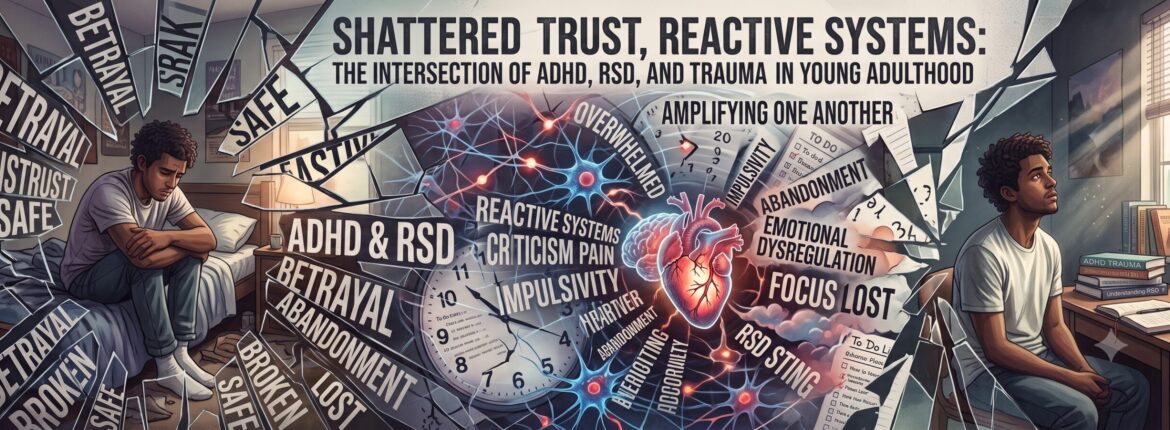
When ADHD, Rejection Sensitive Dysphoria (RSD), and unresolved childhood trauma from a significant event like a sexual assault intersect in a young adult, they don't just exist side-by-side—they actively amplify one another.
ADHD brings a naturally intense, highly reactive nervous system and executive dysfunction. RSD adds an agonizing vulnerability to perceived criticism or abandonment. Childhood trauma layer on a baseline state of unsafety and shattered trust. In a young adult, this complex trifecta typically expresses itself across several key areas:
1. Interpersonal Hyper-Vigilance and Misinterpreting Cues
Because both RSD and trauma train the brain to look for threats, the young adult is often trapped in a state of high alert.
- The "Threat Scan": The trauma baseline says the world is unsafe, while RSD says people will reject me if I am imperfect. Minor shifts in someone's tone, a delayed text, or a neutral facial expression can be instantly interpreted as catastrophic proof of abandonment or impending harm.
- Preemptive Isolation: To protect themselves from the excruciating pain of RSD or the vulnerability triggered by trauma, they may "ghost" relationships, break off friendships prematurely, or completely avoid dating. The logic becomes: If I leave first, I can't be hurt or rejected.
2. The Perfectionism and People-Pleasing Trap
A common survival strategy is trying to become entirely beyond reproach to keep the environment predictable and safe.
- Masking and Overachieving: They might push themselves to exhausting lengths to be perfect at work, school, or in relationships, hoping that flawless performance will insulate them from criticism.
- Loss of Boundaries: Saying "no" feels dangerous. Agreeing to things that compromise their comfort or safety happens because the fear of the conflict or rejection that might follow a boundary feels completely intolerable.
3. Volatile Emotional Regulation
ADHD already makes it difficult to inhibit emotional responses. When you add the raw nerve of RSD and the emotional triggers of childhood trauma, emotional storms can hit with overwhelming force.
- The RSD "Crash": A perceived slight can trigger an immediate, deep emotional dive into intense shame, despair, or rage. Because executive functioning is impaired by ADHD, stepping back to rationally analyze the situation is incredibly difficult in the moment.
- Fight-or-Flight Reactions: Sudden bursts of defensive anger or severe emotional withdrawal (freezing/shutting down) can occur when a situation triggers the old trauma, even if the current scenario is entirely unrelated.
4. Chronic Executive Fatigue and Burnout
Managing these competing internal states requires immense cognitive and emotional energy.
- The Cognitive Load: The brain is simultaneously trying to manage ADHD focus issues, suppress painful trauma memories, and monitor everyone's reactions for signs of rejection. This leads to frequent, severe mental exhaustion or burnout.
- Paralysis: When faced with tasks that carry a risk of failure (like applying for a job or turning in an assignment), the ADHD paralysis is magnified tenfold by the RSD fear of being judged and the trauma-driven fear of not being in control.
5. Somatic and Body Disconnection
Trauma related to bodily violation heavily impacts how a person occupies their physical self, which clashes uniquely with ADHD sensory processing.
- Dissociation vs. Hyper-awareness: They may swing between completely zoning out (dissociating from the body to avoid trauma memories or emotional pain) and being hyper-sensitive to physical sensations, sounds, or changes in their environment.
- Neglecting Physical Needs: The combination can make it easy to miss or ignore basic bodily cues, leading to erratic sleep schedules, forgetting to eat, or chronic physical tension and pain.
Navigating this combination is incredibly heavy, but recognizing how these layers feed into each other is a massive first step. Because these challenges are so deeply intertwined, traditional ADHD strategies alone often aren't enough. Healing usually involves trauma-informed care (like EMDR or somatic therapies) alongside practical ADHD management and targeted support for emotional regulation.
6. The Illusion of Control Through Orchestrated Failure
For a young adult carrying this weight, the absolute worst-case scenario isn't failure; it is unpredictable vulnerability. When a person grows up where trying their best still results in verbal abuse, the traditional relationship between effort and reward is completely broken.
- Choosing the Certain Nightmare: As you noted, choosing a guaranteed negative outcome (like intentionally tanking a class) becomes a perverse form of safety. The logic of the traumatized, RSD-driven brain dictates: "If I cause the failure, I control the narrative. I know exactly when, why, and how the blow is coming. The pain is guaranteed, but the suspense is gone."
- The Terror of the "Almost Perfect": Trying your hardest, pouring immense energy into a task, and earning a 'B'—only to still face devastating criticism—is an emotional catastrophe. It proves that no matter how much they bleed, it will never be enough. To a highly sensitive RSD nervous system, that unexpected emotional ambush is far more damaging than the expected punishment of a self-inflicted 'F'.
- Weaponized Apathy: They may adopt a persona of absolute defiance or total apathy ("I didn't even try," "I don't care about this class anyway"). This acts as a psychological shield. If they don't invest their true self or effort into the endeavor, then the inevitable criticism doesn't actually target them—it only targets the mask they put on.
The Cyclical Trap
This strategy creates a devastating paradox. While it successfully protects the young adult from the shock of unpredictable rejection in the short term, it systematically dismantles their future, reinforces their baseline state of unsafety, and feeds right back into the Chronic Executive Fatigue and Burnout. They are forced to expend massive amounts of energy navigating the real-world fallout of intentional failures, all just to keep their emotional head above water.
It highlights why standard academic or behavioral interventions fail so completely here. You cannot fix "procrastination" or "lack of motivation" with a planner when the student is deliberately choosing failure as a literal shield against emotional warfare.