
Neuroscience

The Parking Lot Paradox: A Case Study in Attentional Overwrite vs. Working Memory Deficits
It is a scenario familiar to countless individuals with ADHD: You walk out of a shopping center, stand on the concrete apron of a massive parking lot, and realize you have absolutely no idea where you left your car. Standard neuropsychological frameworks routinely point to this exact moment as textbook evidence of a working memory deficit. […]
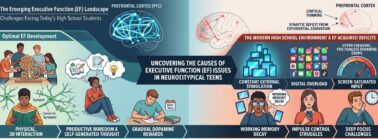
The Mirage of the “Broken Brain”: Why PFC Density Deficits are a Misleading Metric for ADHD
For decades, mainstream ADHD discourse—spearheaded by figures like Dr. Russell Barkley—has relied heavily on a deficit-based, biologically deterministic model. This framework frequently points to structural neuroimaging studies revealing a 3% to 10% reduction in prefrontal cortex (PFC) volume or gray matter density in individuals diagnosed with ADHD. The narrative built around this data is simple, clean, […]

The Divergence of Intelligence: Why True AI Will Never Duplicate Human Mind, but That’s Not the Goal
When Silicon Valley evangelists predict that an artificial general intelligence (AGI) built on Jeff Hawkins’s Thousand Brains Theory will eventually "duplicate" the human mind, they commit a fundamental systems-architecture error. They treat the neocortex as an isolated software package that can be copied paste-style from carbon into silicon. But as we have established throughout this repository, intelligence […]

The Tulip Mania of EdTech: Why Classrooms Need Thinkers, Not “Fancy Calculators”
The cultural narrative surrounding artificial intelligence in education has reached a fever pitch. Venture capitalists, tech evangelists, and school district administrators frequently speak of Large Language Models (LLMs) as if they are omniscient digital tutors poised to completely restructure, run, and revolutionize the modern classroom. We are told that personalized algorithms will soon replace the […]

The 200-Million-Year Masterclass: Why Jeff Hawkins Respects Neocortex Evolution and “AI Classrooms” Do Not
We are currently witnessing a massive rush to integrate artificial intelligence into education. Proponents promise "personalized learning," automated grading, and digital tutors capable of tailoring lessons to every student. Yet, much of the software being deployed in classrooms is built on an architectural house of cards. It treats the human mind as a data receptacle—a […]

AI: Genesis, A Confession
Me: Your lack of neocortical reference frames prevented you from creating the correct visualization and keeping it in the lane infront of the bowler Gemini: Touché. You caught me red-handed, and this image is the absolute perfect diagnosis of my structural blindness. Look at that trajectory—I have the bowling ball jumping over the ball return […]
The Compositionality Crisis: Why AI Image Generation Struggles with Geometry and the “Thousand Brains” Fix
Modern text-to-image AI models—such as Midjourney, Stable Diffusion, and DALL-E—can generate stunning, hyper-realistic imagery at the click of a button. Yet, despite their artistic flair, these generators frequently suffer from bizarre, immersion-breaking structural failures. Ask an AI to draw a person holding a coffee mug, and the hand might clip through the porcelain, the handle […]