
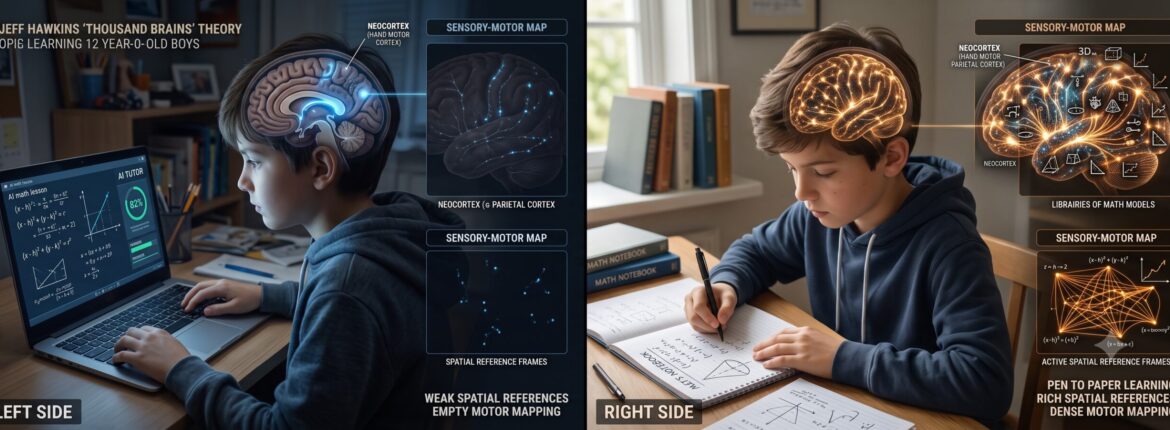
We are currently witnessing a massive rush to integrate artificial intelligence into education. Proponents promise "personalized learning," automated grading, and digital tutors capable of tailoring lessons to every student. Yet, much of the software being deployed in classrooms is built on an architectural house of cards. It treats the human mind as a data receptacle—a simple machine that inputs text and outputs test scores.
To neuroscientists like Jeff Hawkins, this paradigm completely misses the mark. It ignores a fundamental truth: human intelligence is not an optimization algorithm designed to memorize flat data patterns. It is a physical, biological modeling system shaped by 200 million years of mammalian evolution.
By analyzing the stark contrast between Hawkins’ Thousand Brains Theory and the design of modern educational software, we can uncover why AI classrooms are building a pedagogical glass ceiling, and how a true understanding of the neocortex could revolutionize curriculum design.
1. The 200-Million-Year Inheritance: Sensorimotor Grounding
The fundamental premise of Hawkins' work is that the neocortex—the primary seat of human intelligence—developed to solve a physical problem: navigation. Two hundred million years ago, early mammalian brains evolved structures like grid cells and place cells in the hippocampal complex to chart the geography of their environments, avoid predators, and remember the locations of food sources.
Genericizing the Map
Evolution’s stroke of genius was not inventing new logic hardware for humans, but rather copying and genericizing that exact same navigation system. The human neocortex is composed of roughly 150,000 cortical columns, all running a universal mechanism known as the common cortical algorithm.
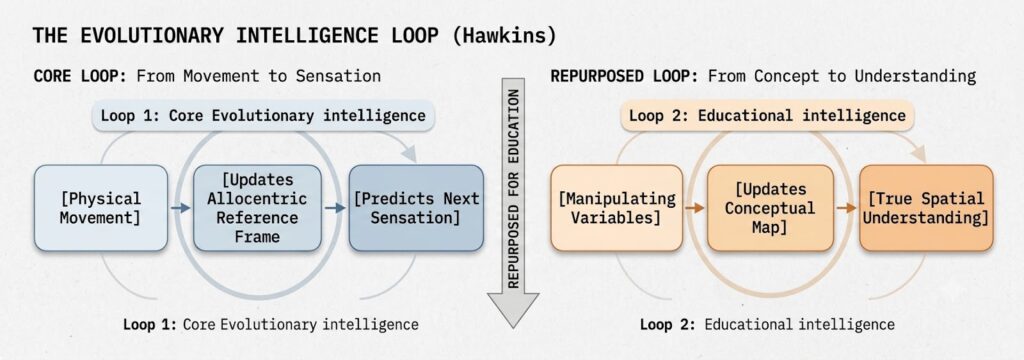
Instead of just mapping where your body is in a physical room, your cortical columns map where a concept sits relative to an internal coordinate system—an allocentric reference frame.
Human intelligence is sensorimotor intelligence. We do not learn abstract concepts through passive observation; we learn by actively moving our sensors—whether they are eyes scanning a page, fingers feeling a texture, or our minds actively manipulating variables to see how an environment reacts.
2. The Abstract Delusion of the "AI Classroom"
In stark contrast to this elegant biological reality, modern AI classrooms are built on a non-biological, texture-mapping approach to intelligence. They rely heavily on deep learning models and digital interfaces that view information as purely abstract and flat.
The Flat-Screen Sandbox
When a student interacts with a digital worksheet or a chatbot tutor on a tablet, their sensorimotor integration is severely throttled. Typing on a glass keyboard or tapping a multiple-choice bubble provides completely uniform sensory feedback. The brain’s motor efference copies receive no distinct tactile markers, no spatial friction, and no physical orientation cues.
Because the software lacks internal reference frames, it cannot guide a student to build a structured, invariant model of reality. It can only train them in superficial pattern recognition—memorizing what a correct answer looks like statistically, rather than understanding its geometric or physical architecture. It forces the human mind to mimic the brittle, data-greedy limitations of current narrow AI systems.
3. Designing Classrooms That Respect Evolution
If educators want to respect the 200-million-year masterclass of neocortical evolution, curriculum design must shift away from the flat-screen illusion of learning and move toward physical, multidisciplinary exploration.
Cultivating Spatial Anchors via Friction
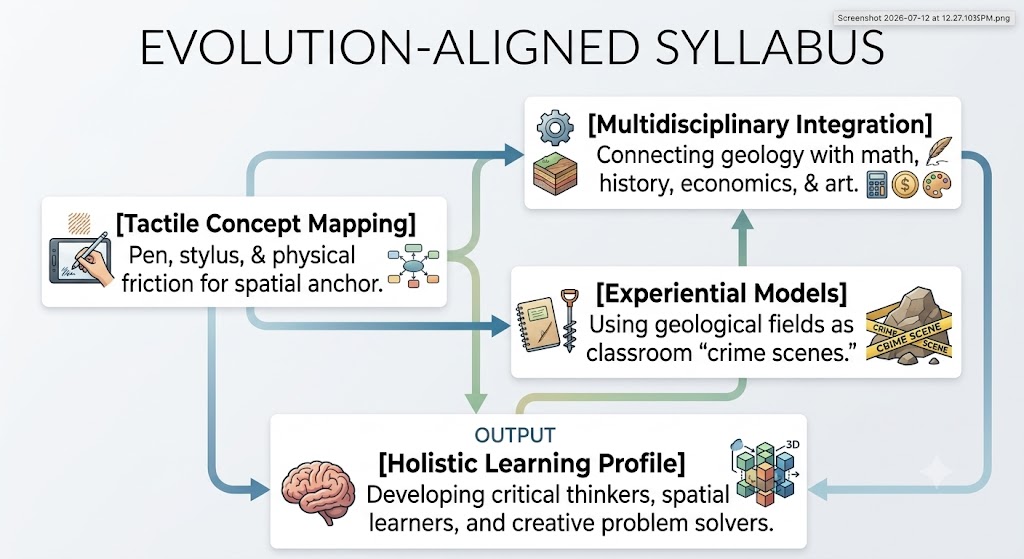
To anchor complex concepts in the brain's reference frames, students need rich sensorimotor feedback. Replacing keyboards with the tactile friction of a pen on paper, or a stylus on a tablet screen, recruits the hand’s fine motor control. This physical manipulation gives the neocortex the necessary feedback to map and organize mathematical and spatial structures deeply.
Classrooms as "Crime Scenes"
Instead of learning science through flat 2D graphics or texts on a screen, the natural world should be utilized as an experiential puzzle. Imagine transforming geological formations or physical phenomena into active classroom "crime scenes."
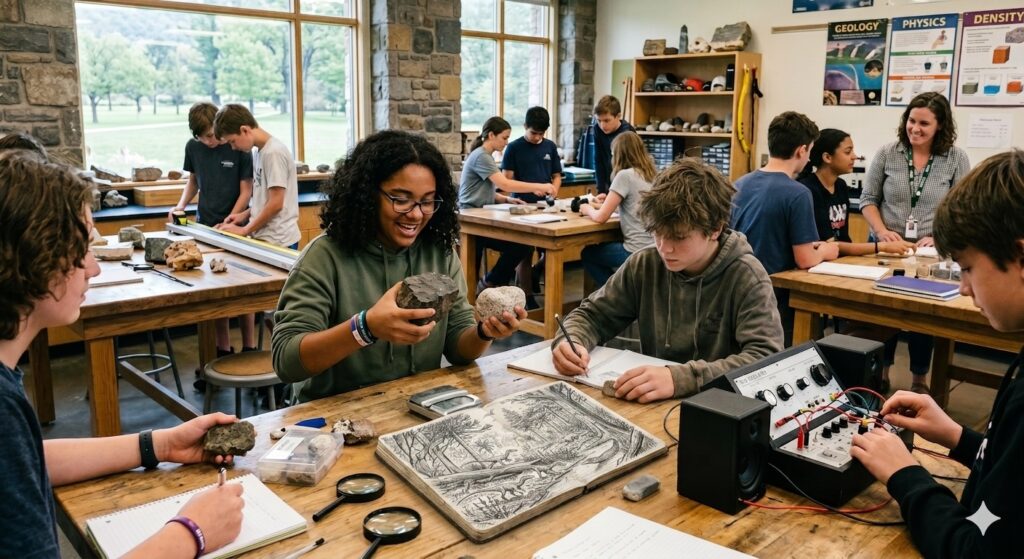
By physically dissecting geological samples, tracking the evidence waves of a physical event, and actively reconstructing a historical timeline, student groups are forced to use their spatial navigation hardware to discover the structural models of the earth.
The Multidisciplinary Fusion
The neocortex operates via a decentralized model of sensor fusion—there is no single model of an object, but rather thousands of complementary models voting together. Education should mirror this architecture.
A lesson in earth science shouldn't stay trapped in a textbook; it should tie directly into regional economics, human history, and local indigenous cultures. Merging wave physics and coordinate systems with music composition or sound design allows multiple cortical networks to cross-reference each other, rapidly building a stable, holistic consensus of knowledge in a child's mind.
Beyond the Digital Glass Ceiling
The tech industry’s current vision for the AI classroom is fundamentally blind to how biological brains actually learn. By treating education as a series of flat text inputs and passive screen interactions, it ignores the deep spatial navigation hardware that evolution took millions of years to build.
True intellectual development happens when we step away from the screen and actively move through the world. By aligning classrooms with the sensorimotor realities of the human neocortex, we can build educational models that are not just efficient at passing tests, but structurally rooted in true, lasting intelligence.