

It is a scenario familiar to countless individuals with ADHD: You walk out of a shopping center, stand on the concrete apron of a massive parking lot, and realize you have absolutely no idea where you left your car.
Standard neuropsychological frameworks routinely point to this exact moment as textbook evidence of a working memory deficit. The clinical consensus is straightforward: the individual’s internal "mental sticky note" is structurally weak, failing to hold onto basic spatial data over a short period.
However, by analyzing this phenomenon through the lens of frontline performance mechanics—the domain of sports psychologists rather than sterile lab clinics—a completely different cognitive reality emerges. The failure to find the car is not a failure of memory retention. It is a case study in acute attentional overwrite.
The Anatomy of the Overwrite
Creating a spatial map of a parking location relies on a synchronized effort between the hippocampus and the prefrontal cortex to establish "grid cells"—the brain’s internal GPS. This process requires a brief window of low-stimulus, active awareness to encode coordinates (e.g., three rows down from the light pole, facing the north entrance).
For an ADHD brain, the sequence of leaving the vehicle looks radically different from the linear model assumed by traditional testing:
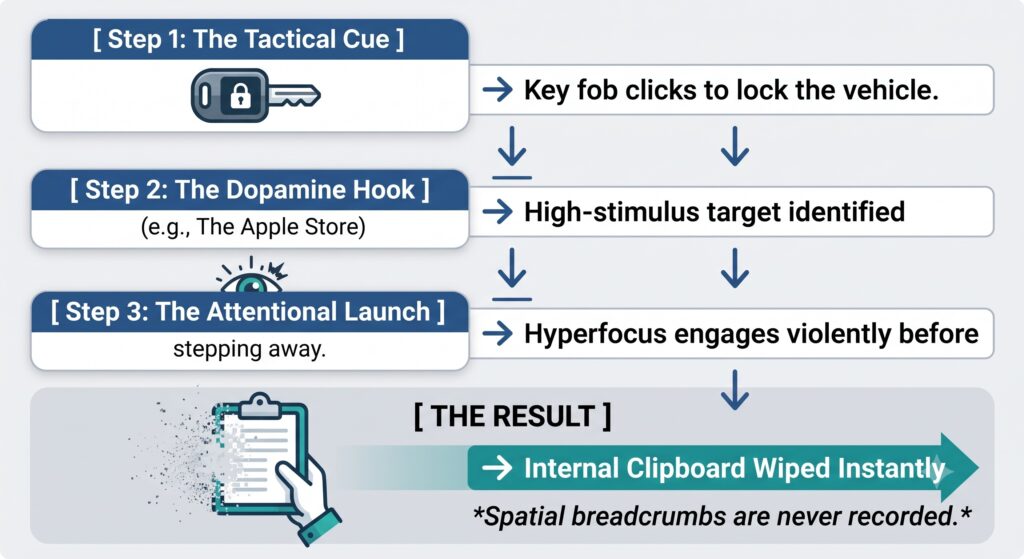
The moment a high-dopamine target captures the attention, the brain does not merely plan to walk toward it; it mentally arrives there. To maximize computational efficiency for the impending high-stimulus environment, the brain’s aggressive attentional switching mechanism issues an immediate eviction notice to the active working memory buffer. The clipboard is instantly cleared to make room for the incoming data stream.
The Diagnostic Misinterpretation
When an individual stands stranded in the parking lot an hour later, the traditional clinical model diagnoses a capacity issue: The patient lacks the working memory volume to retain spatial tracking data while distracted.
But as any elite performance coach or sports psychologist understands, you cannot recall data that was never recorded in the first place.
The capacity of the working memory loop did not fail. Rather, the hyperfocus mechanism refused to let the camera record the parking lot because the brain was already rolling film on the destination. In sports science, this is recognized as attentional tunneling—an intense, involuntary narrowing of the cognitive field that purges peripheral data to optimize execution on a primary objective.
The Performance Strategy: Externalizing the Buffer
Because this aggressive gear-shift is an involuntary neurological trait, standard clinical advice—like "trying harder to pay attention"—is functionally useless. The solution requires inserting a physical brake into the sequence before the hyperfocus launch can vaporize the buffer.
1. The Verbal Brake
Physically stopping at the driver’s door, looking directly at a fixed, permanent landmark (a main sign or a distinct architectural feature, rather than a transient car row), and stating the location aloud:
"I am parked in line with the main entrance pillar."
Vocalizing forces the auditory cortex to briefly hijack the prefrontal cortex, interrupting the premature hyperfocus launch just long enough to anchor the spatial coordinates.
2. The Tactile Prerequisite
Transforming the recording of the data into a physical barrier to leaving the vehicle—such as taking a photograph of the row marker on a phone before hitting the key fob. By externalizing the working memory onto a device, the data is secured before the brain has the opportunity to overwrite it.
Conclusion
The parking lot paradox demonstrates why standard, static cognitive metrics fail to accurately capture the ADHD brain. The issue is not an inherent deficit in memory capacity, but a highly volatile, non-linear system that shifts gears at speeds standard diagnostic tools simply cannot track.