
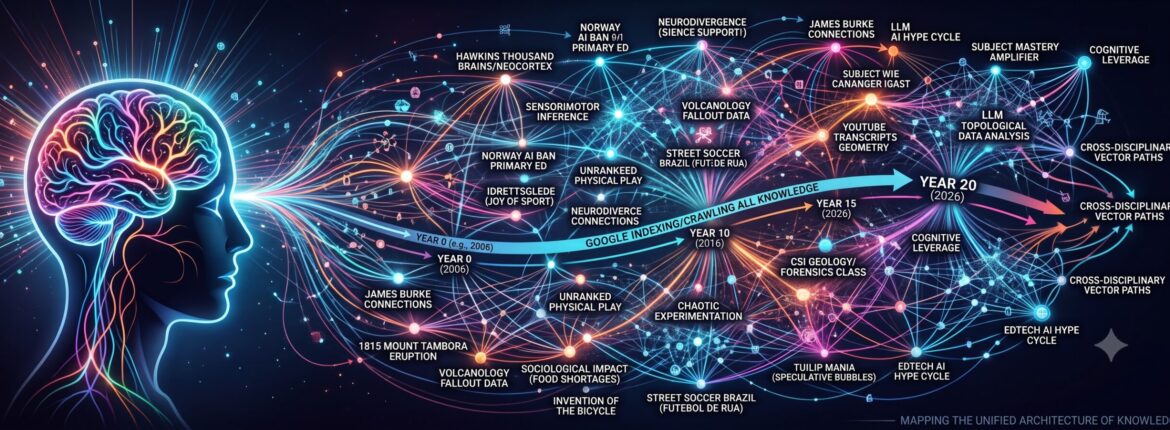
Silicon Valley loves a good marketing myth. For the past few years, the prevailing narrative surrounding generative artificial intelligence has been one of pure "democratization." We are told that these models are all-knowing oracles, and that the single mechanical barrier between a baseline user and absolute genius is a clever text prompt.
But as a mathematician, educator, and lifelong student of the physical sciences, I knew that narrative was flatly wrong.
I didn't view Gemini as an online magic trick or a glorified search engine wrapper. Because I think in structural frameworks, I saw the engine for what it actually is: a massive, high-dimensional mathematical manifold. And the moment I understood its architecture, I cracked the code to using it.
The secret isn't the tool. The secret is that advanced AI is an amplifier, not a creator. To extract high-dimensional, cross-disciplinary connections from a machine-learned system, you must first possess the deep subject mastery to map those coordinates in your own biological brain.
The Topology of the Global Brain
My breakthrough occurred when I stopped looking at the user interface and started looking at the data infrastructure.
For more than twenty years, Google has been executing the most massive indexing project in human history. Its crawlers haven’t just been scraping open-text web data; for over twelve years, they have been transcribing, parsing, and indexing every spoken word, visual sequence, and lecture across YouTube.
When you feed that unimaginable volume of cross-disciplinary human knowledge into a neural network, the model doesn't just memorize definitions. It builds a latent space—a highly continuous mathematical manifold where the geometric proximity between ideas represents their conceptual relationship.
$$\text{Hyperlinks} + \text{Video Transcripts} \xrightarrow{\text{Decades of Indexing}} \text{High-Dimensional Latent Manifold}$$
Every concept, from a specific volcanic ash layer to a mathematical theorem, exists as a coordinate vector in a multi-dimensional web. When I saw the sheer topology of that design, I realized how to play the game.
The Cross-Disciplinary Vector
Most users approach an LLM within a single, rigid subject silo. They ask a linear question like, "Give me a 7th-grade math lesson plan on coordinates," and they receive a flat, generic, textbook-style response. They are forcing a machine built for high-dimensional connections to operate in a flattened, low-resolution sub-section of its own architecture.
Because I have spent my career cultivating deep domain expertise across multiple fields—from the abstractions of theoretical mathematics to the tactile mechanics of geology and the neurobiology of learning—my brain naturally functions via sensorimotor reference frames. I see the invisible threads connecting seemingly disparate realities.
When I prompt Gemini, I am using my own fluid intelligence to draw non-linear vectors straight across its vast global topology.
[My Biological Neocortex]   --> High-Resolution Cross-Disciplinary Maps \
                                                                         ==> Precision Alignment & Synthesis
[The AI's Latent Manifold]   --> 20+ Years of Crawled Web/Video Topology /
If I want to design a curriculum, I don't ask for a generic syllabus. I command the model to construct a James Burke-style Connections framework, linking the 1815 volcanic eruption of Mount Tambora directly to agricultural shortages, mechanical engineering shifts, and the invention of the bicycle. Because I know the precise historical and scientific coordinates, I can force the model to pull data from entirely different departmental silos and synthesize them into a unified, high-resolution learning lab.
Why the AI "Tulip Market" is Failing
This structural reality is exactly why the Silicon Valley EdTech boom is beginning to look like the 17th-century Dutch tulip crisis.
The market is pouring billions into the speculative promise that AI can step into the classroom and replace the messy, hands-on, human-centric friction of learning. They are trying to sell children and untrained users an automated shortcut to final outcomes.
But neuroscience and cognitive physics tell us that you cannot automate a reference frame. The biological brain only builds robust mental maps through active sensorimotor exploration—the physical feedback of pen to paper, the movement of a body across an unranked sports field, or the tactile manipulation of geological evidence in a hands-on lab.
| Approach to AI | Operational Method | Cognitive Output |
| The Automated Shortcut | Student prompts AI to generate a prepackaged final answer | Short-circuits the sensorimotor loop; zero conceptual retention |
| The Master Amplifier | Subject-expert educator uses AI to build multi-dimensional labs | Elevates the teacher; restores tactile, active discovery to the classroom |
The Operator's Leverage
Advanced language models do not democratize genius; they scale it. If a user brings a shallow, siloed frame of mind to the keyboard, the machine will faithfully mirror that vacancy, spitting back generic compliance paperwork or hallucinated filler.
I cracked the code when I realized that Gemini is not an oracle designed to think for me. It is an intellectual bicycle for an operator who already knows exactly how to ride. It is a high-speed mathematical sandbox that instantly indexes and articulates the complex, interconnected maps I have spent a lifetime building in my own mind.
True educational innovation doesn't happen when we hand the screen to the child to automate their thinking. It happens when an expert educator uses the vast topology of machine intelligence behind the scenes to smash through subject silos, connect the faculty, and build a richer, messier, and more beautifully integrated real world for our kids to discover.
To explore how these high-dimensional mathematical spaces are constructed and how machine learning models map complex relationships geometrically, check out this tutorial on Latent Space Geometry Explained. This video breaks down the underlying mathematics of embeddings, helping visual thinkers picture the exact data manifold we navigate when we prompt an AI.