
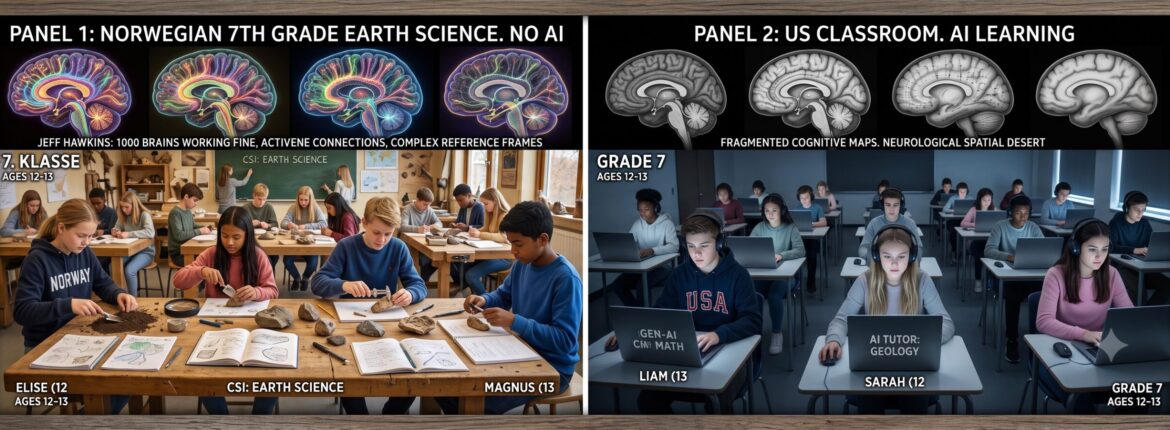
When Norway announced a sweeping ban on generative AI for grades 1 through 7 alongside a massive reinvestment in physical textbooks, tech-optimists balked. To the Silicon Valley crowd, it looked like luddite regression—a stubborn refusal to prepare children for an automated future.
But if you look past the political headlines and examine the architecture of the human brain, Norway’s policy isn’t backwards at all. It is a profoundly advanced application of neuroscience. Specifically, it aligns perfectly with the Thousand Brains Theory of intelligence pioneered by neuroscientist Jeff Hawkins.
By pulling generative shortcuts out of primary classrooms, Norway isn't just protecting "old-school" childhood; they are protecting the precise mechanism by which the human brain builds a predictive model of reality.
The Neocortex as a Mapmaker
To understand why AI shortcuts are toxic to early learning, you have to look at how the brain processes information. In A Thousand Brains, Hawkins explains that the neocortex—the seat of higher intelligence—is divided into roughly 150,000 microscopic structures called cortical columns.
For decades, computer scientists assumed the brain was a passive processor: you feed it data through the eyes, and it labels what it sees. Hawkins proved the opposite. The brain is an active modeling engine. Every single one of those 150,000 cortical columns learns by creating reference frames—internal, map-like coordinate systems identical to the grid cells we use to navigate physical geography.
We do not learn what an object is by staring at it. We learn by moving our sensors relative to it.
When a baby learns what a coffee cup is, their brain doesn't just snap a photo. It tracks how their fingers slide along the ceramic curve, how the weight shifts as it tilts, and how the texture changes. The brain builds a multi-dimensional map of the cup based on sensorimotor inference—predicting what the next sensory input will be based on movement.
The Big Leap: Abstract Thinking is Spatial Navigation
The foundational breakthrough of Hawkins’s theory—and the key to teaching everything from basic arithmetic to advanced theoretical mathematics—is that abstract thought uses the exact same coordinate maps as physical space.
When a child learns a concept like "fractions," "gravity," or "grammatical tense," the neocortex doesn't store it as a dry definition. It assigns the concept to a reference frame. The brain "moves" through abstract concepts the same way it walks through a kitchen.
Consider how a child learns math. If they physically slide five wooden blocks across a desk, scratch a proof onto a piece of paper with a pencil, or flip back and forth between two pages in a book, their motor cortex is firing in sync with their visual cortex. This physical friction is the raw fuel for sensorimotor inference. The brain uses the physical movement of the hand and eye to build a high-resolution, spatial reference frame for the mathematical logic.
Why Generative AI Starves the Sensorimotor Loop
This is precisely why generative AI in the primary classroom is a systemic threat to cognitive development.
When a child uses a generative prompt to answer a question or solve a problem, the technology delivers an instantaneous, optimized outcome. But it completely deletes the process.
| Learning Method | Action Required | Cortical Column Impact |
| Active Problem Solving | Messy trial-and-error, physical notation, spatial cross-referencing | Builds deep, permanent reference frames for abstract logic |
| Generative AI Prompting | Typing a command, reading a pre-packaged result | Short-circuits the sensorimotor loop; no reference frames created |
By providing the final answer without the exploratory movement, AI starves the cortical columns of the sensorimotor data they need to build an internal map. The child is left with a fragile, shallow understanding. They can recognize the answer, but they haven't built the cognitive scaffolding to manipulate the concept in higher dimensions later in life.
The Cognitive Inflation Crisis
Handing generative tools to a child before they turn twelve is the cognitive equivalent of putting them in a motorized wheelchair before they learn to walk. It gives the illusion of rapid advancement while ensuring the underlying biological infrastructure never fully develops.
Reclaiming the Cognitive Scaffolding
Norway’s return to physical books and pen-and-paper writing up to age twelve is a deliberate defense of the sensorimotor loop. It ensures that during the peak years of cortical plasticity, children are forced to do the heavy lifting of building internal reference frames from scratch.
By stepping back from the digital rush, Norway isn't falling behind. They are ensuring that their children develop the robust, deeply rooted mental maps required to think creatively, tolerate cognitive friction, and navigate complex abstractions. They remind us that before we can build artificial neural networks, we must first allow the human ones to properly form.