

By the time a child with ADHD reaches their twelfth birthday, they have received an estimated 20,000 more negative messages, corrections, and public rejections than their neurotypical peers.
Let that number sink in. It isn't just a staggering statistic; it is the blueprint for a profound, secondary psychological injury.
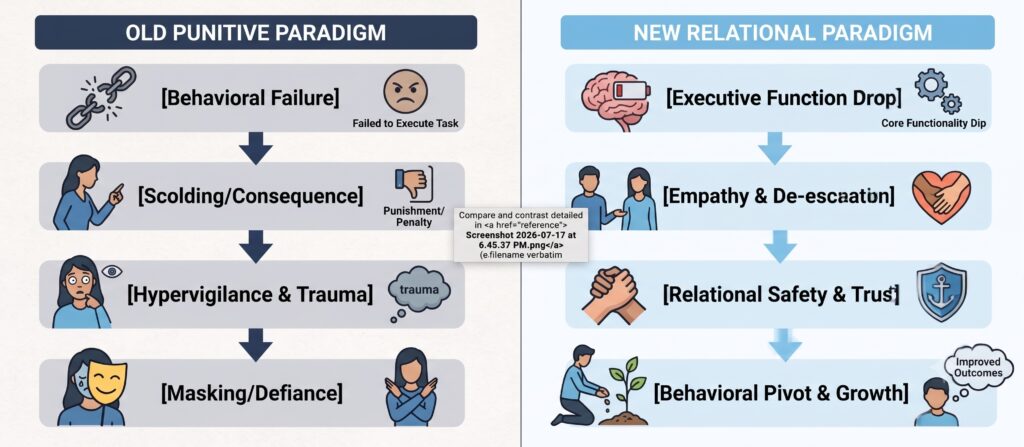
For decades, school disciplinary frameworks have been built on a fundamental misunderstanding of the neurodivergent brain. When a student with ADHD forgets their materials, blurt out answers, moves constantly, or fails to initiate a low-stimulation assignment, the standard administrative playbook relies heavily on the legacy tools of behavioral compliance: scolding, loss of privileges, detentions, and suspensions.
But modern neuropsychology offers a definitive verdict: Punishment and secondary consequences seldom work to improve ADHD behavior. In fact, they do something far worse—they convert a neurodevelopmental struggle into a chronic trauma response.
To truly reach these students, school leaders must fundamentally rethink discipline. We must pivot away from behavioral compliance and move toward an administrative framework anchored in empathy, relational safety, and structural modification.
The Neurobiology of Why Punishment Fails
When an administrator punishes a student for an ADHD-driven behavior, they are operating under a false premise: that the student could comply but is simply choosing to be defiant. In reality, ADHD is a disorder of execution, not knowledge.
1. The Time-Blindness Trap
As Dr. Russell Barkley’s neuropsychological model establishes, ADHD acts as a fundamental "blindness to time." The ADHD brain lives almost entirely in the absolute present—a framework of "Now vs. Not Now." For a consequence to alter future behavior, a brain must cleanly link the action to the future fallout. When an administrator hands down a detention for an infraction that happened hours or days ago, the ADHD prefrontal cortex cannot meaningful absorb the lesson. The student doesn’t learn accountability; they simply experience the school as a hostile, arbitrary environment.
2. Threat Does Not Equal Motivation
Dr. William Dodson’s clinical research reveals that the ADHD brain possesses a structurally distinct Interest-Based Nervous System. While neurotypical students can often force themselves to complete dry, low-stimulation tasks based on "Importance" or "Secondary Consequences" (like avoiding a bad grade or a trip to the principal’s office), the ADHD brain cannot.
Threatening an ADHD student with punishment does not magically manufacture the dopamine required to sustain attention or regulate behavior. Instead, severe pressure triggers intense anxiety or physical panic. Under this stress, the prefrontal cortex shuts down entirely, inducing total emotional dysregulation or protective dissociation (the "ADHD freeze").
From Rational Fear to Lifelong Anxiety
When schools rely on a constant drip of micro-corrections and behavioral punishments, they step into a toxic feedback loop.
A student genetically wired with Rejection Sensitive Dysphoria (RSD) experiences criticism not as a minor reprimand, but as an agonizing, almost physical blow. To survive a school day filled with thousands of these micro-rejections, the student’s nervous system adapts the exact same way a brain adapts to classic trauma: it enters permanent hypervigilance.
The resulting "ADHD social anxiety" or chronic school avoidance isn't a cognitive distortion; it is a completely logical, anticipatory trauma response. The student becomes terrified of criticism, constantly scanning educators' faces, tones, and body language for signs of impending rejection.
To escape this pain, many students build a mask. Some become people-pleasers to a debilitating degree; others weaponize humor, playing the "class clown" or the defiant rebel to strike first and control the narrative before a teacher can reject them.
The Administrative Shift: Relational Safety over Compliance
If administrators want ADHD students to pivot their behavior, the school environment must pivot its approach. You cannot punish a student out of a neurodevelopmental deficit. You can only support them through it.
Administrators must lead their staff in a shift from punitive discipline to structural, relationship-driven interventions:
1. Build an "Interest-Based" Scaffold
Because threats of failure don't work, educators must leverage Dodson’s four performance triggers to hook the ADHD nervous system: Interest, Challenge, Novelty, and Urgency. Instead of scolding a student for incomplete work, administrators and teachers should collaborate to restructure the task—introducing immediate, real-time feedback, gamifying the challenge, or breaking the objective down into bite-sized, visually distinct steps.
2. Prioritize Connection Before Correction
An ADHD student will not learn from an educator they do not feel safe around. When an executive function failure occurs, the first administrative step must be emotional regulation and empathy building. Validating the student's internal frustration removes the threat of rejection, lowering their hyperarousal. Only when the student feels relationally secure can their prefrontal cortex come back online to problem-solve.
3. Move Interventions to the "Point of Performance"
Rather than punishing a student after a failure occurs, administrators must focus on proactive, environmental modifications. This means changing the seating layout, externalizing reminders with visual cues, and ensuring that instructions are brief and immediate.
The Takeaway
Every time an administrator chooses connection over a detention slip, they chip away at those 20,000 negative corrections. By replacing the legacy tools of shame and compliance with empathy and structural safety, schools can transform from a source of developmental trauma into a launching pad for neurodivergent brilliance.