
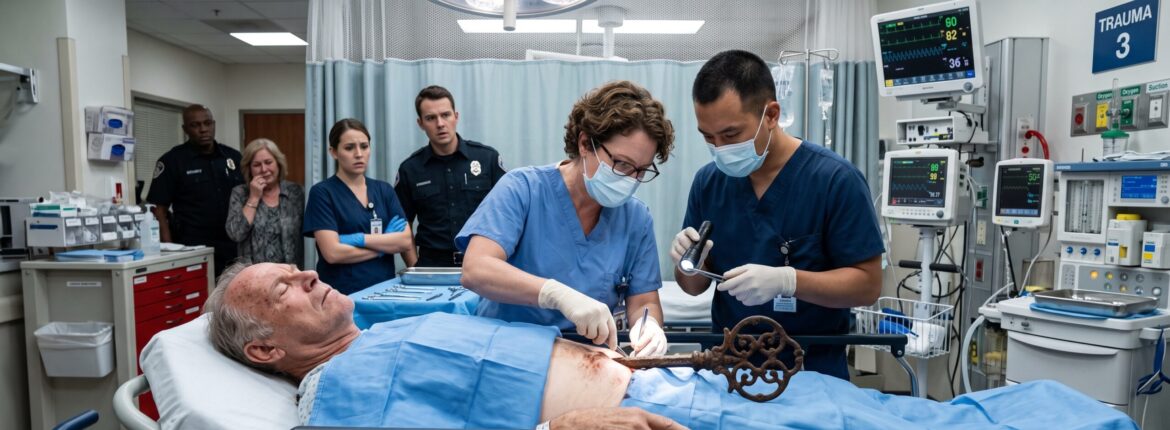
Dr. William Dodson, a pioneer in neurodiversity, once observed that if he ever suffered a life-threatening condition and had to go to an emergency room, his absolute best chance at survival was if both his ER doctor and nurse had ADHD.
To a culture that still largely treats Attention Deficit Hyperactivity Disorder as a clinical deficit, this sounds counterintuitive, if not downright terrifying. Why would you want the people handling a life-or-death crisis to have a nervous system known for distractibility?
But ask anyone who actually runs a trauma bay, and they will tell you a secret: the ER is powered by ADHD. While the general population has an ADHD prevalence of around 2% to 5%, emergency medicine consistently draws a concentration that is significantly higher.
The ER doesn't just tolerate ADHD; it is the exact physical environment where the ADHD brain transforms from a daily frustration into a life-saving superpower.
The Chemistry of Chaos: Adrenaline as Medicine
To understand why the ER is a natural magnet for neurodivergent clinicians, you have to look at the unique neurochemistry of the ADHD brain.
A neurotypical brain regulates attention based on importance and secondary rewards—long-term consequences, duty, or deadlines. The ADHD brain is biologically blind to those filters. Instead, it is chemically driven by a completely different set of triggers: interest, novelty, challenge, and urgency.
Neurotypical Brain Triggers:  [ Importance ]  ──>  [ Future Consequences ]  ──>  [ Action ]
ADHD Brain Triggers:          [ Novelty ]     ──>  [ High Urgency ]         ──>  [ Action ]
When a massive trauma hits the bay, the environment explodes into high-stakes urgency. The sudden spike of adrenaline and noradrenaline floods the central nervous system. For a neurodivergent clinician, this massive chemical surge acts exactly like a high-powered, short-acting stimulant medication. It instantly corrects the baseline chemical deficit in the prefrontal cortex.
While the external world becomes absolute chaos, the internal world of the ADHD clinician suddenly becomes perfectly calm and clear. The external noise overrides the internal static.
The Hyperfocus Pivot: Sensorimotor Mastery
A common misconception is that ADHD means an inability to pay attention. In reality, it is a difficulty regulatingattention. In low-stimulation environments (like filling out insurance codes), the brain wanders. But when a crisis hits, the ADHD brain can slip into a state of hyperfocus—an intense, laser-like concentration where peripheral distractions vanish.
Where a neurotypical brain might become overwhelmed or freeze from sensory overload—beeping monitors, shouting staff, and multiple bleeding sites—the ADHD brain thrives on quick sensorimotor inferences. It scans the chaotic environment, tracks multiple moving variables at once, and intuitively synthesizes the data. Time seems to slow down, allowing the clinician to make split-second, high-stakes decisions with absolute clarity.
Built for Sprinting, Not Marathons
The structural workflow of emergency medicine aligns perfectly with the executive function profile of ADHD. It favors the sprinter over the marathon runner through two distinct dynamics:
- Zero Latency: An ER shift offers immediate feedback loops. A patient arrives, you stabilize them, and you hand them off to the ICU, surgery, or discharge them home. There is no long-term case management or tracking a single patient over six months. The task is immediate, active, and complete.
- Predictable Unpredictability: No two shifts, and no two hours, are identical. The constant pivot from an orthopedic fracture to an acute cardiac event provides the continuous novelty that keeps the ADHD brain engaged and prevents it from slipping into under-arousal.
The Structural Paradox
This neurological wiring comes with a distinct flip side. The very same doctor or nurse who can calmly intubate a crashing patient while simultaneously directing a code team will often find themselves entirely defeated by the mundane administrative tasks that follow.
The ER Paradox: The same clinical genius who can save a life in a chaotic 10-minute window will intensely struggle with the three hours of static, low-stimulation digital charting, tracking compliance protocols, or sitting through institutional staff meetings that follow.
When we view neurodiversity through a purely academic or diagnostic lens, it is easy to see only the deficits. But as Dr. Dodson's perspective highlights, human brains evolved to handle different kinds of environments. In the quiet structure of a boardroom, the ADHD brain may struggle to sit still. But when life is on the line and every second counts, you want the adrenaline alchemists in your corner—the ones whose brains are built to find absolute peace within the storm.