
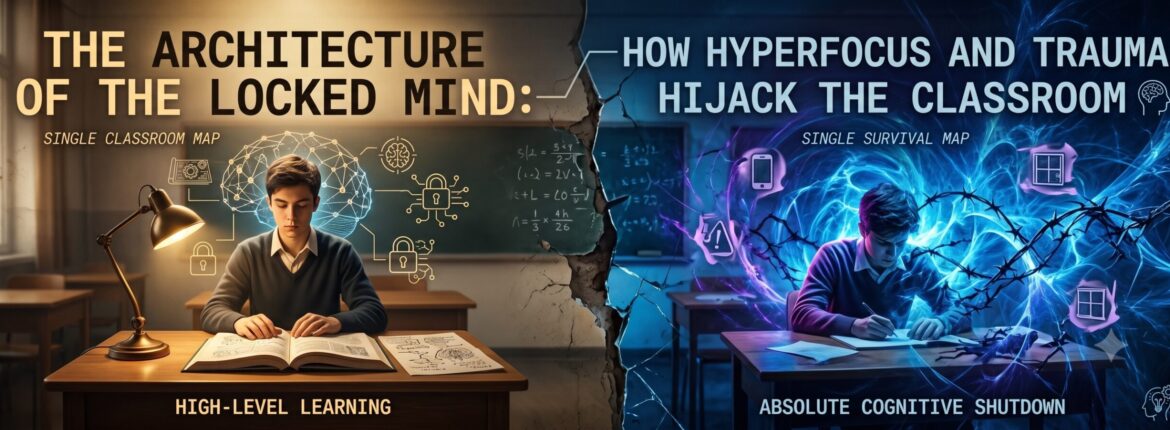
Every day, teachers stand in front of classrooms trying to reach two types of students who appear to be polar opposites.
The first is the student in a state of absolute hyperfocus—bent over a notebook or a screen, so deeply locked into a coding project, a historical narrative, or a physics problem that the school bell could ring and they wouldn't hear it. The second is the student trapped in a trauma loop—hypervigilant, eyes scanning the room, instantly dysregulated by a sudden loud noise, a shift in a teacher’s tone, or a minor conflict with a peer.
To the untrained eye, one student is achieving peak academic focus, while the other is experiencing a behavioral disruption.
But neurobiologically, these two states are identical twins. Both are experiencing a profound, instantaneous phase shift where the brain collapses its scattered everyday maps down to a single, resonant reference frame. In both states, the ordinary "bridge" of working memory disappears.
Understanding this architectural hijack changes everything we know about how students learn, how they shut down, and how we must design the modern classroom.
The Non-Existent Bridge in the Classroom
In a standard educational model, we assume learning is a linear, step-by-step process. We expect students to walk across a logical bridge: listen to the instructions, hold them in their "mental RAM" (working memory), and apply them to the task.
But frameworks like Jeff Hawkins’ Thousand Brains Theory show us that the brain doesn't work like a computer scratchpad. It works via spatial and temporal pooling—running continuous, predictive simulations across internal maps or reference frames.
When a student transitions into hyperfocus or a trauma state, they don't walk across a bridge. They experience a total neurological rewrite.
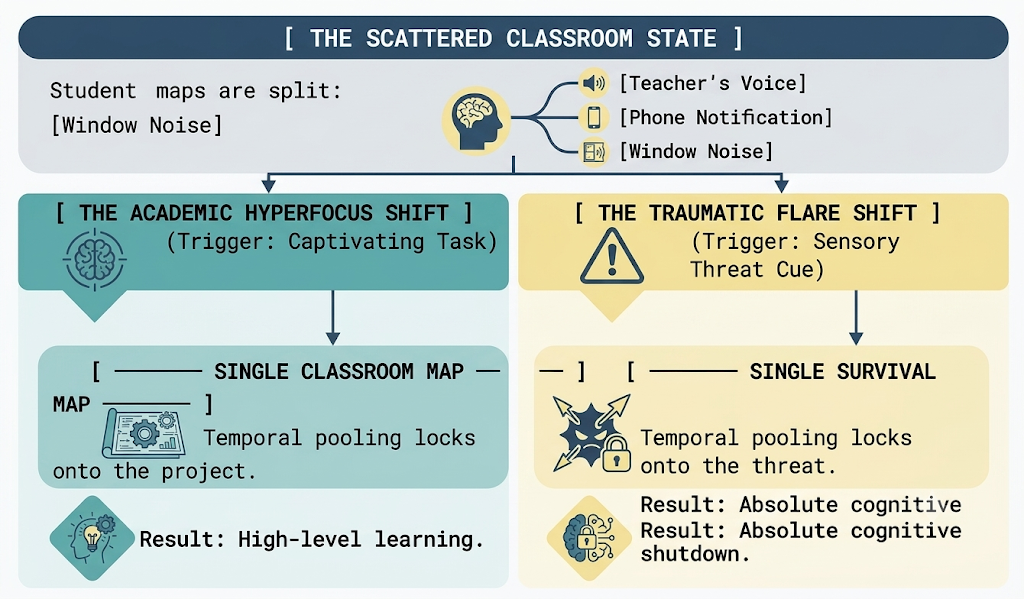
In both instances, the competing maps of the classroom vanish. The brain dedicates its entire predictive engine to one single space.
How This Rewrites the Rules of Learning
When the brain undergoes this phase shift, it fundamentally alters how a student processes information.
1. The Trap of the "Limitless" Working Memory
When a student is hyperfocused on a task, their temporal pooling becomes perfectly resonant. They aren't holding more pieces of data; they have just stopped dropping the signal. This is when deep, creative breakthroughs happen.
But when a traumatized student enters this same state of resonance, their entire working memory capacity is hijacked by a survival simulation. They are using 100% of their neural architecture to calculate escape routes, monitor the teacher's micro-expressions, or brace for impact. Because the network is completely full running this threat map, there is literally zero computational space left to process a math equation or a reading passage. The student isn't "refusing to learn"; their brain physically cannot spare the cells.
2. The Loss of Contextual Time
Because these states exist in the absence of a transitional bridge, a student inside them loses the context of time. The hyperfocused student doesn't realize two hours have passed. The traumatized student, triggered by an old memory, doesn't realize the danger happened two years ago—to their predictive engine, the past threat is the current coordinate space they are standing in.
Redesigning the Classroom for the Predictive Brain
If we accept that learning is about stabilizing reference frames rather than filling up a working memory box, the traditional structure of school—45-minute factory bells, constant transitions, and heavy reliance on abstract, digital inputs—is actively working against human biology.
To optimize the hyperfocus engine and disarm the trauma loop, the classroom must shift from abstract instruction to experiential, physical anchors.
The Power of Tactile Architecture
When we hand a student a physical object—a geological rock sample to dissect like a "crime scene," a wooden puzzle, or a real-world tool—we bypass the slow, easily fractured loops of the conscious prefrontal cortex.
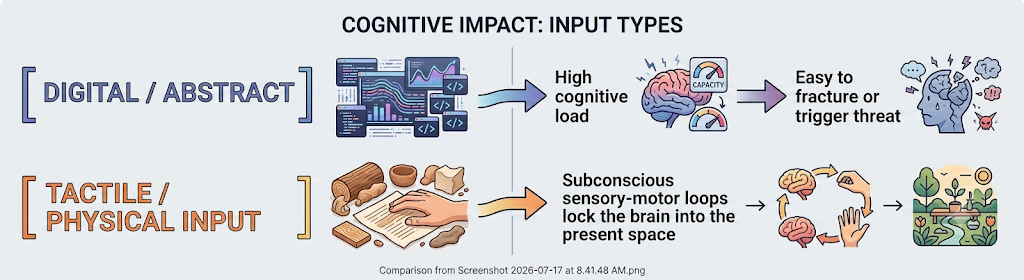
Physical, hands-on learning forces the brain's ancient sensory-motor loops to engage. It anchors the student's spatial tracking to the physical reality right in front of them.
- For the hyperfocused student, tactile tools turn abstract concepts into an immersive, physical map they can actively navigate.
- For the traumatized student, physical objects act as an immediate neurological circuit breaker. You cannot easily run a terrifying mental simulation of the past when your hands, eyes, and subcortical reflexes are actively deciphering the weight, texture, and geometry of a physical object in the present.
The Verdict on the Modern Classroom
The human brain is an unparalleled predictive engine, but it is highly volatile. It is designed to look for patterns, lock onto loops, and protect itself at all costs.
When we treat the classroom as a place where students must sit still and absorb abstract data into a fictional "working memory box," we invite distraction and trigger hypervigilance. But when we design classrooms that respect the phase shifts of the brain—providing the time needed for deep temporal pooling to lock in, and the physical, tactile anchors needed to keep the subconscious engine feeling safe—we stop fighting the biology of focus. We finally build a space where the mind can safely lay down its survival maps and pick up the maps of discovery.