
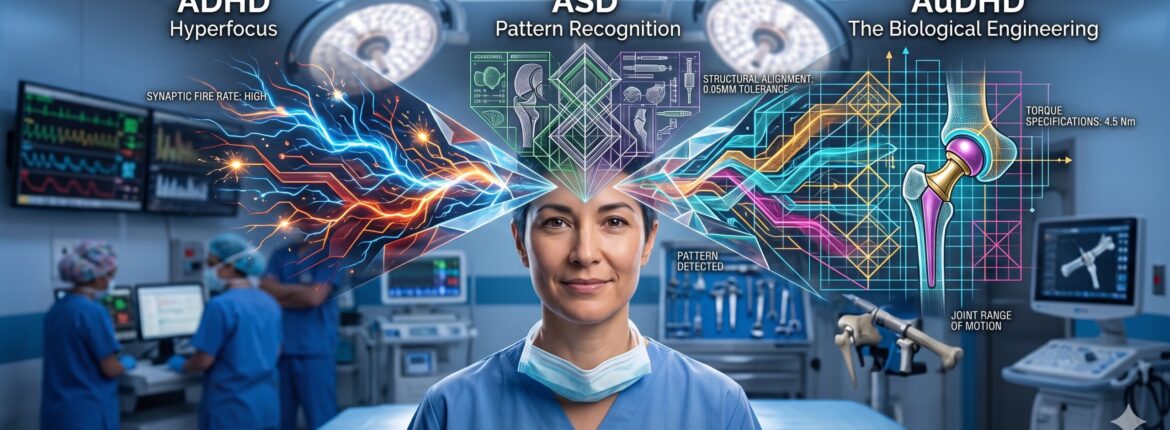
To the outside observer, an orthopedic operating room can look and sound like a controlled construction site. There is the rhythmic hum of monitors, the precise clink of surgical steel, the forceful drive of specialized drills, and the tactile, mechanical focus of rebuilding a shattered human joint. It is a high-stakes environment where millimeters matter, and decisions must be made with absolute certainty.
For the neurotypical mind, this intense combination of sensory input, physical exertion, and high-stakes urgency can be exhausting. But for individuals with ADHD, Autism Spectrum Disorder (ASD), or AuDHD (the co-occurrence of both), the orthopedic operating room often functions as something entirely different: a perfect cognitive sanctuary.
Recent medical training data suggests this is far from accidental. While adult ADHD symptoms are estimated to affect roughly 3% to 4% of the general public, studies have found that these traits are present in up to 31.6% of surgical trainees. When we look closer at how the neurodivergent brain processes space, structure, and adrenaline, it becomes clear that orthopedic surgery doesn't just tolerate neurodiversity—it actively rewards it.
The Neurodivergent Toolkit in Orthopedics
When ADHD and Autism intersect, they create a unique cognitive pairing. While they are often viewed as opposing forces, the operating room provides a rare arena where their contrasting strengths complement each other seamlessly.
ADHD: The Kinetic Engine
The ADHD brain inherently operates on a lower baseline of dopamine and norepinephrine, meaning it requires higher levels of stimulation to achieve peak focus. In a standard, sedentary clinic setting, this can manifest as restlessness or difficulty sustaining attention on administrative tasks.
In the operating room, however, the high-stakes environment acts as a natural neural amplifier. The immediate, hands-on feedback of manipulating bone and tissue commands an intense state of hyperfocus. When an unexpected complication arises mid-procedure, the ADHD mind thrives on the rapid-fire situational troubleshooting required to pivot strategies instantly.
ASD: The Meticulous Architect
Where ADHD brings fluid adaptability, Autism brings unparalleled systemic precision. Orthopedic surgery is, at its core, biological engineering. It demands an exceptional grasp of spatial reasoning, structural mechanics, and predictable patterns.
An autistic surgeon often possesses an encyclopedic mental catalog of anatomy and a profound tolerance—and desire—for rigid protocol. The need to align a complex intra-articular fracture down to the exact millimeter satisfies a deep cognitive drive for order, symmetry, and perfection.
AuDHD: The Paradoxical Balance
For the AuDHD individual, life outside the hospital can feel like a constant internal tug-of-war: the ADHD side craves novelty and high stimulation, while the ASD side demands routine and strict predictability.
Orthopedics elegantly solves this paradox. The overarching framework of the surgical day is deeply comforting to the autistic mind—the rigid scrubbing-in sequences, the standardized instrument trays, and the clear behavioral boundaries of the OR staff eliminate social ambiguity. Yet, packed inside that rigid structure is the dynamic, physical, and high-urgency work of surgery, which provides the precise dopamine hit required to keep the ADHD engine running at peak performance.
                        THE AuDHD SYNERGY IN THE OR

   THE ASD FOUNDATION                             THE ADHD ENGINE
 [ Strict OR Protocols ]                       [ High-Urgency Environment ]
 [ Standardized Toolsets ]                     [ Tactile, On-Your-Feet Work ]
 [ Meticulous Alignment ]                      [ Rapid-Fire Troubleshooting ]
           │                                                 │
           └────────────────────────┬────────────────────────┘
                                    ▼
                          [ Peak Surgical Focus ]
                   Absolute precision under high pressure.
Sensorimotor Inference and the Spatial Sanctuary
To understand why this environment is so grounding for neurodivergent professionals, it helps to look at how the brain builds its model of the world. The human brain continuously navigates chaotic environments by updating its internal maps through sensorimotor inference—the constant feedback loop between what we see, what we touch, and how we move.
In an unstructured social setting or a chaotic open office, a neurodivergent brain can easily become overwhelmed by unpredictable, non-linear sensory data. But an orthopedic procedure anchors the mind to tangible, physical realities.
When a surgeon uses a mallet, drives a pin, or feels the distinct mechanical resistance of cortical bone, they are receiving direct, unambiguous tactile feedback. This intense physical interaction allows the brain to map the spatial layout of the anatomy with absolute clarity. The noise of the outside world fades away, replaced by a hyper-focused, meditative state where the hand, the tool, and the bone operate as a single, unified system.
Redefining the "Deficit"
For decades, traits like ADHD and Autism have been viewed strictly through the lens of deficit and dysfunction. But in the demanding world of orthopedic surgery, these exact same traits reveal themselves to be profound clinical advantages.
The hyper-systematization that makes a person meticulous, the high-stimulus drive that keeps them calm under pressure, and the need for deep tactile engagement are the very attributes that create world-class surgical precision. Ultimately, the orthopedic operating room proves that when a neurodivergent mind finds an environment perfectly tailored to its cognitive architecture, "disability" transforms directly into mastery.